Mexican Peso struggles as citizens back judiciary reform

Most recent article: Mexican Peso bottoms out as post-election selling eases
- Mexican Peso down 0.29% amid risk aversion on weak China data and European political uncertainty.
- Banxico's verbal intervention last week stabilized the Peso, central bank remains vigilant on currency volatility.
- Upcoming economic data from Mexico expected to show economic slowdown.
The Mexican Peso traded with minuscule losses against the US Dollar on Monday and is down 0.29% as risk appetite deteriorates based on weak China data and political uncertainty in Europe. The emerging market currency would remain volatile as traders digest the incumbent judiciary reform in September, presented by current President Andres Manuel Lopez Obrador and approved by upcoming President Claudia Sheinbaum. The USD/MXN trades at 18.51, gaining 0.34%
The Mexican currency stabilized last week after verbal intervention by Bank of Mexico (Banxico) Governor Victoria Rodriguez Ceja last Wednesday, who said the central bank is attentive to volatility in the Mexican currency exchange rate and could act to restore “order” in markets.
Last week, Claudia Sheinbaum tried to calm investors and told them not to be concerned about the reforms. She said, “Mexico’s economy is healthy and strong, and [there is] nothing to worry about.”
In the meantime, Sheinbaum presented the results of the poll made by ruling party Morena and two independant surveys, which showed citizens approval to the reform.
The economic docket in Mexico will feature the announcement of Aggregate Demand, Private Spending, Retail Sales, and Economic Activity data. The data is expected to show that the economy is slowing down due to higher interest rates set by Banxico at 11%, which are expected to be lowered in the June 27 meeting.
Despite that, the USD/MXN exchange rate continues to be driven by political uncertainty about the changes to the Mexican Constitution that threaten the state of law.
Across the border, the latest Federal Reserve (Fed) decision to keep rates unchanged and the projection of just one interest rate cut in 2024 cushioned the Greenback and boosted the USD/MXN to 14-month highs.
The US economic docket is absent except for Fed officials crossing the newswires. Up next, the Philadelphia Fed’s Patrick Harker will give a speech later on Monday.
Daily digest market movers: Mexican Peso on defensive amid risk-aversion
- In February 2024, AMLO presented several proposals to the Mexican Congress. These include a Supreme Court reform to elect Supreme Court ministers through a popular vote, an electoral reform aimed at electing electoral commission councilors by popular vote and reducing multi-member representation, and a reform of autonomous bodies that proposes dissolving the transparency body.
- Mexican Peso depreciation could weigh on Banxico's decision to ease policy on June 27 despite last month’s dip in core prices. Therefore, keeping interest rates higher could prompt deceleration in the economy and increase the odds of a possible recession.
- Morgan Stanley noted that if Mexico’s upcoming government and Congress adopted an unorthodox agenda, it would undermine Mexican institutions and be bearish for the Mexican Peso, which could weaken to 19.20.
- Latest US inflation report increased the odds of a Fed rate cut in September from 62% to 56.3%, according to CME FedWatch Tool.
- December’s 2024 fed funds futures contract hints that investors expect 35 basis points of rate cuts by the Fed through the end of the year.
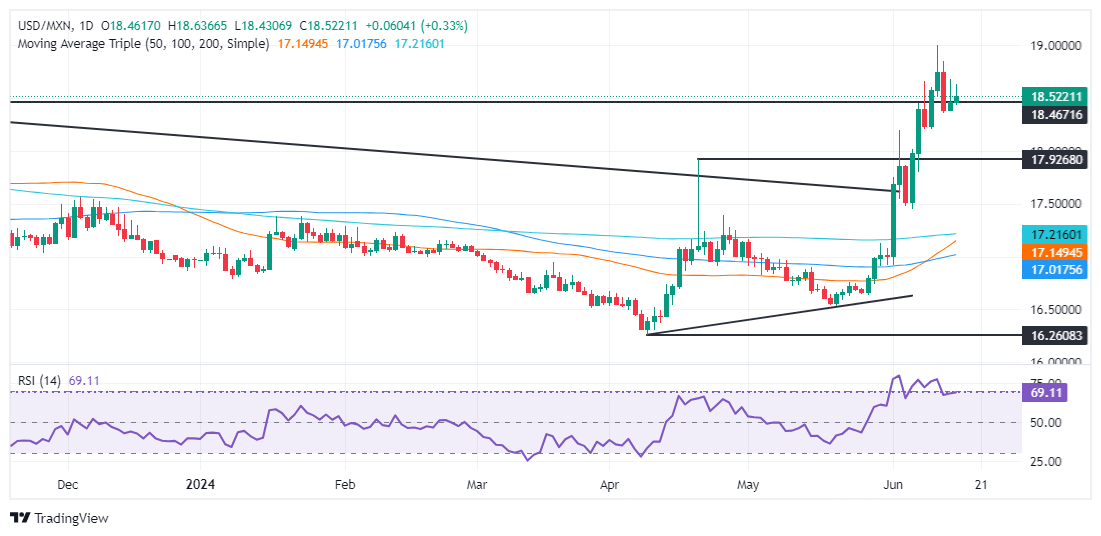
Technical analysis: Mexican Peso registers losses as USD/MXN climbs above 18.50
The USD/MXN uptrend remains intact, even though it has hovered near 18.50 for the last three trading days. Momentum supports buyers as the Relative Strength Index (RSI) remains bullish after exiting overbought territory. That said, if buyers achieve a daily close above 18.50, that could pave the way for further upside.
Once buyers reclaim 18.50, the next resistance level would be the year-to-date high of 18.99, followed by the March 20, 2023, high of 19.23. A breach of the latter will sponsor an uptick to 19.50, ahead of the psychological 20.00 mark.
Conversely, if sellers push prices below the April 19 high of 18.15, that would keep the exotic pair trading within the 18.00-18.15 range.
Economic Indicator
Retail Sales (MoM)
The Retail Sales released by INEGI measures the total receipts of retail stores. Monthly percent changues reflect the rate of changes of such sales. Changes in retail sales are widely followed as an indicator of consumer spending. Generally speaking, a high reading is seen as positive or bullish for the Mexican peso, while a low reading is seen as negative or bearish.
Read more.Author

Christian Borjon Valencia
FXStreet
Markets analyst, news editor, and trading instructor with over 14 years of experience across FX, commodities, US equity indices, and global macro markets.

















