Mexican Peso recovers after strong domestic data
- The Mexican Peso trades in a tight range on Tuesday as the currency recovers from the post-election sell-off.
- President-elect Claudia Sheinbaum seeks to calm markets with positive messages about the economy and the popularity of reforms.
- USD/MXN continues pulling back in the midst of a short and medium-term uptrend.

The Mexican Peso (MXN) appreciates on Tuesday amid positive risk appetite and after the post-election sell-off – which saw the currency lose on average 10% against its key counterparts – runs out of steam.
Market risk appetite remains solid after US stock indexes reached new all-time highs on Monday led by a rally in tech, and Asian investors carried the baton through into their session. The risk-on tone provides a constructive backdrop for the Peso, which tends to perform better when investors have more appetite for risk.
The Mexican Peso is supported by the release of higher Mexican GDP Aggregate Demand and Private Spending data for Q1.
Aggregate Demand showed a 1.5% rise QoQ and 2.6% YoY, which compared favorably to the 0.4% and 2.2% respectively, registered in the prior quarter, data from the INEGI showed on Tuesday.
Private Spending rose 1.5% QoQ and 3.6% YoY in Q1 which was above the 0.9% of the porevious quarter, but below the 5.1% YoY figure for Q4.
USD/MXN, meanwhile was pressured by lower-than-expected US Retail Sales data for May and a substantial downwards revision into negative territory of April's preliminary estimates.
At the time of writing, a single US Dollar (USD) buys 18.34 Mexican Pesos, EUR/MXN is trading at 19.69 and GBP/MXN at 23.29.
Mexican Peso bottoms out after heavy selling
The Mexican Peso continues its recovery on Tuesday as the bearish squeeze that saw the currency sell off dramatically following the June 2 elections, loses momentum.
Despite lingering concerns about a raft of constitutional reforms the new left-leaning coalition government wishes to make, which range from increasing the minimum wage to judicial reform, speculators appear to have eased off pushing the Peso lower.
Analysts at Capital Economics see USD/MXN as fair priced at 19.00, the June 12 high. The overweight long position that had built up in the Peso when it climbed to the 16.20s in May, has likely now been fully cremated.
Incoming President Claudia Sheinbaum sought to calm investors on Monday, saying “Mexico’s economy is healthy and strong, and [there is] nothing to worry about.”
She further cited independent polls commissioned over the weekend that indicated the controversial judicial reforms proposed by her party – which market commentators have held responsible for the Peso’s sell-off – are backed by the population at large.
Technical Analysis: USD/MXN still pulling back within an uptrend
USD/MXN is still in the midst of a pullback within an uptrend. It is possible the correction could have further to run, however, thereafter the dominant bull trend is likely to reassert itself. The next target higher is situated at 19.22 (March 2023 high).
USD/MXN Daily Chart
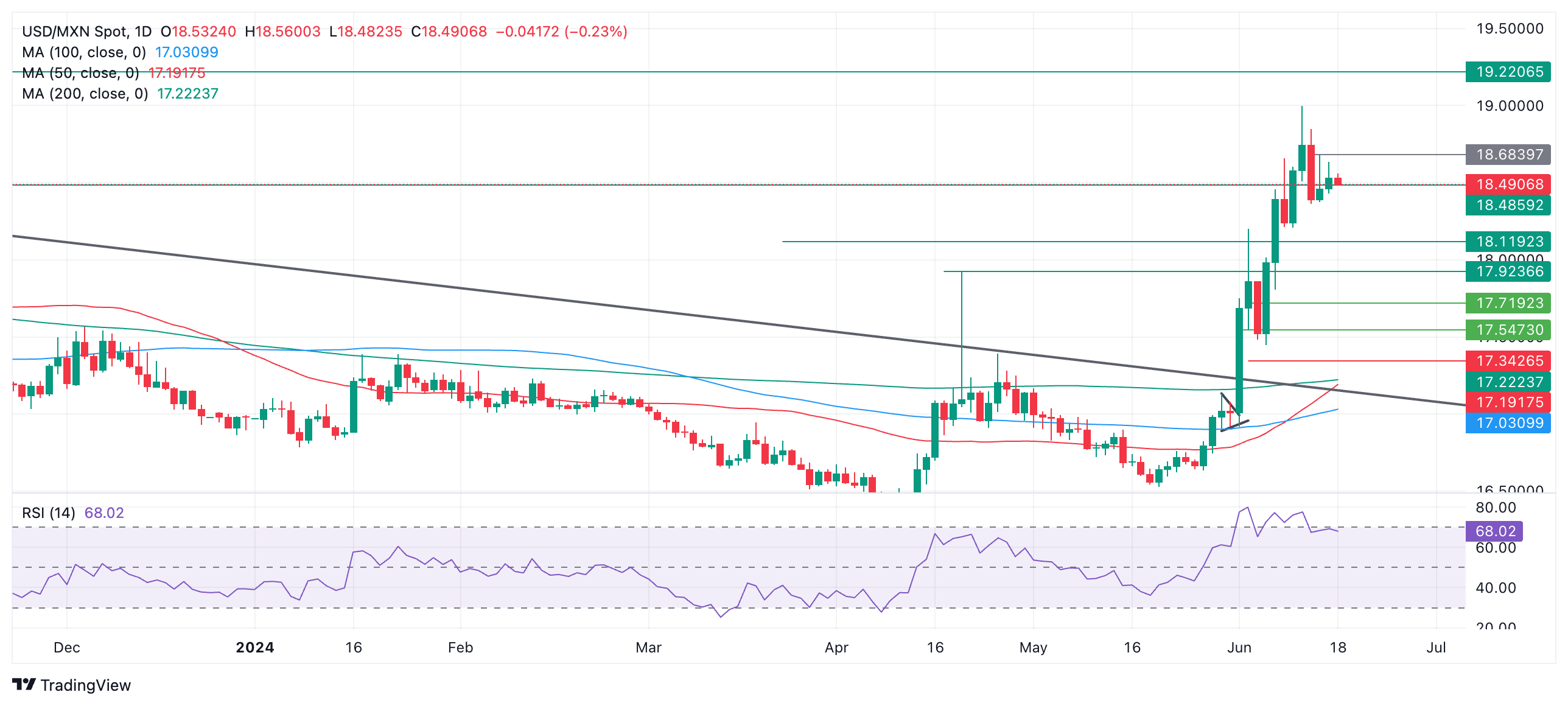
A break above Friday’s high at 18.68 would provide additional confirmation of more upside towards the target at 19.22.
The Relative Strength Index (RSI) has just exited the overbought zone, however, further suggesting a risk the correction could still go deeper. That said, the established uptrend is likely to resume eventually.
The short and medium term trends are now firmly bullish. The direction of the long-term trend, however, is in doubt after the break above the October 2023 high. Previous to that, it was bearish.
Mexican Peso FAQs
The Mexican Peso (MXN) is the most traded currency among its Latin American peers. Its value is broadly determined by the performance of the Mexican economy, the country’s central bank’s policy, the amount of foreign investment in the country and even the levels of remittances sent by Mexicans who live abroad, particularly in the United States. Geopolitical trends can also move MXN: for example, the process of nearshoring – or the decision by some firms to relocate manufacturing capacity and supply chains closer to their home countries – is also seen as a catalyst for the Mexican currency as the country is considered a key manufacturing hub in the American continent. Another catalyst for MXN is Oil prices as Mexico is a key exporter of the commodity.
The main objective of Mexico’s central bank, also known as Banxico, is to maintain inflation at low and stable levels (at or close to its target of 3%, the midpoint in a tolerance band of between 2% and 4%). To this end, the bank sets an appropriate level of interest rates. When inflation is too high, Banxico will attempt to tame it by raising interest rates, making it more expensive for households and businesses to borrow money, thus cooling demand and the overall economy. Higher interest rates are generally positive for the Mexican Peso (MXN) as they lead to higher yields, making the country a more attractive place for investors. On the contrary, lower interest rates tend to weaken MXN.
Macroeconomic data releases are key to assess the state of the economy and can have an impact on the Mexican Peso (MXN) valuation. A strong Mexican economy, based on high economic growth, low unemployment and high confidence is good for MXN. Not only does it attract more foreign investment but it may encourage the Bank of Mexico (Banxico) to increase interest rates, particularly if this strength comes together with elevated inflation. However, if economic data is weak, MXN is likely to depreciate.
As an emerging-market currency, the Mexican Peso (MXN) tends to strive during risk-on periods, or when investors perceive that broader market risks are low and thus are eager to engage with investments that carry a higher risk. Conversely, MXN tends to weaken at times of market turbulence or economic uncertainty as investors tend to sell higher-risk assets and flee to the more-stable safe havens.
Author

Joaquin Monfort
FXStreet
Joaquin Monfort is a financial writer and analyst with over 10 years experience writing about financial markets and alt data. He holds a degree in Anthropology from London University and a Diploma in Technical analysis.















