Mexican Peso surges ahead, brushes off Banxico’s dovish stance
- Mexican Peso stages a comeback, reversing earlier losses driven by brief escalation in Russia-Ukraine conflict.
- Banxico Governor Victoria Rodriguez Ceja indicates the potential for continued rate cuts.
- Mexico’s 2025 fiscal budget viewed as optimistic, based on growth targets of 2-3% amid concerns over public spending cuts.

The Mexican Peso advanced against the US Dollar during the North American session on Tuesday, yet it recovered some ground after the USD/MXN hit a daily high of 20.34 due to risk aversion. A brief escalation of the Russia-Ukraine conflict was the main reason that pushed the pair higher, yet the Mexican currency staged a comeback despite dovish rhetoric by Bank of Mexico (Banxico) Governor Victoria Rodriguez Ceja.
At the time of writing, the USD/MXN trades at 20.11, around seven-day lows. Earlier, headlines revealed that Russia had widened its doctrine for using nuclear weapons, though toned down its rhetoric as Foreign Minister Lavrov said, “Russia's position is that nuclear war won't happen.” This sparked the Peso’s rally, to the detriment of the Greenback, as traders seeking risk lifted US equities higher.
Banxico Governor Victoria Rodriguez Ceja told Reuters the central bank would continue to cut its benchmark rate. "Given the progress of disinflation, we believe that we can continue with the cuts to the reference rate, and in the following meetings, we will be assessing the inflationary outlook and making the corresponding decisions," said Rodriguez late on Monday.
On Friday, the Finance Ministry presented the 2025 fiscal budget. Regarding this, Gabriela Siller of Banco Base said, “It is extremely difficult to achieve GDP growth of between 2% and 3% in 2025, especially in the first year of administration and with cuts in public spending.”
The Ministry of Finance projects Gross Domestic Product (GDP) to reach 2% to 3%, though it has been qualified as optimistic by most analysts.
James Salazar, Deputy Director of Economic Analysis at CiBanco, said, “It is optimistic […] Is it feasible? It can be achieved with a combination of a change in perception. The problem is that it seems that everything is against the Mexican economy, and this will make it difficult to achieve this goal, so it seems complex.”
In an interview with El Financiero, Salazar questioned where the resources would come if the growth expectations were not met, as most income would be tax, of around 2.6%, up to 5.3 billion Pesos.
On the US front, the economic schedule revealed housing data slightly below estimates that failed to underpin the Greenback. Kansas City Fed President Jeffrey Schmid will give a speech on Tuesday. By Wednesday, speeches by Fed Governors Lisa Cook, Michelle Bowman and Boston Fed President Susan Collins will be scrutinized by market players in search of cues for the path of US interest rates.
Besides this, traders continued to assess US President-elect Donald Trump’s inflation-prone policies, which might deter the US Federal Reserve (Fed) from lowering rates.
Daily digest market movers: Mexican Peso climbs despite strong US Dollar
- The USD/MXN shrugs off a strong US Dollar. The US Dollar Index (DXY) is up 0.14% at 106.36.
- US Building Permits in October improved compared to September but dropped -0.6% from 1.425 million to 1.416 million.
- Housing Starts for the same period tumbled for the third consecutive month, contracting by -3.1% from 1.353 million to 1.311 million.
- Market participants trimmed estimates for a 25 bps cut by the Fed, with odds falling from 62% to 59%. The odds of keeping rates unchanged are up at 41%, as depicted by the CME FedWatch Tool.
- Data from the Chicago Board of Trade, via the December fed funds rate futures contract, shows investors estimate 23 bps of Fed easing by the end of 2024.
- Last week, Moody’s changed Mexico’s credit outlook to negative, mentioning constitutional reforms that could negatively impact Mexico’s economic and fiscal strength.
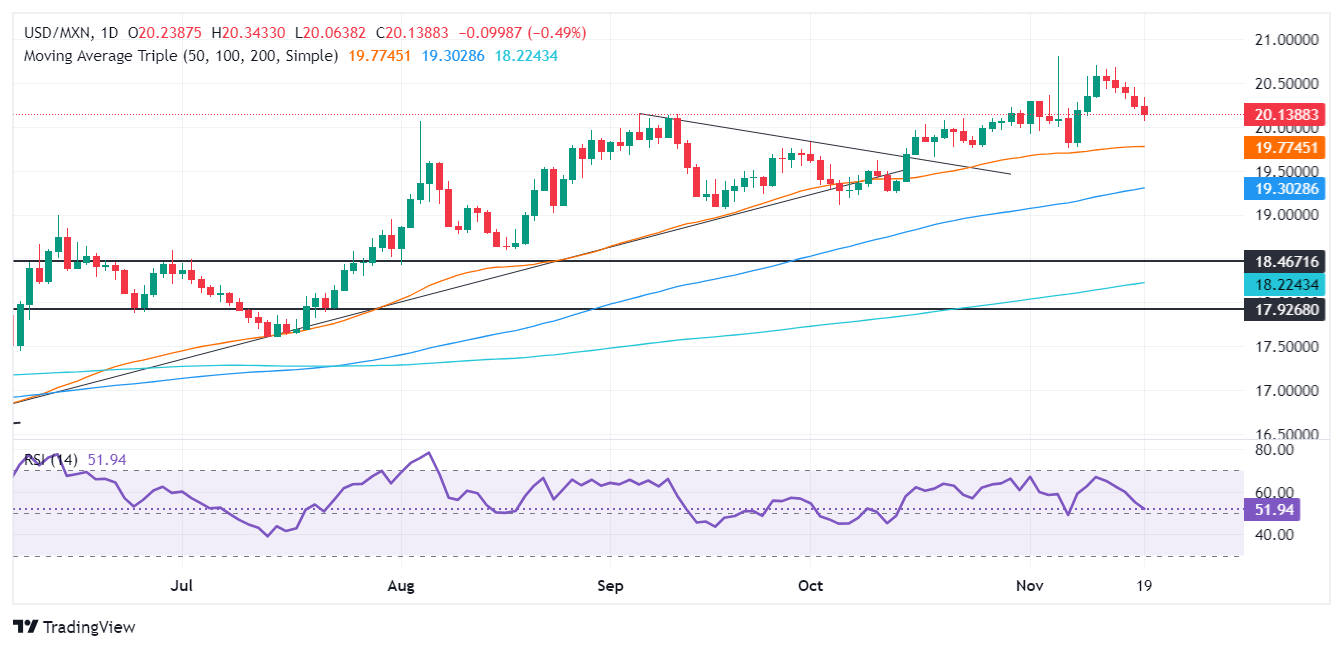
USD/MXN technical outlook: Mexican Peso climbs as USD/MXN drops below 20.30
Although the USD/MXN posts five consecutive days of losses, the pair remains upwardly biased, unless sellers drive the exchange rate below the confluence of the 50-day Simple Moving Average (SMA) and the November 7 low around 19.75. But firstly, traders must clear the 20.00 psychological figure, followed by the latter, before challenging the 19.50 mark.
Conversely, buyers need to lift the exchange rate past 20.50, before challenging the November 12 peak at 20.69. Once those levels are taken out, the next resistance would be the year-to-date (YTD) high of 20.80.
Oscillators like the Relative Strength Index (RSI) remain bullish though short-term, suggesting some consolidation before buyers gather steam.
Mexican Peso FAQs
The Mexican Peso (MXN) is the most traded currency among its Latin American peers. Its value is broadly determined by the performance of the Mexican economy, the country’s central bank’s policy, the amount of foreign investment in the country and even the levels of remittances sent by Mexicans who live abroad, particularly in the United States. Geopolitical trends can also move MXN: for example, the process of nearshoring – or the decision by some firms to relocate manufacturing capacity and supply chains closer to their home countries – is also seen as a catalyst for the Mexican currency as the country is considered a key manufacturing hub in the American continent. Another catalyst for MXN is Oil prices as Mexico is a key exporter of the commodity.
The main objective of Mexico’s central bank, also known as Banxico, is to maintain inflation at low and stable levels (at or close to its target of 3%, the midpoint in a tolerance band of between 2% and 4%). To this end, the bank sets an appropriate level of interest rates. When inflation is too high, Banxico will attempt to tame it by raising interest rates, making it more expensive for households and businesses to borrow money, thus cooling demand and the overall economy. Higher interest rates are generally positive for the Mexican Peso (MXN) as they lead to higher yields, making the country a more attractive place for investors. On the contrary, lower interest rates tend to weaken MXN.
Macroeconomic data releases are key to assess the state of the economy and can have an impact on the Mexican Peso (MXN) valuation. A strong Mexican economy, based on high economic growth, low unemployment and high confidence is good for MXN. Not only does it attract more foreign investment but it may encourage the Bank of Mexico (Banxico) to increase interest rates, particularly if this strength comes together with elevated inflation. However, if economic data is weak, MXN is likely to depreciate.
As an emerging-market currency, the Mexican Peso (MXN) tends to strive during risk-on periods, or when investors perceive that broader market risks are low and thus are eager to engage with investments that carry a higher risk. Conversely, MXN tends to weaken at times of market turbulence or economic uncertainty as investors tend to sell higher-risk assets and flee to the more-stable safe havens.
Author

Christian Borjon Valencia
FXStreet
Markets analyst, news editor, and trading instructor with over 14 years of experience across FX, commodities, US equity indices, and global macro markets.