Mexican Peso lifted by Banxico Minutes, Finmin meets US bank chiefs
- The Mexican Peso recovers after the release of benign Banxico minutes improved the outlook.
- President Sheinbaum sends an envoy to meet the US finance magnates Dimon and Fink.
- USD/MXN peaks and pulls back after its mini-rally runs out of steam.

The Mexican Peso (MXN) edges higher in its most-traded pairs on Friday, carrying momentum over from its recovery on the previous day, when it found a floor and rose following the release of the Bank of Mexico (Banxico) meeting minutes.
In their discussions, Banxico officials painted an overall benign picture of the Mexican economy, with inflation “improving”, a “stable” labor market, and high demand for exports but also a loss of “dynamism” and “productive activity” in the domestic economy.
The Peso may be garnering further support as political risks ease following the Mexican Finance Secretary's meetings with the CEOs of US finance giants JP Morgan Chase and Blackrock, and pivot back to the US elections.
Mexican Peso rises after release of Banxico Minutes
The Mexican Peso appreciated following the release of the Banxico September meeting Minutes on Thursday, at which the bank decided by a majority vote to lower the target for the Overnight Interbank Interest Rate by 25 basis points (bps) to 10.50%. There was one dissenter, Jonathan Ernest Heath Constable. Below are ten key takeaways from the Minutes:
- Most noted the inflation outlook in Mexico has been improving.
- Forecasts for headline and core were adjusted slightly downward for some quarters in the near term.
- In the last reading, food commodity inflation was 3.95%, while non-food was 1.69%, in both cases clearly below their respective historical averages.
- All agreed services inflation continues to show persistence.
- The balance of risks with respect to the expected trajectory of inflation over the forecast horizon remains skewed to the upside.
- All members indicated that the labor market remains solid.
- The yield curve of government securities showed downward movements, especially in the short maturities.
- Most noted a contraction in consumption of imported goods, whilst the value of manufacturing exports – both automotive and non-automotive – recorded some reactivation during July.
- All agreed that domestic productive activity is going through a period of weakness, and most agreed that there has been a visible loss of dynamism since the last quarter of 2023.
- The information available for the beginning of the third quarter shows some rebound regarding domestic demand.
Sheinbaum administration courts US investors
Despite investor concerns regarding the political outlook for Mexico after the Morena-led coalition victory in June, there appear to be signs the new Sheinbaum administration is attempting to build bridges with some of the big players in global finance.
On Thursday, the Mexican Secretary of Finance, Rogelio Ramírez de la O, separately met with the CEO of Blackrock, Larry Fink, and JP Morgan Chase’s CEO, Jamie Dimon, reports El Financiero. Although no details of the meetings have been made public, the move could be interpreted as part of a charm offensive by the Mexican government to win back the confidence of investors.
“Before the election turmoil, Dimon said last November that he saw a “huge” opportunity in Mexico, amid a boom in factories moving to the country to be closer to the United States, as part of a business trend known as nearshoring,” said El Financiero.
Perhaps of greater concern to investors now is the outcome of the US presidential election in November. JP Morgan strategists downgraded their bullish stance on the Mexican Peso on Thursday due to the risks of a “highly unpredictable” US presidential election result.
Technical Analysis: USD/MXN retreats after peaking
USD/MXN bottomed out at the base of its long-term rising channel and recovered on October 4. However, its nascent uptrend has reversed after peaking at 19.62 on Thursday. Prices are now pulling back down towards the base of the channel and the 50-day Simple Moving Average (SMA) again.
USD/MXN Daily Chart
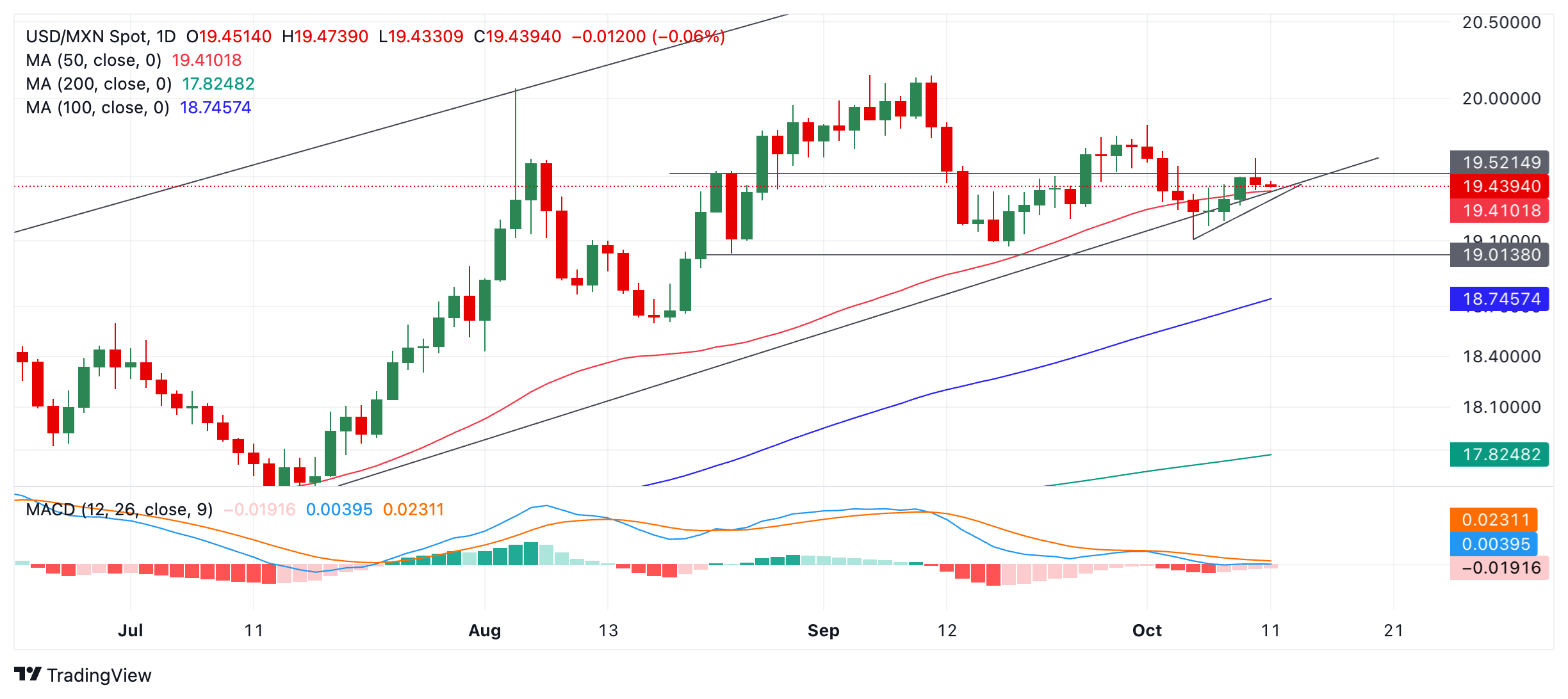
That said, USD/MXN’s new short-term uptrend is still probably intact, and prices could still recover and continue rising within the ascending channel. In addition, the medium and longer-term trends remain bullish, and given the technical analysis principle that “the trend is your friend,” this favors an eventual continuation higher when the longer bullish cycles kick in.
A break above the 19.62 high would see USD/MXN resume its uptrend and continue up to the next target at 19.83 (October 1 high).
A break below 19.31 (October 9 low), however, would be a bearish sign indicating the possibility the short-term uptrend had ended and either a sideways or more bearish trend was evolving instead.
Mexican Peso FAQs
The Mexican Peso (MXN) is the most traded currency among its Latin American peers. Its value is broadly determined by the performance of the Mexican economy, the country’s central bank’s policy, the amount of foreign investment in the country and even the levels of remittances sent by Mexicans who live abroad, particularly in the United States. Geopolitical trends can also move MXN: for example, the process of nearshoring – or the decision by some firms to relocate manufacturing capacity and supply chains closer to their home countries – is also seen as a catalyst for the Mexican currency as the country is considered a key manufacturing hub in the American continent. Another catalyst for MXN is Oil prices as Mexico is a key exporter of the commodity.
The main objective of Mexico’s central bank, also known as Banxico, is to maintain inflation at low and stable levels (at or close to its target of 3%, the midpoint in a tolerance band of between 2% and 4%). To this end, the bank sets an appropriate level of interest rates. When inflation is too high, Banxico will attempt to tame it by raising interest rates, making it more expensive for households and businesses to borrow money, thus cooling demand and the overall economy. Higher interest rates are generally positive for the Mexican Peso (MXN) as they lead to higher yields, making the country a more attractive place for investors. On the contrary, lower interest rates tend to weaken MXN.
Macroeconomic data releases are key to assess the state of the economy and can have an impact on the Mexican Peso (MXN) valuation. A strong Mexican economy, based on high economic growth, low unemployment and high confidence is good for MXN. Not only does it attract more foreign investment but it may encourage the Bank of Mexico (Banxico) to increase interest rates, particularly if this strength comes together with elevated inflation. However, if economic data is weak, MXN is likely to depreciate.
As an emerging-market currency, the Mexican Peso (MXN) tends to strive during risk-on periods, or when investors perceive that broader market risks are low and thus are eager to engage with investments that carry a higher risk. Conversely, MXN tends to weaken at times of market turbulence or economic uncertainty as investors tend to sell higher-risk assets and flee to the more-stable safe havens.
Author
Joaquin Monfort
FXStreet
Joaquin Monfort is a financial writer and analyst with over 10 years experience writing about financial markets and alt data. He holds a degree in Anthropology from London University and a Diploma in Technical analysis.