Mexican Peso rises after US PPI inflation print


Most recent article: Mexican Peso steadies after mixed US CPI report
- Mexican Peso strengthens as December US PPI data suggests easing inflation, lessening Fed pressure.
- Gross Fixed Investment data and President Sheinbaum's nearshoring incentives may further Peso influence.
- US focus on CPI; upcoming retail sales and jobless claims to guide Fed decisions.
The Mexican Peso recovered some ground against the US Dollar on Tuesday after US inflation data suggested that prices paid by producers rose moderately but below economists’ estimates. Although it didn’t change traders' views that the US Federal Reserve (Fed) could lower rates just once in 2025, the Greenback remained on the back foot, a headwind for USD/MXN, which trades at 20.45, down 0.95%.
Mexico’s economic docket remains scarce, but Gross Fixed Investment for October will be released on January 15. Meanwhile, President Claudia Sheinbaum presented a plan to boost nearshoring incentives and reduce the country’s imports from China.
In the US, the December Producer Price Index (PPI) dipped less than estimates, indicating that inflation has resumed its downward trend. Nevertheless, traders are eyeing the release of the latest Consumer Price Index (CPI) for the same period, which is expected to remain around familiar levels.
The US economic schedule will feature the CPI, Fed speakers, Retail Sales data and jobless claims data for the week ending January 11.
Daily digest market movers: Mexican Peso counterattacks ahead of US CPI report
- The Mexican currency advanced on news that the upcoming Trump team is considering gradual tariff hikes of 2% to 5% on a monthly basis.
- Sheinbaum’s “Plan Mexico” would offer incentives for nearshoring, including tax deductions, and develop plans for individual sectors. The decree, which will be published on January 17, offers incentives to domestic and foreign companies.
- Former Deputy Finance Minister Alejandro Werner said in an article by El Economista that the Mexican economy would enter a recession this year and could lose its investment-grade status before 2027.
- The US PPI rose by 3.3% YoY below estimates of 3.4%, up from 3%. Core PPI expanded 3.5% YoY, missed forecasts for a 3.8% increase, up a tenth from 3.4%.
- Last week, Banco de Mexico (Banxico) revealed December's meeting minutes. The minutes showed that inflation continues to trend lower, suggesting that the easing cycle might continue. Banxico's Governing board stated that "larger downward adjustments could be considered in some meetings."
- Kansas City Fed President Jeffrey Schmid said that the Fed will act if Trump’s tariffs throw inflation or jobs off course.
- The Fed's latest Meeting Minutes showed that despite reducing rates, some policymakers supported keeping the fed funds rate unchanged as worries had grown that inflation risks were skewed to the upside.
- Consequently, they adopted a more gradual approach as Fed officials opened the door to slowing the pace of interest rate cuts.
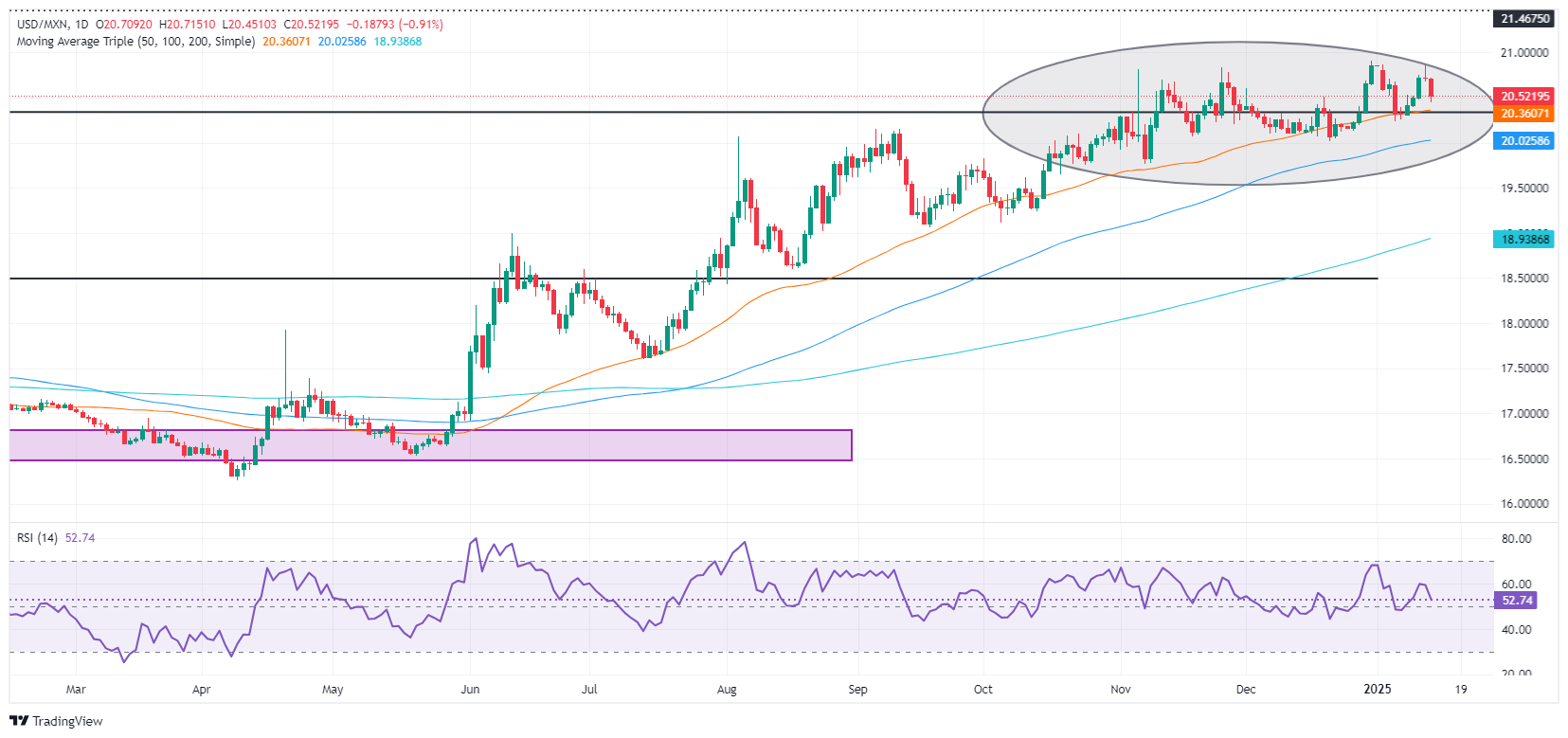
USD/MXN technical outlook: Mexican Peso recovers as USD/MXN falls below 20.50
The USD/MXN uptrend remains in place as long as buyers hold prices above the 50-day Simple Moving Average (SMA) of 20.32, but over the short-term momentum has shifted slightly bearish.
The Relative Strength Index (RSI) is bullish but aims down toward its neutral line, hinting that sellers are stepping in. Therefore, the USD/MXN first support will be the 50-day SMA, followed by the 20.00 figure. On further weakness, the 100-day SMA will be tested at 19.98.
Conversely, if USD/MXN rises past 20.50, the first resistance will be the year-to-date (YTD) peak of 20.90. If surpassed, the next stop would be the March 8, 2022 high of 21.46, ahead of 21.50 and the 22.00 psychological level.
Banxico FAQs
The Bank of Mexico, also known as Banxico, is the country’s central bank. Its mission is to preserve the value of Mexico’s currency, the Mexican Peso (MXN), and to set the monetary policy. To this end, its main objective is to maintain low and stable inflation within target levels – at or close to its target of 3%, the midpoint in a tolerance band of between 2% and 4%.
The main tool of the Banxico to guide monetary policy is by setting interest rates. When inflation is above target, the bank will attempt to tame it by raising rates, making it more expensive for households and businesses to borrow money and thus cooling the economy. Higher interest rates are generally positive for the Mexican Peso (MXN) as they lead to higher yields, making the country a more attractive place for investors. On the contrary, lower interest rates tend to weaken MXN. The rate differential with the USD, or how the Banxico is expected to set interest rates compared with the US Federal Reserve (Fed), is a key factor.
Banxico meets eight times a year, and its monetary policy is greatly influenced by decisions of the US Federal Reserve (Fed). Therefore, the central bank’s decision-making committee usually gathers a week after the Fed. In doing so, Banxico reacts and sometimes anticipates monetary policy measures set by the Federal Reserve. For example, after the Covid-19 pandemic, before the Fed raised rates, Banxico did it first in an attempt to diminish the chances of a substantial depreciation of the Mexican Peso (MXN) and to prevent capital outflows that could destabilize the country.
Author
Christian Borjon Valencia
FXStreet
Markets analyst, news editor, and trading instructor with over 14 years of experience across FX, commodities, US equity indices, and global macro markets.