Mexican Peso gains ground amid growing optimism for Fed's 50 bps cut
- Mexican Peso rises to a three-week peak as US Dollar drops.
- Fed rate cut expectations increase with CME FedWatch Tool showing a 43% chance of a 50 bps cut, pressuring the US Dollar.
- Political concerns in Mexico ease following the approval of the judicial reform, helping the Peso's rally.

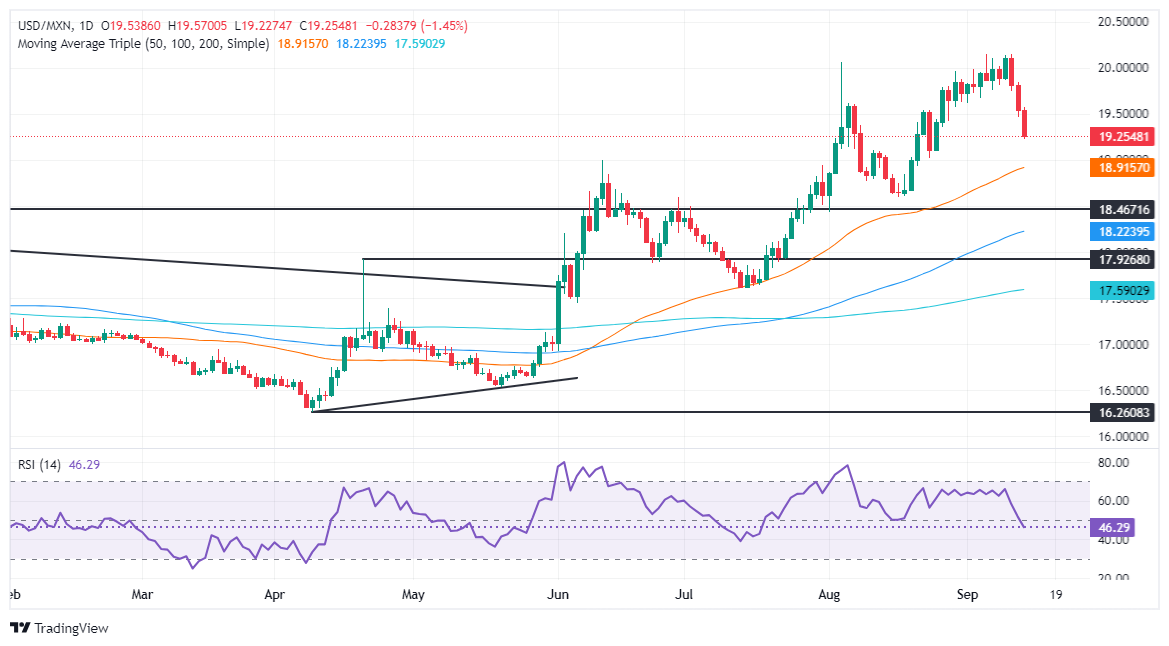
The Mexican Peso rallied for the third straight session against the US Dollar due to overall weakness on the latter. Market participants gaining confidence that the US Federal Reserve (Fed) will lower borrowing costs “aggressively” boosted the Mexican currency, which shrugged off judicial reform fears. The USD/MXN trades at 19.25, down 1.30%.
The Greenback has been the focus during the last two trading sessions. On Thursday, investors seemed confident that the Fed will cut interest rates by 0.25% due to data provided by the CME FedWatch Tool. Nevertheless, a worse-than-expected Initial Jobless Claims report overshadowed an uptick in the Producer Price Index (PPI).
On Thursday, the CME FedWatch Tool showed that the odds for a 50-basis-point Fed cut were 28%. However, at the time of writing, the chances increased to 43%; and for a 25 bps cut, diminished to 53%.
This undermined the buck, which, according to the US Dollar Index (DXY), lost 0.17%, changing hands at 101.06.
The University of Michigan (UoM) revealed that Consumer Sentiment rose to a four-month peak in September, which was helped by an improvement in inflation expectations.
Meanwhile, in Mexico, the political turbulence eased after the approval of the judicial system bill.
Gerardo Carrillo, Regional Director for LATAM at Fitch Ratings, commented on Mexico’s creditworthiness. He said, “The rating outlook is stable, which means that we are seeing a balance between strengths and weaknesses. Before observing a direct downgrade of the sovereign rating, what could be expected from us is a change in the outlook, either from stable to positive or from stable to negative, the latter probably occurring.”
On Thursday, Bank of Mexico (Banxico) Director of Economic Research Alejandrina Salcedo stated that a robust environment in the rule of law can help generate conditions that encourage investment. She added that respecting the rule of law and public safety “would provide greater certainty, boost the flow of investment in all regions, and contribute to capitalizing on the opportunities offered by the relocation process.”
Daily digest market movers: Mexican Peso is bolstered by US Dollar weakness
- USD/MXN would continue to be driven by market mood and expectations for a bigger Fed rate cut.
- Mexico’s economic docket next week will feature Aggregate Demand and Private Spending for the second quarter of 2024.
- Mexico’s Inflation dipped below 5% in August, increasing the chances of additional easing by Banxico.
- September’s Citibanamex Survey showed that Banxico is expected to lower rates to 10.25% in 2024 and to 8.25% in 2025. The USD/MXN exchange rate is forecast to end 2024 at 19.50 and 2025 at 19.85.
- The UoM Consumer Sentiment index rose from 67.9 to 69.0, exceeding estimates of 68.
- Inflation expectations improved from 2.8% to 2.7% for the one-year period. For a longer term, they rose from 3% to 3.1%.
- Greenback remained offered in the US after the US Bureau of Labor Statistics revealed that the August PPI figures were mixed. At the same time, the number of Americans filing for unemployment benefits rose as estimated and cleared the previous week's reading.
- Data from the Chicago Board of Trade suggests the Fed will cut at least 98 basis points this year, down from 108 a day ago, according to the fed funds rate futures contract for December 2024.
USD/MXN technical outlook: Mexican Peso surges as USD/MXN slumps below 19.30
The USD/MXN’s sudden pullback pushed the exotic pair more than 7,000 pips below the 20.00 psychological figure, though key support levels lie ahead. Nonetheless, momentum shifted in the sellers' favor as the Relative Strength Index (RSI) turned bearish.
Hence, in the short term, the USD/MXN is tilted to the downside. The first support would be the August 23 low of 19.02. A breach of the latter will expose the 50-day Simple Moving Average at 18.99, followed by the August 19 cycle low of 18.59.
Conversely, the USD/MXN must clear the psychological 20.00 figure for a bullish continuation. If surpassed, the next ceiling level would be the YTD high at 20.22. On further strength, the pair could challenge the daily high of September 28, 2022, at 20.57. If those two levels are surrendered, the next stop would be the swing high at 20.82 on August 2, 2022, ahead of 21.00.
Banxico FAQs
The Bank of Mexico, also known as Banxico, is the country’s central bank. Its mission is to preserve the value of Mexico’s currency, the Mexican Peso (MXN), and to set the monetary policy. To this end, its main objective is to maintain low and stable inflation within target levels – at or close to its target of 3%, the midpoint in a tolerance band of between 2% and 4%.
The main tool of the Banxico to guide monetary policy is by setting interest rates. When inflation is above target, the bank will attempt to tame it by raising rates, making it more expensive for households and businesses to borrow money and thus cooling the economy. Higher interest rates are generally positive for the Mexican Peso (MXN) as they lead to higher yields, making the country a more attractive place for investors. On the contrary, lower interest rates tend to weaken MXN. The rate differential with the USD, or how the Banxico is expected to set interest rates compared with the US Federal Reserve (Fed), is a key factor.
Banxico meets eight times a year, and its monetary policy is greatly influenced by decisions of the US Federal Reserve (Fed). Therefore, the central bank’s decision-making committee usually gathers a week after the Fed. In doing so, Banxico reacts and sometimes anticipates monetary policy measures set by the Federal Reserve. For example, after the Covid-19 pandemic, before the Fed raised rates, Banxico did it first in an attempt to diminish the chances of a substantial depreciation of the Mexican Peso (MXN) and to prevent capital outflows that could destabilize the country.
Economic Indicator
Michigan Consumer Sentiment Index
The Michigan Consumer Sentiment Index, released on a monthly basis by the University of Michigan, is a survey gauging sentiment among consumers in the United States. The questions cover three broad areas: personal finances, business conditions and buying conditions. The data shows a picture of whether or not consumers are willing to spend money, a key factor as consumer spending is a major driver of the US economy. The University of Michigan survey has proven to be an accurate indicator of the future course of the US economy. The survey publishes a preliminary, mid-month reading and a final print at the end of the month. Generally, a high reading is bullish for the US Dollar (USD), while a low reading is bearish.
Read more.Last release: Fri Sep 13, 2024 14:00 (Prel)
Frequency: Monthly
Actual: 69
Consensus: 68
Previous: 67.9
Source: University of Michigan
Consumer exuberance can translate into greater spending and faster economic growth, implying a stronger labor market and a potential pick-up in inflation, helping turn the Fed hawkish. This survey’s popularity among analysts (mentioned more frequently than CB Consumer Confidence) is justified because the data here includes interviews conducted up to a day or two before the official release, making it a timely measure of consumer mood, but foremost because it gauges consumer attitudes on financial and income situations. Actual figures beating consensus tend to be USD bullish.
Author

Christian Borjon Valencia
FXStreet
Markets analyst, news editor, and trading instructor with over 14 years of experience across FX, commodities, US equity indices, and global macro markets.