Mexican Peso ends day up, undeterred by positive US data
- Mexican Peso recovers after USD/MXN hit 20.00; gains over 0.19%.
- Peso faces additional pressure from former President Trump’s tariff threat on Mexican-made cars, triggering a sell-off.
- IMF lowers Mexico’s 2024 growth forecast to 1.5%, highlighting a deeper slowdown and rising inflation risks.

The Mexican Peso appreciated late in the North American session, slashing four days of losses against the Greenback. US Retail Sales and jobs data fared better than economists expected, bolstering the US Dollar, though the Peso recovered some ground. At the time of writing, the USD/MXN trades at 19.89, below its opening price by 0.15%.
Earlier, during the North American session, the USD/MXN cleared the psychological 20.00 figure after the US Department of Commerce revealed solid Retail Sales in September. At the same time, the US Department of Labor announced last week that the number of Americans filing for unemployment benefits was below projections.
After the data, the buck extended its gains, as shown by the US Dollar Index (DXY). The DXY, which tracks the American currency against another six, gains 0.26% to 103.80, slightly above the 200-day Simple Moving Average (SMA) of 103.77.
Despite that, the US Federal Reserve (Fed) is heavily expected to lower interest rates by 25 basis points at the November meeting. Odds remained at 90.9%, according to the CME FedWatch Tool data.
Recently released data showed that US Industrial Production tumbled, blamed on the Boeing strike and two hurricanes.
Across the south of the border, Mexico’s economic docket remained absent. However, former President Donald Trump's announcement that he would impose a 200% tariff on cars manufactured in Mexico once he wins the election triggered a Peso sell-off.
In its latest report, the International Monetary Fund (IMF) projected the Mexican economy to grow 1.5% in 2024, lower than in its previous forecast. The IMF estimates a deeper economic slowdown for the next year, estimating 1.3% GDP growth, and foresees inflation moving toward the Bank of Mexico’s (Banxico)3% goal.
Further US data will be revealed on Friday. Building Permits, Housing Starts and Fed speakers could dictate the direction of the USD/MXN.
Daily digest market movers: Mexican Peso counterattacks, USD/MXN tumbles below 19.90
- Earlier during the North American session, the Mexican Peso touched a five-week low as the USD/MXN hit a high of 20.02
- The IMF said that a recent judicial reform creates "important uncertainties about the effectiveness of contract enforcement and the predictability of the rule of law."
- Banxico’s survey revealed that economists estimate the central bank will lower rates by 50 bps for the rest of the year. The USD/MXN exchange rate is projected to end at 19.69, and the economy is expected to grow by 1.45% in 2024.
- September US Retail Sales rose by 0.4% MoM, above estimates of 0.3% and August’s 0.1% increase.
- Initial Jobless Claims for the week ending October 12 came at 241K, below estimates and last week’s 258K.
- US Industrial Production in September contracted -0.3% MoM from 0.3% growth due to external factors.
- Data from the Chicago Board of Trade via the December fed funds rate futures contract shows investors estimate 48 bps of Fed easing by the end of the year.
USD/MXN technical outlook: Mexican Peso remains pressured after USD/MXN pierced 19.85
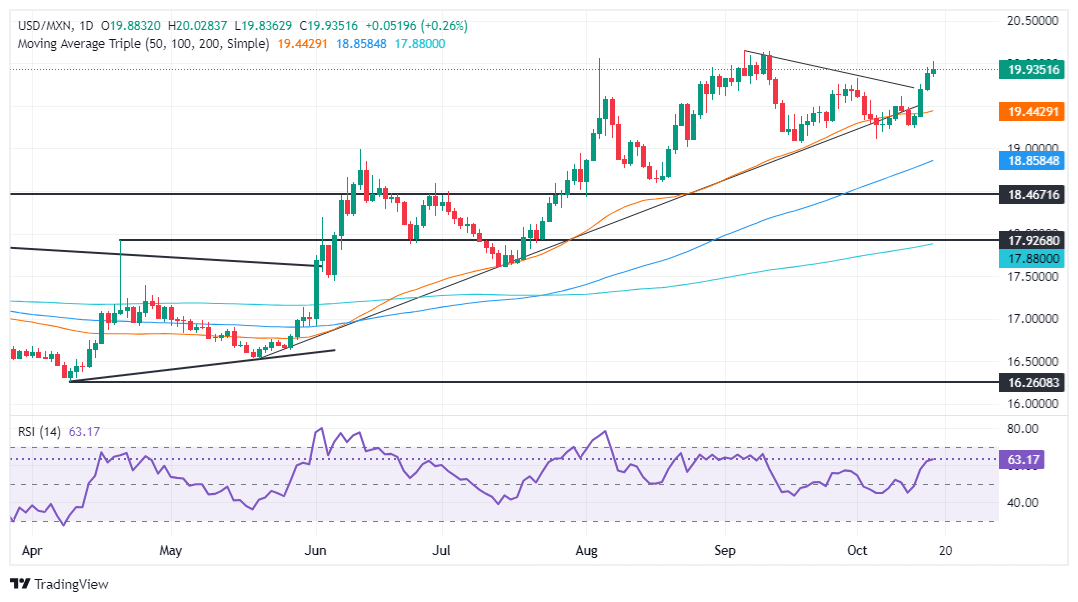
The USD/MXN uptrend remains in play and hit a two-month high above 20.00. The Relative Strength Index (RSI) suggests that bulls are in charge, which could pave the way for further upside.
If USD/MXN clears the 20.02 high of October 17, the next stop would be the YTD high at 20.22. On further strength, a rally to 20.50 is on the cards.
Conversely, if the USD/MXN tumbles below the October 1 high turned support at 19.82, it could exacerbate a test of the October 10 daily peak at 19.61. On further weakness, the next floor will be the October 4 swing low of 19.10 before testing 19.00.
Mexican Peso FAQs
The Mexican Peso (MXN) is the most traded currency among its Latin American peers. Its value is broadly determined by the performance of the Mexican economy, the country’s central bank’s policy, the amount of foreign investment in the country and even the levels of remittances sent by Mexicans who live abroad, particularly in the United States. Geopolitical trends can also move MXN: for example, the process of nearshoring – or the decision by some firms to relocate manufacturing capacity and supply chains closer to their home countries – is also seen as a catalyst for the Mexican currency as the country is considered a key manufacturing hub in the American continent. Another catalyst for MXN is Oil prices as Mexico is a key exporter of the commodity.
The main objective of Mexico’s central bank, also known as Banxico, is to maintain inflation at low and stable levels (at or close to its target of 3%, the midpoint in a tolerance band of between 2% and 4%). To this end, the bank sets an appropriate level of interest rates. When inflation is too high, Banxico will attempt to tame it by raising interest rates, making it more expensive for households and businesses to borrow money, thus cooling demand and the overall economy. Higher interest rates are generally positive for the Mexican Peso (MXN) as they lead to higher yields, making the country a more attractive place for investors. On the contrary, lower interest rates tend to weaken MXN.
Macroeconomic data releases are key to assess the state of the economy and can have an impact on the Mexican Peso (MXN) valuation. A strong Mexican economy, based on high economic growth, low unemployment and high confidence is good for MXN. Not only does it attract more foreign investment but it may encourage the Bank of Mexico (Banxico) to increase interest rates, particularly if this strength comes together with elevated inflation. However, if economic data is weak, MXN is likely to depreciate.
As an emerging-market currency, the Mexican Peso (MXN) tends to strive during risk-on periods, or when investors perceive that broader market risks are low and thus are eager to engage with investments that carry a higher risk. Conversely, MXN tends to weaken at times of market turbulence or economic uncertainty as investors tend to sell higher-risk assets and flee to the more-stable safe havens.
Author

Christian Borjon Valencia
FXStreet
Markets analyst, news editor, and trading instructor with over 14 years of experience across FX, commodities, US equity indices, and global macro markets.