Mexican Peso recovers despite dovish Banxico meeting
- The Mexican Peso recovers despite a dovish tilt to the Banxico policy meeting on Thursday.
- A change in the distribution of voting and language of the statement suggests a higher change of interest-rate cuts.
- USD/MXN trades in volatile ups and downs with no clear trend in the short-term.

The Mexican Peso (MXN) recovers roughly three quarters of a percent in its most traded pairs on Friday despite a dovish tilt to the Bank of Mexico (Banxico) policy meeting on Thursday. Banxico decided to leave interest rates unchanged at 11.00% and although the decision was widely expected, the change in the language of the statement and the division of voting were not.
These changes suggest Banxico is more likely to cut interest rates in the future than was previously supposed (dovishness). This, in turn, had a moderately weakening effect on the Mexican Peso, since lower interest rates are generally bearish for currencies because they attract lower foreign capital inflows.
At the time of writing, one US Dollar (USD) buys 18.30 Mexican Pesos, EUR/MXN is trading at 19.58, and GBP/MXN at 23.14.
Mexican Peso weakens after changes to voting and Banxico language
The Mexican Peso recovers the losses incurred following the Banxico policy meeting. Several changes to the language of the accompanying statement and the inclusion of a single vote to cut interest rates – by Omar Mejia – were new developments that gave the meeting a dovish slant.
The key changes to the statement were as follows:
- At the previous meeting one member had voted to raise interest rates by 0.25%, in contrast at the June meeting a member voted to cut interest rates by 0.25%.
- Overall it gave little weight to the Peso’s devaluation, according to analysts at Rabobank.
- “Of note was the seemingly little weight the Bank placed on recent MXN depreciation filtering through to higher inflation. Overall, we would argue there is a dovish tilt that leaves the door wide open to further rate cuts this year,” Rabobank said in its note.
- Nevertheless, near-term inflation forecasts were revised up due to pass-through from the weaker Mexican Peso, however, longer-term forecasts were left unchanged.
- New language was added about economic activity slowing down, including “the balance of risks to growth of economic activity is biased to the downside”.
- The same mention of slowing activity preceded the interest-rate cut in March, according to economists at advisory service Capital Economics.
- Further, Banxico added that it saw scope for, “discussing reference rate adjustments”.
- “Our sense is that policymakers have opened the door to a 25bp cut at the August meeting,” said Capital Economics, adding “Even so, once the easing cycle is resumed, we expect that rates will be lowered more gradually than most anticipate.”
- Rabobank expects two 0.25% rate cuts from Banxico in 2024, with a policy rate of 10.50% to end the year.
- Capital Economics are more dovish, expecting four rate cuts and an end-of-year policy rate of 10.00%.
Technical Analysis: USD/MXN displays volatility
USD/MXN rose after the Banxico meeting to touch a weekly high of 18.60, however, it has since fallen back down to the 18.30s.
The pair moved up after the formation of a three-wave ABC correction. This suggests the possibility the pair might not be correcting the short-term downtrend but instead has entered a short-term uptrend.
USD/MXN 4-hour Chart
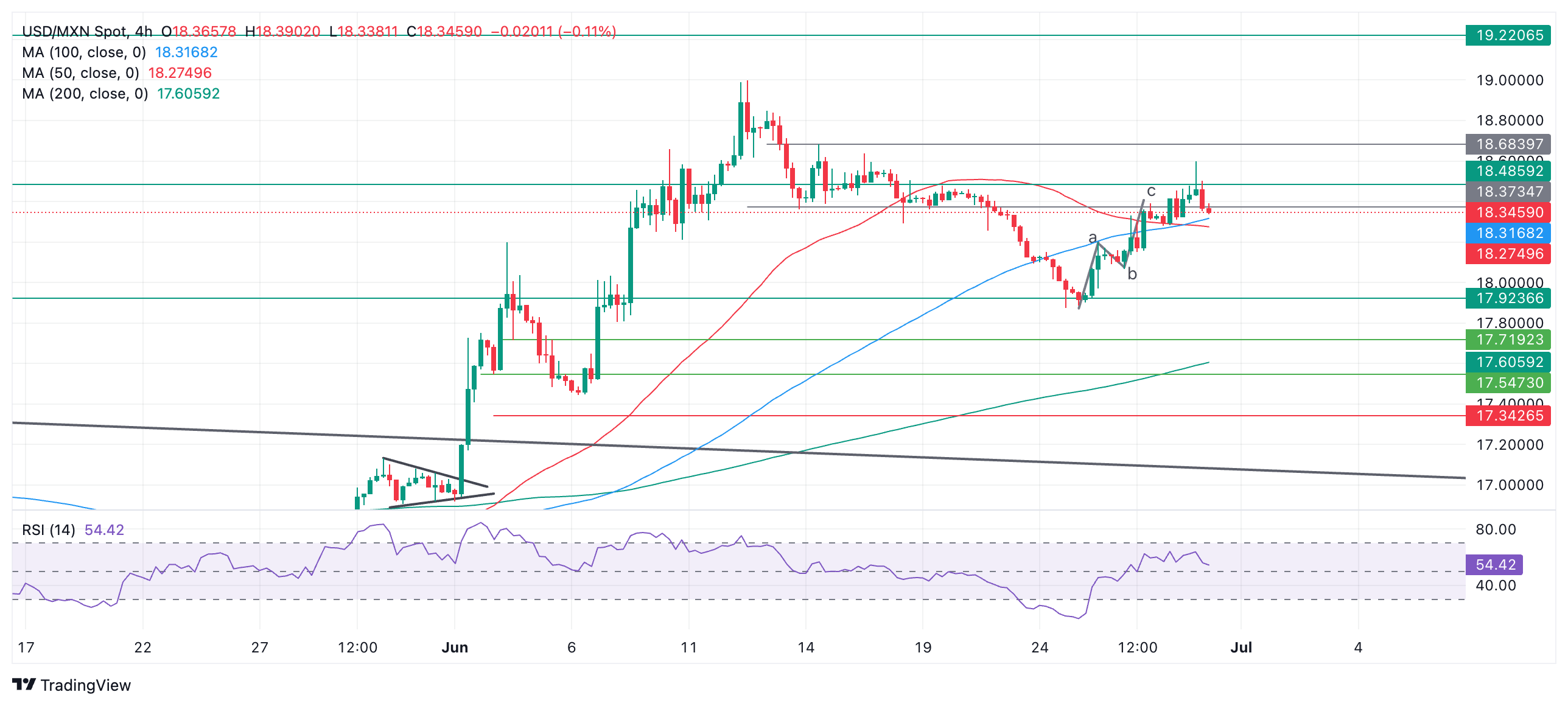
However, the evidence is not strong either way and ultimately the direction of the short-term trend is unclear at the moment.
A move below 18.06 (June 26 low) would suggest the downtrend was resuming and probably see a continuation down to 17.87 (June 24 low).
Alternatively, if USD/MXN rallies and breaks above 18.60 (June 28 high), it is likely to continue up to 18.68 (June 14 high), followed by 19.00 (June 12 high). A break above 19.00 would provide strong confirmation of a resumption of the short-and-intermediate term uptrend.
The direction of the long-term trend remains in doubt.
Mexican Peso FAQs
The Mexican Peso (MXN) is the most traded currency among its Latin American peers. Its value is broadly determined by the performance of the Mexican economy, the country’s central bank’s policy, the amount of foreign investment in the country and even the levels of remittances sent by Mexicans who live abroad, particularly in the United States. Geopolitical trends can also move MXN: for example, the process of nearshoring – or the decision by some firms to relocate manufacturing capacity and supply chains closer to their home countries – is also seen as a catalyst for the Mexican currency as the country is considered a key manufacturing hub in the American continent. Another catalyst for MXN is Oil prices as Mexico is a key exporter of the commodity.
The main objective of Mexico’s central bank, also known as Banxico, is to maintain inflation at low and stable levels (at or close to its target of 3%, the midpoint in a tolerance band of between 2% and 4%). To this end, the bank sets an appropriate level of interest rates. When inflation is too high, Banxico will attempt to tame it by raising interest rates, making it more expensive for households and businesses to borrow money, thus cooling demand and the overall economy. Higher interest rates are generally positive for the Mexican Peso (MXN) as they lead to higher yields, making the country a more attractive place for investors. On the contrary, lower interest rates tend to weaken MXN.
Macroeconomic data releases are key to assess the state of the economy and can have an impact on the Mexican Peso (MXN) valuation. A strong Mexican economy, based on high economic growth, low unemployment and high confidence is good for MXN. Not only does it attract more foreign investment but it may encourage the Bank of Mexico (Banxico) to increase interest rates, particularly if this strength comes together with elevated inflation. However, if economic data is weak, MXN is likely to depreciate.
As an emerging-market currency, the Mexican Peso (MXN) tends to strive during risk-on periods, or when investors perceive that broader market risks are low and thus are eager to engage with investments that carry a higher risk. Conversely, MXN tends to weaken at times of market turbulence or economic uncertainty as investors tend to sell higher-risk assets and flee to the more-stable safe havens.
Author

Joaquin Monfort
FXStreet
Joaquin Monfort is a financial writer and analyst with over 10 years experience writing about financial markets and alt data. He holds a degree in Anthropology from London University and a Diploma in Technical analysis.