Mexican Peso appreciates further as Fed rate cut prospects increase

Most recent article: Mexican Peso trades mixed as key counterparts experience volatility
- Mexican Peso strengthens by 0.35% as traders fully price in the Fed rate cut for September.
- Banxico’s dovish comments and Fed Chair Powell’s balanced mandate remarks influence market sentiment.
- US Dollar Index (DXY) rises slightly to 104.18; US Retail Sales data meet expectations.
The Mexican Peso recovered and registered gains of more than 0.35% against the US Dollar on Tuesday as traders had fully priced in the Federal Reserve's decision to cut interest rates in September. This will widen the interest rate differential between Mexico and the US, boosting the emerging market currency; hence, the USD/MXN trades at 17.65, down 0.40%.
Mexico’s economic docket remains absent for the current week. Yet, dovish comments by Bank of Mexico’s (Banxico) Deputy Governor Omar Mejia Castelazo spurred a leg-up in the USD/MXN pair.
Across the borders, Federal Reserve Chair Jerome Powell said the US economy fared well in the last couple of years and that they need further confidence in the disinflation process to lower borrowing costs. Powell added that the dual mandate risks had become more balanced and stated, “There is no slack in the labor market…essentially, we’re at equilibrium now.”
Later, San Francisco Fed President Mary Daly said that “confidence is growing that inflation is heading towards the US central bank’s 2% goal.”
In the meantime, the CME FedWatch Tools show the chances for a quarter of a percentage rate cut to the federal funds rate are at 100%, capping the Greenback’s advance. The US Dollar Index (DXY), which tracks the buck's performance against the other six currencies, rose 0.10% to 104.18.
US data-wise, the US Census Bureau revealed that Retail Sales in June were unchanged as expected, excluding autos, which rose sharply, exceeding forecasts.
Daily digest market movers: Mexican Peso appreciates on Fed rate cut bets
- Mexico’s economic docket will be absent during the week, resuming on July 22, when the National Statistics Agency (INEGI) reveals growth figures for the month of May. Nevertheless, Bank of Mexico (Banxico) policymakers and political developments could rock the boat.
- Banxico’s Deputy Governor Omar Mejia Castelazo's recent comments on interest rates have sparked significant interest in the financial markets. Mejia, the sole dissenter in Banxico’s June 27 monetary policy decision, advocated for a quarter of a percentage rate cut, emphasizing the need for any rate adjustments to be gradual and not continuous, adding that further easing would not imply the beginning of a cycle of interest rate cuts.
- Mexico’s June inflation figures were higher than expected due to a rise in food prices when most economists expect Banxico to resume lowering interest rates.
- US Retail Sales in June were flat at 0% MoM, as expected. Core sales expanded by 0.4% MoM, above the 0.1% projected by the consensus.
- Export and Import Prices for the same period decreased, with the former dropping -0.5% MoM, below forecasts of -0.1%. Import prices rose compared to May’s -0.2% plunge and came at 0%, beneath estimates of 0.2% increase.
- June consumer inflation figures were lower than expected in the United States, increasing the chances that the Federal Reserve would lower borrowing costs in 2024 by at least 54 basis points, according to the December 2024 fed funds rate futures contract.
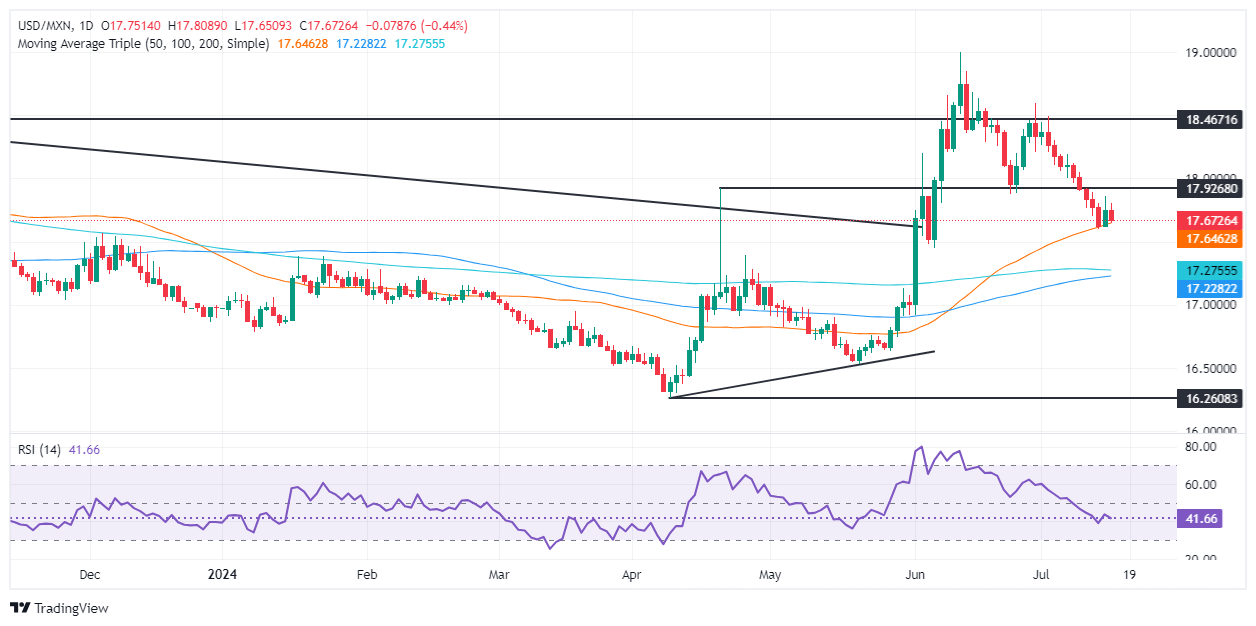
Technical analysis: Mexican Peso climbs as USD/MXN tumbles below 17.70
The USD/MXN is downward biased despite Monday’s upward correction, which breached last Friday’s high of 17.80. Momentum is bearish, as depicted by the Relative Strength Index (RSI), but strong support is found at the 50-day Simple Moving Average (SMA) at 17.63.
In the outcome of a breach under the 50-day SMA, the first support would be the December 5 high at 17.56, followed by the 200-day SMA at 17.27. Further losses would test the 100-day SMA at 17.21.
Conversely, if USD/MXN aims up, the next resistance would be the June 24 low-turned resistance at 17.87, followed by the 18.00 figure. Further upside potential is seen above the July 5 high at 18.19, followed by the June 28 high of 18.59, allowing buyers to aim for the YTD high of 18.99.
Mexican Peso FAQs
The Mexican Peso (MXN) is the most traded currency among its Latin American peers. Its value is broadly determined by the performance of the Mexican economy, the country’s central bank’s policy, the amount of foreign investment in the country and even the levels of remittances sent by Mexicans who live abroad, particularly in the United States. Geopolitical trends can also move MXN: for example, the process of nearshoring – or the decision by some firms to relocate manufacturing capacity and supply chains closer to their home countries – is also seen as a catalyst for the Mexican currency as the country is considered a key manufacturing hub in the American continent. Another catalyst for MXN is Oil prices as Mexico is a key exporter of the commodity.
The main objective of Mexico’s central bank, also known as Banxico, is to maintain inflation at low and stable levels (at or close to its target of 3%, the midpoint in a tolerance band of between 2% and 4%). To this end, the bank sets an appropriate level of interest rates. When inflation is too high, Banxico will attempt to tame it by raising interest rates, making it more expensive for households and businesses to borrow money, thus cooling demand and the overall economy. Higher interest rates are generally positive for the Mexican Peso (MXN) as they lead to higher yields, making the country a more attractive place for investors. On the contrary, lower interest rates tend to weaken MXN.
Macroeconomic data releases are key to assess the state of the economy and can have an impact on the Mexican Peso (MXN) valuation. A strong Mexican economy, based on high economic growth, low unemployment and high confidence is good for MXN. Not only does it attract more foreign investment but it may encourage the Bank of Mexico (Banxico) to increase interest rates, particularly if this strength comes together with elevated inflation. However, if economic data is weak, MXN is likely to depreciate.
As an emerging-market currency, the Mexican Peso (MXN) tends to strive during risk-on periods, or when investors perceive that broader market risks are low and thus are eager to engage with investments that carry a higher risk. Conversely, MXN tends to weaken at times of market turbulence or economic uncertainty as investors tend to sell higher-risk assets and flee to the more-stable safe havens.
Author

Christian Borjon Valencia
FXStreet
Markets analyst, news editor, and trading instructor with over 14 years of experience across FX, commodities, US equity indices, and global macro markets.

















