Mexican Peso weakens after macro data impacts counterparts
- The Mexican Peso is trading lower against its main counterparts amid data releases and changing interest rate expectations.
- MXN is weakening against the USD after a higher-than-expected rise in Building Permits supports the US economic outlook.
- Stubbornly high inflation in the old continent could delay rate cuts from the BoE and ECB, supporting European FX.

The Mexican Peso (MXN) is trading down against its key counterparts on Wednesday as macroeconomic data provides them with a lift.
Against the US Dollar (USD) the Peso has given back earlier gains after the release of US Building Permits beat expectations. Since the metric is seen as a leading indicator for the US economy the release improves the economic outlook for the world's largest economy, which, in turn, supports the Greenback.
Building Permits rose to 1.446 million in June from a revised-up 1.399M in May, beating expectations of 1.390M, according to data from the US Census Bureau. This translated into a 3.4% rise following a 2.8% decline in the previous month.
The Mexican Peso is weakening against the Pound Sterling (GBP) after UK Consumer Price Index (CPI) data showed inflation remained stubbornly high in June. This suggests the Bank of England (BoE) could delay cutting interest rates in the UK, and elevated interest rates are a positive factor for currencies as they lead to more foreign capital inflows. The same is true of EUR/MXN, which is up over a percent after the release of Eurozone inflation data showed similarly persistent inflation in the euro area.
At the time of writing, one US Dollar (USD) buys 17.78 Mexican Pesos, EUR/MXN trades at 19.46, and GBP/MXN at 23.17.
Mexican Peso trades mixed depending on counterpart
The Mexican Peso started Wednesday rising versus a weaker USD after a speech from the Fed Board of Governors’ member Adriana Kugler in which she said the Fed might cut rates “later this year”. Markets interpreted this as further confirmation of an interest rate cut in September.
“It will be appropriate to begin easing monetary policy later this year if economic conditions continue to evolve favorably,” said Kugler in a speech to the Peterson Institute for International Economics on Tuesday.
Kugler also added that further signs of deterioration in the labor market might provide another reason for the Fed to lower interest rates, a move which could stimulate hiring through lower borrowing costs. June’s Nonfarm Payrolls report revealed that the Unemployment Rate rose to 4.1%. It was the third month in a row that unemployment had risen in the US, and the highest level it has been at since November 2021. Unlike most central banks, the Fed has a dual mandate to achieve target inflation (of 2.0%) and “full employment”.
Her comments come on the back of market-moving statements made by Federal Reserve Chairman Jerome Powell on Monday, and a marked cooling in recent US inflation data.
Inflation in Europe remains stubbornly high
The Mexican Peso is losing ground against both the Euro and the Pound on Wednesday after the release of CPI data from both the UK and the Eurozone showed inflation remaining largely unchanged in June. This raises the possibility the Bank of England (BoE) and European Central Bank (ECB) may delay making further rate cuts as they wait for inflation to continue cooling.
UK CPI rose 2.0% on a year-over-year (YoY) basis and 0.1% month-over-month (MoM) in June, which was in line with expectations and the previous month’s reading, although the MoM data fell compared to May’s 0.3% reading. UK core CPI showed a 3.5% rise YoY, which was in line with estimates and the same as previous, according to data from the UK Office of National Statistics (ONS) released on Wednesday.
The Eurozone Harmonized Index of Consumer Prices (HICP) rose 2.5% YoY in June – the same as the previous month and in line with estimates, whilst monthly HICP rose 0.2%, also the same as expected and the previous.
Eurozone core HICP rose 2.9% YoY in June, the same as expected and previously, and 0.4% MoM, slightly above the 0.3% registered in May, according to data from Eurostat.
It is a quiet data week for the Mexican Peso, with the next key macroeconomic release not until July 22, when the National Statistics Agency (INEGI) reveals growth figures for the month of May.
Technical Analysis: USD/MXN finds support at 50-day SMA
USD/MXN has found support after its recent decline from the June 12 high.
The pair is consolidating along the line of the 50-day Simple Moving Average (SMA) at 17.65.
USD/MXN Daily Chart
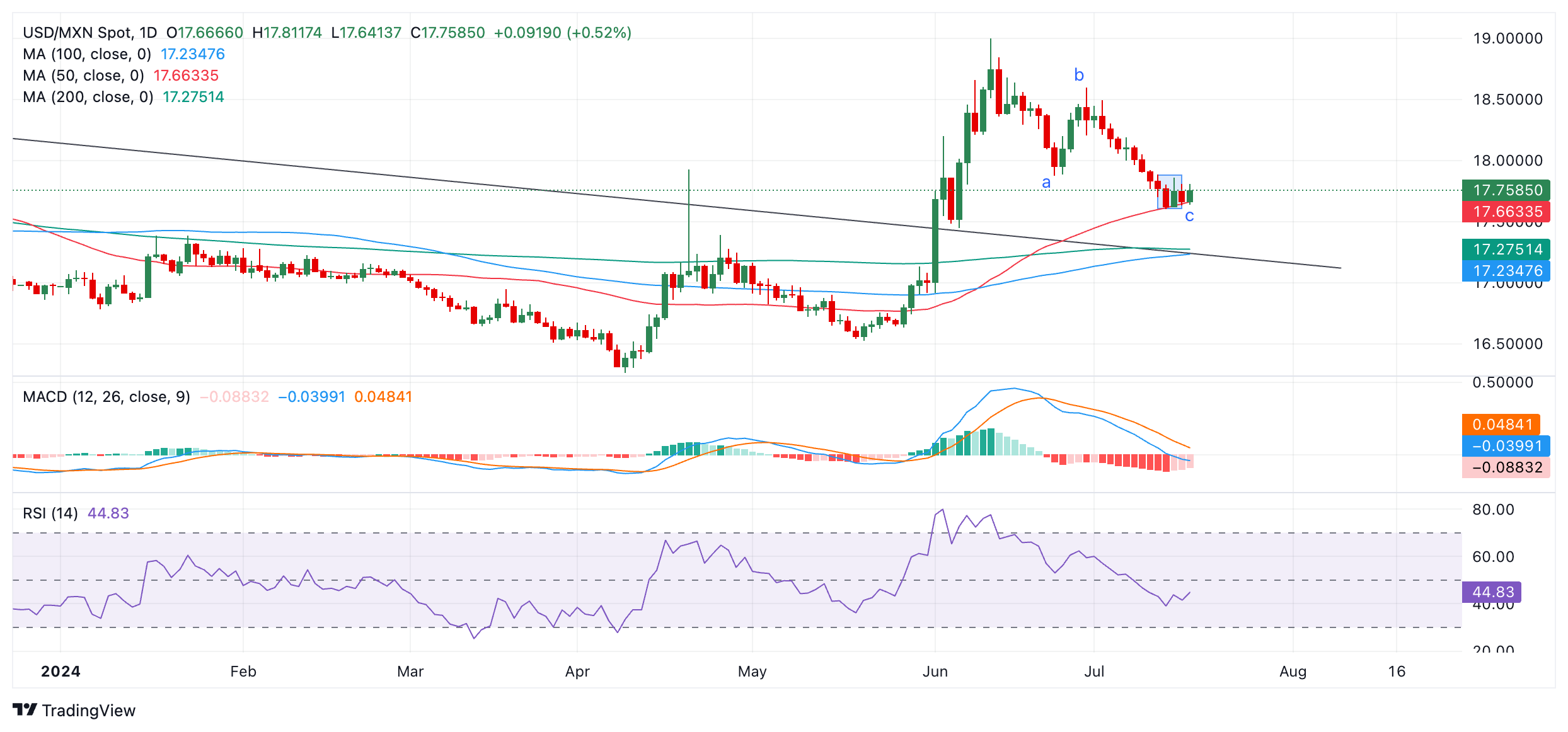
It is possible USD/MXN is preparing for a reversal higher, although there is insufficient evidence yet of this, and it remains in a short-term downtrend. Given that the “trend is your friend,” this still technically favors bearish bets.
The pair, however, might have completed a Measured Move (MM) pattern, a further sign of a reversal may be on the cards.
MMs are large, three-wave zig-zags, with waves labeled A, B, and C. The end of wave C can be estimated using the length of wave A as a guide. C is usually equal to A or, at least, a Fibonacci ratio of A. C is now roughly the same length as A, suggesting the pattern could be complete or near completion.
That said, the trend remains bearish, and a break plus a daily close below the 50-day Simple Moving Average (SMA) would reconfirm the dominant short-term downtrending bias. This could lead to a probable decline to 17.27, the level of the 200-day SMA and a major multi-month trendline.
Meanwhile, the direction of the medium and long-term trends remain in doubt.
Mexican Peso FAQs
The Mexican Peso (MXN) is the most traded currency among its Latin American peers. Its value is broadly determined by the performance of the Mexican economy, the country’s central bank’s policy, the amount of foreign investment in the country and even the levels of remittances sent by Mexicans who live abroad, particularly in the United States. Geopolitical trends can also move MXN: for example, the process of nearshoring – or the decision by some firms to relocate manufacturing capacity and supply chains closer to their home countries – is also seen as a catalyst for the Mexican currency as the country is considered a key manufacturing hub in the American continent. Another catalyst for MXN is Oil prices as Mexico is a key exporter of the commodity.
The main objective of Mexico’s central bank, also known as Banxico, is to maintain inflation at low and stable levels (at or close to its target of 3%, the midpoint in a tolerance band of between 2% and 4%). To this end, the bank sets an appropriate level of interest rates. When inflation is too high, Banxico will attempt to tame it by raising interest rates, making it more expensive for households and businesses to borrow money, thus cooling demand and the overall economy. Higher interest rates are generally positive for the Mexican Peso (MXN) as they lead to higher yields, making the country a more attractive place for investors. On the contrary, lower interest rates tend to weaken MXN.
Macroeconomic data releases are key to assess the state of the economy and can have an impact on the Mexican Peso (MXN) valuation. A strong Mexican economy, based on high economic growth, low unemployment and high confidence is good for MXN. Not only does it attract more foreign investment but it may encourage the Bank of Mexico (Banxico) to increase interest rates, particularly if this strength comes together with elevated inflation. However, if economic data is weak, MXN is likely to depreciate.
As an emerging-market currency, the Mexican Peso (MXN) tends to strive during risk-on periods, or when investors perceive that broader market risks are low and thus are eager to engage with investments that carry a higher risk. Conversely, MXN tends to weaken at times of market turbulence or economic uncertainty as investors tend to sell higher-risk assets and flee to the more-stable safe havens.
Author

Joaquin Monfort
FXStreet
Joaquin Monfort is a financial writer and analyst with over 10 years experience writing about financial markets and alt data. He holds a degree in Anthropology from London University and a Diploma in Technical analysis.

















