Mexican Peso makes gains as main FX peers suffer on lower interest-rate outlook
- The Mexican Peso rises in key pairs as expectations of lower interest rates in the US and Europe weigh on counterparts.
- The USD is hit by a revival of the debate over a 50 or 25 bps cut, and the Euro by lower economic growth forecasts.
- USD/MXN reaches the downside target after a key breakout from a rising channel.

The Mexican Peso (MXN) extends its gains on Friday, capping off a week in which the currency has appreciated on average 2.3% against its most heavily-traded counterparts so far.
The expectation that interest rates will fall more rapidly in Europe and the US as growth slows and labor markets weaken is weighing on the Peso’s key counterparts – the US Dollar (USD), the Euro (EUR) and the Pound Sterling (GBP). Meanwhile, still-elevated interest rates in Mexico, at 10.75%, continue to attract foreign capital inflows, supporting MXN.
Mexican Peso rises against USD after WSJ article, Dudley speech
The Mexican Peso rises against the USD on the back of a revival of the possibility of the Federal Reserve (Fed) making a larger 0.50% (50 basis points) interest-rate cut at its September meeting next week. Such a cut would be negative for the US Dollar (USD) as lower interest rates attract less capital inflows.
Speculation of a larger 0.50% cut was revived by a respected The Wall Street Journal (WSJ) reporter, Nick Timiraos, who wrote an article in support of the case. This was followed by a story in the Financial Times (FT) along similar lines.
During Friday’s Asian session, William Dudley, the former President of the Federal Reserve (Fed) Bank of New York, said “there’s a strong case” for the Fed making a half a percentage point rate cut at the September FOMC meeting, in a speech in Singapore, according to Reuters.
The articles and Dudley’s comments appear to have caused a sudden drop in two-year US Treasury yields, which tumbled five basis points during Friday’s Asisan session. The USD weakened too as traders priced in the possibility of lower interest rates amid a less inflationary outlook.
“US yields fell in Asia trade on Friday while rates futures rallied in reaction to media reports that next week's decision on whether to cut by 25 bps or 50 bps was a close call,” according to Reuters.
ECB cuts rates and flags waning economic growth
Against the Euro, the Peso is rising after the European Central Bank (ECB) decided to slash interest rates at its September meeting on Thursday.
The ECB cut its deposit rate by 0.25% but lowered its main overnight refinancing rate and marginal lending facility by a deeper 0.60%. Although the cuts were widely telegraphed, the accompanying statement showed a downward-revision to ECB economic growth forecasts for the region, which some analysts see as a red flag warning of future cuts. This, in turn, weakened the Euro.
ECB President Christine Lagarde refused to speculate as to whether the ECB would cut rates again in October during her press conference. However, according to Bloomberg News, if the Fed goes ahead with a larger 0.50% cut next Wednesday, it would encourage the ECB to cut by another 0.25% in October.
The Pound Sterling, meanwhile, is trading on the back foot after data out of the UK showed Gross Domestic Product (GDP) growth stalled in July when economists had forecast a 0.2% rise. This, combined with declines in both Manufacturing and Industrial output, suggests a greater likelihood of the Bank of England (BoE) deciding to cut interest rates when it meets next Thursday, weighing on GBP.
Peso holds ground
The Mexican Peso remains relatively strong despite the passing of controversial judicial reforms in the country’s Senate on Wednesday. Although the reforms have been widely criticized by investors – including rating agencies such as Moody’s – for undermining the independence of the judiciary and potentially leading to a fall in foreign investment, the Peso appears to have already priced in the risk.
The lower probability of former President Donald Trump winning the presidential election in November after his poor performance in a debate with Vice President Kamala Harris on Tuesday has alleviated some of the political risk that would be associated with the “America First” orientation expected from a Trump presidency.
Despite investor concerns relating to the policies of the current left-leaning government, Mexico continues to benefit from a nearshoring boom as global manufacturing companies relocate to Mexico to produce goods for the US and Latin American market.
This was highlighted by Volvo’s announcement in August, when the automaker said it was planning to build a $700 million heavy-duty truck manufacturing plant in the northern Mexican city of Monterrey.
At the time of writing, one US Dollar (USD) buys 19.45 Mexican Pesos, EUR/MXN trades at 21.55, and GBP/MXN at 25.50.
Technical Analysis: USD/MXN reaches downside target for channel breakout
USD/MXN recently broke out of a channel and has now fallen to the target for the breakout at 19.62, calculated by taking the 0.618 Fibonacci (Fib) ratio of the height of the channel and extrapolating it lower.
USD/MXN 4-hour Chart
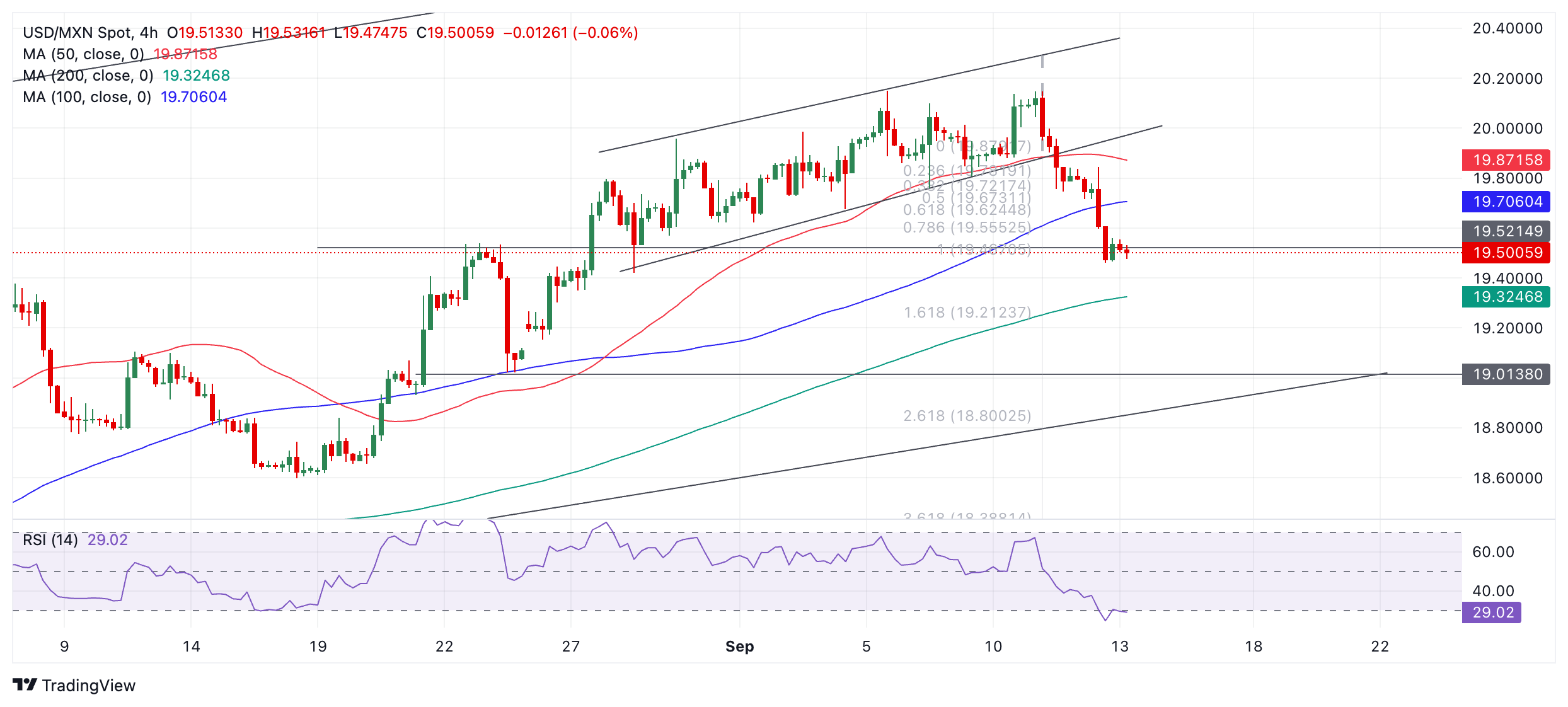
It has also now reached the next target at 19.50 mark, the 1.000 ratio Fib extension, which also coincides with the key support level from the August 22 swing high.
The pair is now oversold, according to the Relative Strength Index (RSI), advising traders not to add to short positions as the risk of a pullback has increased. If RSI exists oversold it will give a signal that a correction is underway and prices will recover. However, given the bear trend in the short term, such a correction might be relatively short-lived before prices resume their downtrend, with next target at 19.01 (August 23 low).
The trend on the medium and long-term charts, however, remains bullish, suggesting the risk of a recovery and resumption of the broader trend higher.
A break above 19.84 would be the first sign of such a bullish resumption, although a break above the year-to-date high at 20.15 would provide more concrete confirmation of a continuation of the bull trend, with the next target at the upper channel line in the 20.60s.
Economic Indicator
Producer Price Index ex Food & Energy (YoY)
The Producer Price Index ex Food & energy released by the Bureau of Labor statistics, Department of Labor measures the average changes in prices in primary markets of the US by producers of commodities in all states of processing. Those volatile products such as food and energy are excluded in order to capture an accurate calculation. Generally speaking, a high reading is seen as positive (or bullish) for the USD, whereas a low reading is seen as negative (or bearish).
Read more.Last release: Thu Sep 12, 2024 12:30
Frequency: Monthly
Actual: 2.4%
Consensus: 2.5%
Previous: 2.4%
Source: US Bureau of Labor Statistics
Author

Joaquin Monfort
FXStreet
Joaquin Monfort is a financial writer and analyst with over 10 years experience writing about financial markets and alt data. He holds a degree in Anthropology from London University and a Diploma in Technical analysis.