Mexican Peso on the backfoot as USD/MXN rises above 18.40

Most recent article: Mexican Peso recovers as carry-trade unwind fades
- Mexican Peso slips over 0.40% recovering from a six-week low.
- US GDP data for Q2 2024 surpasses expectations, a headwind for the US Dollar.
- Concerns rise over Mexico’s judiciary reforms and Tesla's investment threats due to political uncertainties.
The Mexican Peso recovered some ground and trimmed some of its earlier losses, which pushed the emerging market currency to its lowest level in six weeks against the Greenback. Better-than-expected data in the United States (US) was cheered by investors, who ditched safe-haven assets. Therefore, the USD/MXN trades at 18.43, up 0.47%, after hitting a low of 18.31.
The latest inflation report in Mexico was mixed. Underlying prices decelerated towards the Bank of Mexico (Banxico) goal of 3% plus or minus 1% band, while headline inflation edged above the 5% threshold.
Nevertheless, the report was overshadowed by concerns around judiciary reforms supported by the incumbent President Claudia Sheinbaum, which can potentially impact the emerging market currency. This and threats that Tesla might refrain from investing in Mexico if Donald Trump wins the election on November 5 hurts the country’s nearshoring prospects.
ING mentioned that traders are unwinding high-yielding currencies, particularly against the Japanese Yen, as the Bank of Japan (BoJ) prepares for another rate hike next week. They said, “... markets appear to be unwinding positions in some selected high yielding currencies like MXN and ZAR, while the funding JPY continues to perform very well.”
Aside from this, the US economy is gathering pace as Gross Domestic Product (GDP) crushed estimates in the second quarter of 2024. Other data reinforced the strength of the economy as the number of Americans filing for unemployment benefits missed the mark and was lower than the previous reading.
In the meantime, Durable Goods Orders tanked, though excluding transportation, expanded.
Daily digest market movers: Mexican Peso depreciates amid weaker US Dollar
- Mexico’s mid-month inflation for July jumped by 0.71% MoM, well above the expected 0.39% and the previous 0.21%. Annually, prices rose 5.61%, beating forecasts of 5.27% and last year's 4.78%. Core inflation, excluding volatile items, increased by 0.18% MoM, slightly above the previous month but below expectations. Core prices eased from 4.17% to 4.02% YoY, as predicted.
- According to Citi Research, analysts now estimate that annual inflation will end at 4.30%, up from the previous forecast of 4.20%, with core inflation expected to finish 2024 at 4.0%. Mexico's economic growth is projected to slow, with an expected growth rate of 1.9%, down from 2.0% in the last poll.
- The US Dollar Index (DXY), which tracks the buck’s value against the other six currencies, drops 0.04% to 104.29.
- US GDP for Q2 2024 jumped from 1.4% to 2.8% QoQ, exceeding forecasts of 2% on its advance reading.
- US Initial Jobless Claims for the week ending July 20 rose by 235K, less than estimates of 238K and the prior’s number of 245K.
- US Durable Goods orders plummeted -6.6% MoM in June, well below estimated 0.3%. Core Durable Goods, which excludes aircraft, expanded by 0.5% MoM, up from -0.1% and above consensus projections of 0.2%.
- The CME FedWatch Tools show that the chances of a quarter-percentage-rate cut to the federal funds rate in September are 100%.
- Data by the Chicago Board of Trade (CBOT) shows that traders are pricing in 53 basis points (bps) of easing towards the end of the year, as shown by the December 2024 fed funds rate futures contract.
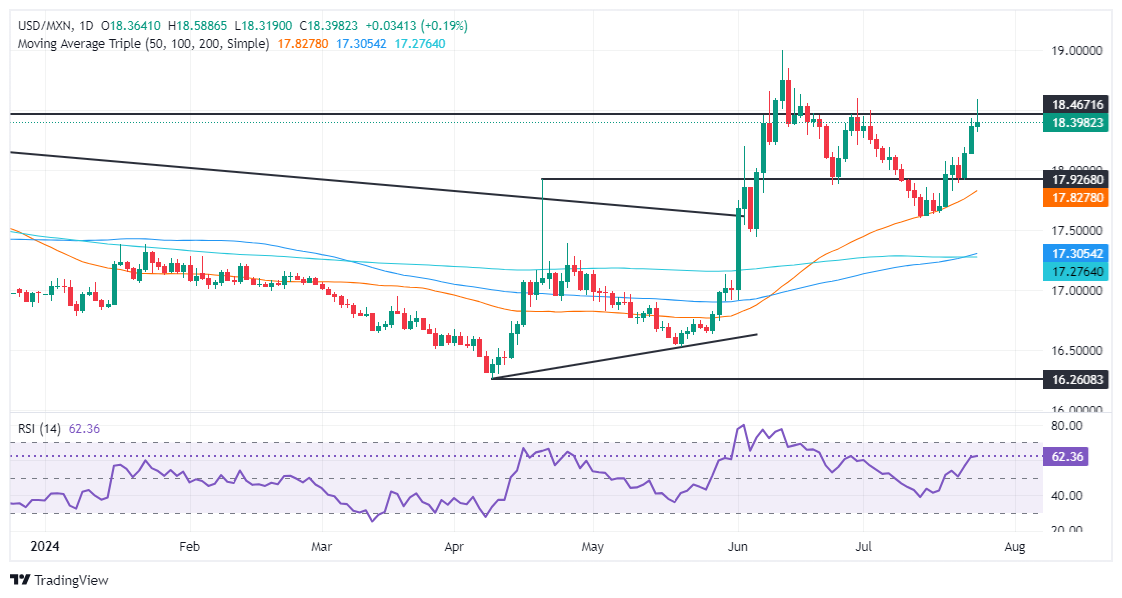
Technical analysis: Mexican Peso on the defensive as USD/MXN says above 18.30
The uptrend is set to continue once the USD/MXN cleared the daily Simple Moving Averages (SMA) and reclaimed the 18.00 psychological level. Buyers continued to gain traction as depicted by the Relative Strength Index (RSI), which is bullish and with space before turning overbought.
If the USD/MXN decisively breaks the 18.50 figure, the next stop would be the year-to-date (YTD) high at 18.99. A breach of the latter will expose the March 20, 2023, peak at 19.23 before challenging 19.50.
Conversely, if USD/MXN retreated beneath 18.00, that would pave the way to challenge the 50-day Simple Moving Average (SMA) at 17.74, the first support level. The next support would be the latest cycle low of 17.58; the July 12 high turned support. A breach of the latter will expose the January 23 peak at 17.38.
Mexican Peso FAQs
The Mexican Peso (MXN) is the most traded currency among its Latin American peers. Its value is broadly determined by the performance of the Mexican economy, the country’s central bank’s policy, the amount of foreign investment in the country and even the levels of remittances sent by Mexicans who live abroad, particularly in the United States. Geopolitical trends can also move MXN: for example, the process of nearshoring – or the decision by some firms to relocate manufacturing capacity and supply chains closer to their home countries – is also seen as a catalyst for the Mexican currency as the country is considered a key manufacturing hub in the American continent. Another catalyst for MXN is Oil prices as Mexico is a key exporter of the commodity.
The main objective of Mexico’s central bank, also known as Banxico, is to maintain inflation at low and stable levels (at or close to its target of 3%, the midpoint in a tolerance band of between 2% and 4%). To this end, the bank sets an appropriate level of interest rates. When inflation is too high, Banxico will attempt to tame it by raising interest rates, making it more expensive for households and businesses to borrow money, thus cooling demand and the overall economy. Higher interest rates are generally positive for the Mexican Peso (MXN) as they lead to higher yields, making the country a more attractive place for investors. On the contrary, lower interest rates tend to weaken MXN.
Macroeconomic data releases are key to assess the state of the economy and can have an impact on the Mexican Peso (MXN) valuation. A strong Mexican economy, based on high economic growth, low unemployment and high confidence is good for MXN. Not only does it attract more foreign investment but it may encourage the Bank of Mexico (Banxico) to increase interest rates, particularly if this strength comes together with elevated inflation. However, if economic data is weak, MXN is likely to depreciate.
As an emerging-market currency, the Mexican Peso (MXN) tends to strive during risk-on periods, or when investors perceive that broader market risks are low and thus are eager to engage with investments that carry a higher risk. Conversely, MXN tends to weaken at times of market turbulence or economic uncertainty as investors tend to sell higher-risk assets and flee to the more-stable safe havens.
Author

Christian Borjon Valencia
FXStreet
Markets analyst, news editor, and trading instructor with over 14 years of experience across FX, commodities, US equity indices, and global macro markets.