Mexican Peso slides as Banxico hold rates amid depreciation concerns
- Mexican Peso declined after the Banxico decision to keep rates at 11.00%, hinting at possible future easing.
- Policymakers optimistic about ongoing disinflation, open to future rate adjustments.
- Despite positive Mexican economic indicators like lower unemployment and trade surplus, Peso stays weak.

The Mexican Peso extended its losses against the US Dollar after the Bank of Mexico (Banxico) monetary policy decision, in which the Mexican central bank held rates unchanged, though it opened the door for further easing. At the time of writing, the USD/MXN trades at 18.39, up by 0.38%.
Banxico’s Governing Board held rates at 11.00%, mentioning that domestic financial markets were volatile due to “idiosyncratic factors,” spurring a jump in Mexican bond yields and the Peso’s depreciation. Nevertheless, Banxico policymakers failed to say that traders’ reaction was sponsored by the ruling party majority in Congress, which would push for bills that could threaten the state of law.
Besides that, officials mentioned that the disinflation process is expected to continue, adding that “the board foresees that the inflationary environment may allow for discussing reference rate adjustments.”
Aside from this, Mexico’s economic docket fared better than foreseen, with the Unemployment Rate coming in below estimates, while the Balance of Trade printed a surprising surplus. Despite that, the Mexican currency remained slightly weaker against the US Dollar (USD).
Across the border, mixed data in the United States (US) boosted the Greenback against most emerging market currencies but dropped against most G7 currencies. The final reading of the Gross Domestic Product (GDP) for Q1 2024 was higher than expected, unemployment claims dipped, and Durable Goods Orders exceeded forecasts.
Daily digest market movers: Mexican Peso stays weak post Banxico
- Data from Mexico, revealed the Unemployment Rate in May was 2.6%, below estimates of 2.7%. The Balance of Trade printed a surplus of $1.99 billion, crushing the consensus projections for a $-2.04 billion deficit.
- Citibanamex survey showed economists priced out fewer rate cuts by the central bank, estimating rates will be lowered to 10.25% in 2024, up from 10.00%. Regarding the USD/MXN, the consensus year-end exchange rate estimate is 18.70, up from 18.00 in the previous report.
- Regarding economic growth, the consensus revised the Gross Domestic Product (GDP) for 2024 downward from 2.2% to 2.1% YoY.
- US GDP for Q1 2024 came at 1.4% higher than the 1.3% in the previous two readings, still trailing last year’s fourth quarter of a 3.4% expansion.
- US Durable Goods Orders in May rose by 0.1% MoM, exceeding forecasts for a -0.1% contraction. At the same time, Initial Jobless Claims dipped from 239K a week ago to 233K, beneath forecasts of 236K.
- CME FedWatch Tool shows odds for a 25-basis-point Fed rate cut at 59.5% up from Wednesday’s 56.3%.
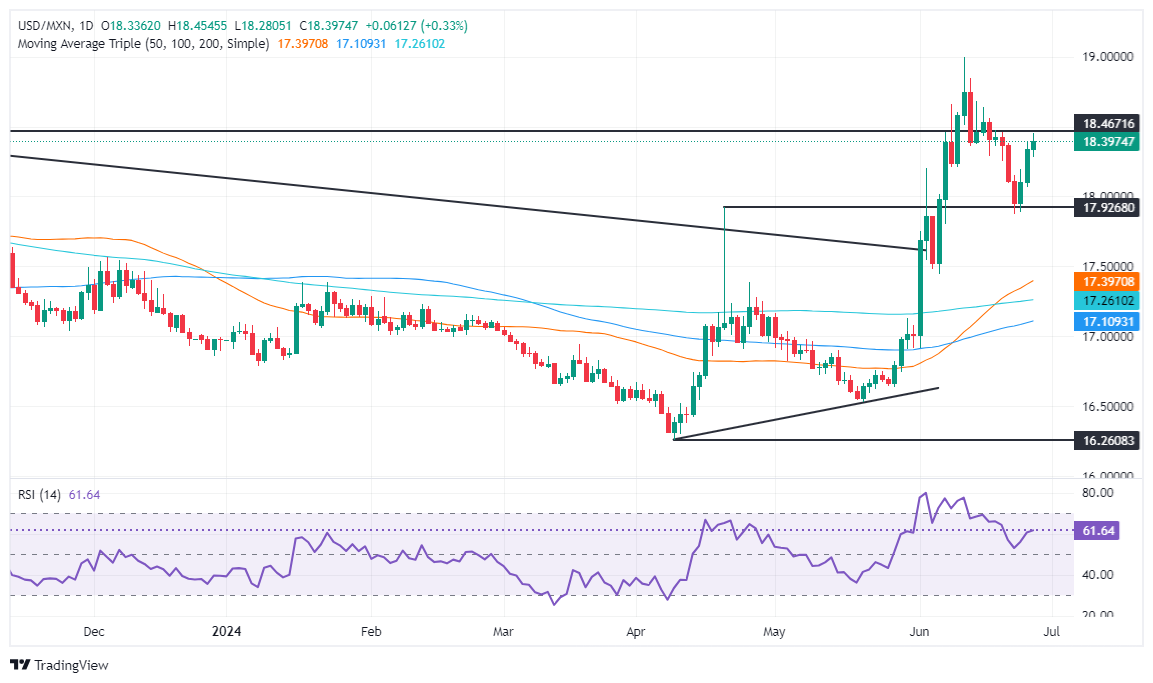
Technical analysis: Mexican Peso slides slightly as USD/MXN rallies back above 18.30
The USD/MXN is upwardly biased, yet the pair would likely remain volatile as Banxico’s decision looms. Despite that, momentum is in favor of buyers as the Relative Strength Index (RSI) suggests that bulls are in control.
For a bullish continuation, buyers need to push the USD/MXN exchange rate past the psychological 18.50 level. Once cleared, the next stop would be the year-to-date (YTD) high of 18.99, followed by the March 20, 2023, high of 19.23, followed by an uptick to 19.50.
On the flip side, if USD/MXN tumbles below the April 19 high turned support at 18.15, that will pave the way toward 18.00. Next key support level would be the 50-day Simple Moving Average (SMA) at 17.37 before testing the 200-day SMA at 17.23. Once those two levels are cleared, the next stop would be the 100-day SMA at 17.06.
Mexican Peso FAQs
The Mexican Peso (MXN) is the most traded currency among its Latin American peers. Its value is broadly determined by the performance of the Mexican economy, the country’s central bank’s policy, the amount of foreign investment in the country and even the levels of remittances sent by Mexicans who live abroad, particularly in the United States. Geopolitical trends can also move MXN: for example, the process of nearshoring – or the decision by some firms to relocate manufacturing capacity and supply chains closer to their home countries – is also seen as a catalyst for the Mexican currency as the country is considered a key manufacturing hub in the American continent. Another catalyst for MXN is Oil prices as Mexico is a key exporter of the commodity.
The main objective of Mexico’s central bank, also known as Banxico, is to maintain inflation at low and stable levels (at or close to its target of 3%, the midpoint in a tolerance band of between 2% and 4%). To this end, the bank sets an appropriate level of interest rates. When inflation is too high, Banxico will attempt to tame it by raising interest rates, making it more expensive for households and businesses to borrow money, thus cooling demand and the overall economy. Higher interest rates are generally positive for the Mexican Peso (MXN) as they lead to higher yields, making the country a more attractive place for investors. On the contrary, lower interest rates tend to weaken MXN.
Macroeconomic data releases are key to assess the state of the economy and can have an impact on the Mexican Peso (MXN) valuation. A strong Mexican economy, based on high economic growth, low unemployment and high confidence is good for MXN. Not only does it attract more foreign investment but it may encourage the Bank of Mexico (Banxico) to increase interest rates, particularly if this strength comes together with elevated inflation. However, if economic data is weak, MXN is likely to depreciate.
As an emerging-market currency, the Mexican Peso (MXN) tends to strive during risk-on periods, or when investors perceive that broader market risks are low and thus are eager to engage with investments that carry a higher risk. Conversely, MXN tends to weaken at times of market turbulence or economic uncertainty as investors tend to sell higher-risk assets and flee to the more-stable safe havens.
Author

Christian Borjon Valencia
FXStreet
Markets analyst, news editor, and trading instructor with over 14 years of experience across FX, commodities, US equity indices, and global macro markets.