Mexican Peso surges on Banxico’s supportive remarks

Most recent article: Mexican Peso recovery falters as investors shrug off Banxico's intervention warning
- Mexican Peso counterattacks, snapping two days of losses.
- Banxico Governor Victoria Rodriguez Ceja assures intervention if Peso exhibits “atypical behavior or extreme volatility.”
- Greenback weakens against Peso despite Fed's unchanged rates and revised projections with US economic data showing mixed signals.
The Mexican Peso recovered some ground on Thursday and appreciated by 1.45 % following a verbal intervention by the Bank of Mexico (Banxico). Governor Victoria Rodriguez Ceja commented that the Bank is ready to step in if the Peso shows “atypical behavior or extreme volatility.” The USD/MXN trades at 18.45, at new two-day lows.
Mexico’s economic docket remains absent for the rest of the week, with traders awaiting the release of Aggregate Demand, Private Spending, and Retail Sales data next week. However, the USD/MXN exchange rate continues to be driven by political uncertainty about the changes to the Mexican Constitution that threaten the state of law.
In the meantime, on Wednesday, Banxico’s Governor Victoria Rodriguez Ceja commented that the Mexican central bank remains attentive to the USD/MXN exchange rate and insisted that policymakers are not trying to defend a specific level.
Aside from this, the Greenback is on the back foot against the Mexican currency even though the US Federal Reserve (Fed) held rates unchanged and adjusted their projections for future monetary policy. Fed Chair Jerome Powell and the central bank’s governors estimate one interest rate cut in 2024 instead of the three projected by the dot plot since December 2023.
Meanwhile, US economic data showed that prices paid by producers in May were virtually unchanged compared to April, while the number of Americans filing for unemployment benefits exceeded estimates.
Daily digest market movers: Mexican Peso on defensive amidst political uncertainty
- In February 2024, AMLO put forward several proposals to the Mexican Congress. These include a Supreme Court reform that suggests electing Supreme Court ministers through popular vote; an electoral reform aimed at electing electoral commission councilors by popular vote and reducing multi-member representation; and a reform of autonomous bodies that proposes dissolving the transparency body.
- Mexican Peso depreciation could weigh on the Bank of Mexico's (Banxico) decision to ease policy on June 27 despite last month’s dip in core prices. Therefore, keeping interest rates higher could prompt deceleration in the economy and increase the odds of a possible recession.
- Morgan Stanley noted that if Mexico’s upcoming government and Congress adopted an unorthodox agenda, it would undermine Mexican institutions and be bearish for the Mexican Peso, which could weaken to 19.20.
- The US Department of Labor revealed that the Producer Price Index (PPI) in May was 2.2% YoY, below estimates of 2.5%, and a tenth below April’s 2.3%. Core PPI for the same month expanded 2.3% YoY, beneath the consensus and the previous reading of 2.4%.
- The latest US inflation report increased the odds for a Fed rate cut in September, according to the CME FedWatch Tool, from 46.7% to 60.5%.
- December’s 2024 fed funds futures contract hints that investors expect 38 basis points of rate cuts by the Fed through the end of the year.
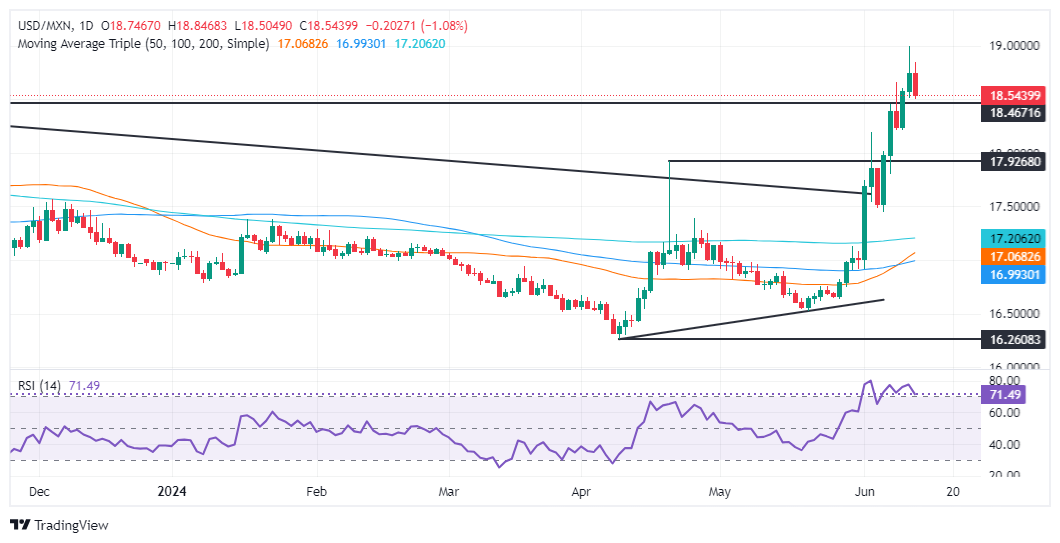
Technical analysis: Mexican Peso advances as USD/MXN slides below 18.60
The USD/MXN uptrend remains intact despite retreating toward the 18.50s region, which could be seen as buyers taking a respite as the Relative Strength Index (RSI) turned overbought. Despite that, momentum favors further upside after the exotic pair cleared strong resistance levels, opening the door for higher spot prices.
The USD/MXN's next resistance would be the year-to-date high of 18.99, followed by the March 20, 2023, high of 19.23. A breach of the latter will sponsor an uptick to 19.50, ahead of the psychological 20.00 mark.
On the other hand, sellers must push the USD/MXN back below the April 19 high of 18.15 if they want to keep the pair within the 18.00-18.15 trading range.
Mexican Peso FAQs
The Mexican Peso (MXN) is the most traded currency among its Latin American peers. Its value is broadly determined by the performance of the Mexican economy, the country’s central bank’s policy, the amount of foreign investment in the country and even the levels of remittances sent by Mexicans who live abroad, particularly in the United States. Geopolitical trends can also move MXN: for example, the process of nearshoring – or the decision by some firms to relocate manufacturing capacity and supply chains closer to their home countries – is also seen as a catalyst for the Mexican currency as the country is considered a key manufacturing hub in the American continent. Another catalyst for MXN is Oil prices as Mexico is a key exporter of the commodity.
The main objective of Mexico’s central bank, also known as Banxico, is to maintain inflation at low and stable levels (at or close to its target of 3%, the midpoint in a tolerance band of between 2% and 4%). To this end, the bank sets an appropriate level of interest rates. When inflation is too high, Banxico will attempt to tame it by raising interest rates, making it more expensive for households and businesses to borrow money, thus cooling demand and the overall economy. Higher interest rates are generally positive for the Mexican Peso (MXN) as they lead to higher yields, making the country a more attractive place for investors. On the contrary, lower interest rates tend to weaken MXN.
Macroeconomic data releases are key to assess the state of the economy and can have an impact on the Mexican Peso (MXN) valuation. A strong Mexican economy, based on high economic growth, low unemployment and high confidence is good for MXN. Not only does it attract more foreign investment but it may encourage the Bank of Mexico (Banxico) to increase interest rates, particularly if this strength comes together with elevated inflation. However, if economic data is weak, MXN is likely to depreciate.
As an emerging-market currency, the Mexican Peso (MXN) tends to strive during risk-on periods, or when investors perceive that broader market risks are low and thus are eager to engage with investments that carry a higher risk. Conversely, MXN tends to weaken at times of market turbulence or economic uncertainty as investors tend to sell higher-risk assets and flee to the more-stable safe havens.
Author

Christian Borjon Valencia
FXStreet
Markets analyst, news editor, and trading instructor with over 14 years of experience across FX, commodities, US equity indices, and global macro markets.