Mexican Peso weakens further after Retail Sales data
- The Mexican Peso falls to the day's low after the release of weaker-than-expected Mexican Retail Sales data.
- The MXN ended a five-day winning streak on Wednesday after the Mexican Congress voted through more controversial reforms.
- USD/MXN could be unfolding an up leg within a range that is part of a larger Measured Move pattern.

The Mexican Peso (MXN) weakens to the day's lows in its most-heavily traded pairs on Thursday after data showed shoppers in Mexico curtailed their spending in September. The data indicates a slowdown in consumer spending which will probably result in lower growth and inflation. This, in turn, is likely to make the Bank of Mexico reduce interest rates at a faster pace, resulting in a drop in capital inflows, and weakness for the Peso.
Mexican Peso falls to day's low after Retail Sales miss
The Mexican Peso depreciated after the release of Mexican Retail Sales which fell by 1.5% YoY in September, accelerating a 0.8% decline YoY registered in August, and below the expected 1.2% decline.
The Mexican Peso fell an average of half-a-percent fall in its key pairs on Wednesday, which marked an end to a five-day winning streak.
The factors leading to the Peso’s weakness included comments from the Governor of the Bank of Mexico (Banxico) Victoria Rodríguez Ceja, the voting through by the Mexican Congress of controversial reforms to autonomous bodies, and heightened geopolitical risk from Russia’s decision to lower the bar for its use of nuclear weapons. Higher geopolitical tensions tend to disproportionately disadvantage risk-sensitive emerging market currencies such as the MXN.
In its accompanying statement to the last policy meeting, Banxico said it saw the balance of risks for economic growth as leaning to the downside, and the weak Retail Sales data has reinforced this conclusion, with negative implications for the Peso.
Further, it supports comments from Banxico head Victoria Rodríguez Ceja that the central bank plans to continue reducing its benchmark interest rate, citing progress in lowering inflation. Lower interest rates are negative for a currency as they reduce foreign capital inflows.
Mexican Congress votes to scrap five autonomous and regulatory bodies
On Wednesday, the Mexican Congress voted through a controversial reform scrapping or replacing five of Mexico’s independent regulatory bodies, according to El Financiero. The move probably contributed to the Peso’s weakening on the day.
It is one of a number of reforms, including a radical overhaul of the judiciary, that have raised concerns among investors, and were responsible for the MXN’s 10% decline following the election in June. Critics of the reforms say they will remove another important check and balance to the power of large organizations and the state, whilst proponents say the autonomous agencies are riddled with corruption and thus unnecessary.
One of the most controversial bodies to be dissolved is The National Institute for Transparency, Access to Information, and Data Protection (INAI), which “has the authority to require government agencies, political parties, labor unions, or other public bodies to comply with freedom of information requests from individuals or organizations,” according to Human Rights Watch. The international NGO flagged concerns after previous President Andres Manuel Lopez Obrador decided to block the election of commissioners to fill vacant seats at INAI, disabling its ability to make decisions. INAI also gives Mexican citizens the right to safeguard their personal data.
The move is likely to inflame relations with the US government, which under Trump’s upcoming leadership is threatening to place tariffs on Mexican imports. This might be seen as another risk to investors because it will raise fears the government and other large organizations in Mexico may not be properly held accountable for their actions.
Technical Analysis: USD/MXN begins possible “C” wave high
USD/MXN may be unfolding a possible “C” wave higher (see chart below) as it completes a Measured Move pattern. These patterns are composed of three waves, in which the first and the third are of a similar length.
USD/MXN 4-hour Chart
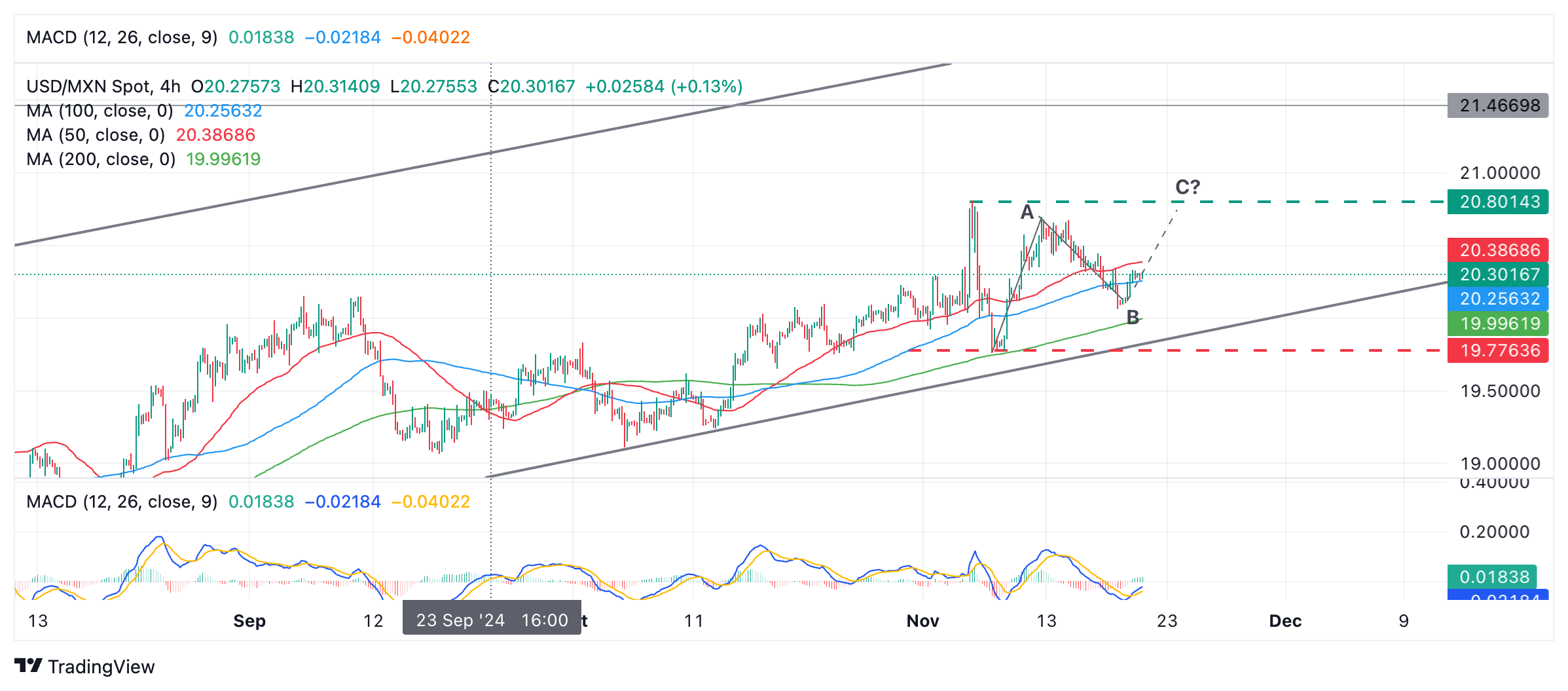
USD/MXN appears range bound in the short term as it oscillates between the 19.70s and 20.80s. The extension of wave C would correspond to an up leg unfolding within this sideways consolidation towards its ceiling (green dashed line).
The (blue) Moving Average Convergence Divergence (MACD) indicator has crossed above its red signal line, supporting evidence that the pair is unfolding higher. As yet, price action has not rallied sufficiently higher, however, to provide confirmation such a leg is unfolding.
Economic Indicator
Retail Sales (YoY)
The Retail Sales released by INEGI measures the total receipts of retail stores. Monthly percent changes reflect the rate of changes of such sales. Changes in retail sales are widely followed as an indicator of consumer spending. Generally speaking, a high reading is seen as positive or bullish for the Mexican peso, while a low reading is seen as negative or bearish.
Read more.Author
Joaquin Monfort
FXStreet
Joaquin Monfort is a financial writer and analyst with over 10 years experience writing about financial markets and alt data. He holds a degree in Anthropology from London University and a Diploma in Technical analysis.