Mexican Peso shrugs off GDP and inflation data
- The Mexican Peso shrugs off key economic data for Mexico and continues trading mixed due to idyosyncratic factors.
- The MXN faces headwinds from slowing growth, central bank dovishness and US politics.
- Technically, USD/MXN is unfolding an up leg within a range that is part of a larger Measured Move pattern.

The Mexican Peso (MXN) trades mixed in its most-traded pairs as the week draws to a close, with idiosyncratic factors impacting each one – the US Dollar (USD), Euro (EUR) and Pound Sterling (GBP) – differently. The release of Mexican Gross Domestic Product (GDP) data for Q3 and mid-month inflation readings for November, have barely moved the needle for the Peso despite diverging from their estimates.
Mexican GDP in Q3 rose by 1.6% YoY against 1.5% expected and the same previous. Quarterly GDP rose 1.1%, beating estimates of 1.0% and a previous reading of the same, according to data from INEGI.
Mid-month inflation data for November rose showed prices increasing by 0.37%, which was lower than the 0.49% forecast or the 0.43% previously.
Core mid-month inflation data showed prices increased 0.04%, which was lower than the 0.17% expected and the 0.23% of the previous period.
The Peso faces headwinds more generally. These include recent weak Retail Sales data – albeit for September sales increased 0.1% on month – and comments from Governor of the Bank of Mexico (Banxico) Victoria Rodríguez Ceja, who said she expects more cuts to interest rates (thereby reducing foreign capital inflows). In addition, policies from US President-elect Donald Trump also weigh, particularly the threat of tariffs and the possibility of a mass repatriation of Mexican immigrants whose remittances pump regular demand for MXN.
The Mexican Peso weakens against the US Dollar
The Mexican Peso has depreciated overall this week versus the US Dollar (USD) as higher US inflation expectations, the anticipation of the Trump government implementing Dollar-positive policies in January and a stronger US labor market, all conspire to underpin the USD.
Economists believe these factors taken together will lead to a shallower downward trajectory for US interest rates, which, in turn, is likely to keep the Greenback supported, since higher interest rates attract more foreign capital inflows.
Market gauges of the probability of the Federal Reserve (Fed) cutting interest rates by 25 basis points (bps) (0.25%) at their December meeting stand at 56%, with the chances of the Fed leaving rates unchanged at 44%, according to the CME FedWatch tool. This is slightly lower than the probability on Thursday. It probably reflects the more robust Initial Jobless Claims data released on the day, which showed a lower-than-expected 213,000 people claimed unemployment benefits in the US in the week ending November 15, compared to the 220,000 expected.
The USD is also gaining strength from safe-haven demand as geopolitical tensions ratchet up between Russia and NATO following the news that Russia might have used a long-range ballistic missile to bomb the Ukrainian city of Dnipro. The move may have been a counter-punch to Ukraine using UK Storm Shadow missiles to attack targets in Russia after the US gave Kyiv the green light to deploy its own ATACMS missiles on Russian territory.
The Mexican Peso strengthens versus Euro, matches GBP
The Mexican Peso is rising against a weaker Euro (EUR) on Friday after the release of Eurozone Purchasing Manager Index (PMI) data showed a contraction in the region's manufacturing and services sectors.
Eurozone preliminary HCOB Composite PMI in November fell to 48.1 from 50 in October and we below the 50 expected. The decline below the 50 level also marks a transition from expansion to contraction for the sector. Both Manufacturing and Services PMIs individually followed suit, with Services unexpectedly falling below 50 too.
The Single Currency is further depreciating after several European Central Bank (ECB) policymakers said that interest rates in Europe needed to be slashed more rapidly in order to counteract stalling economic growth.
Europe’s economic engine, Germany, has been flashing warning signs for some time – both economically and politically – and its latest Q3 GDP growth data missed expectations, showing the Eurozone’s largest economy grew by a meager 0.1%, less than previously estimated
The Mexican Peso versus the Pound Sterling (GBP) has traded range-bound since August on the back of expectations UK interest rates will remain relatively stable – and high at 4.75% – compared to most other major economies, thus supporting the Sterling.
This comes on the back of an improved outlook for UK economic growth. However, GBP is falling against the MXN today after the release of weak UK Retail Sales data, which widely undershot expectations and previous readings; and weaker-than-expected UK S&P Global/CIPS Composite, Manufacturing and Services PMI data as well.
Sheinbaum argues INAI reform was necessary
The Mexican Peso has been dogged by the controversial reform agenda of the new Morena-led government led by President Claudia Sheinbaum. Indeed, this was one of the factors stated by Moody’s Ratings as the reason for its recent downgrade of Mexico’s credit rating from Baa2 “Stable” to “Negative”. On Wednesday, the Mexican congress passed more contentious reforms, this time to scrap or replace five of Mexico’s independent regulatory bodies, according to El Financiero.
One of the most controversial bodies to be dissolved was The National Institute for Transparency, Access to Information, and Data Protection (INAI), which, according to Human Rights Watch “has the authority to require government agencies, political parties, labor unions, or other public bodies to comply with freedom of information requests from individuals or organizations.” INAI also gives Mexican citizens the right to safeguard their personal data.
In a press conference on Thursday, Claudia Sheinbaum was asked about the controversial move. “Those who defend INAI to the hilt forgot about the corruption,” she said.
According to Mexico News Daily, “The president proceeded to cite examples of corruption and nepotism within INAI that were uncovered by the Federal Auditor’s Office (ASF).”
Sheinbaum said high-ranking INAI managers asked for bribes of between 10%-60% of candidates’ salaries to get them jobs in the agency, and INAI was subject to widespread nepotism.
The role of the INAI would be taken over by the Ministry of Anti-Corruption and Good Governance, the President said.
“There will be more transparency … [and] there won’t be corruption. … Personal data will be protected,” Sheinbaum added.
Technical Analysis: USD/MXN extends wave “C” higher
USD/MXN appears to be unfolding a wave “C” higher (see chart below) as it completes a Measured Move pattern. These patterns are composed of three waves, in which the first and the third are of a similar length.
USD/MXN 4-hour Chart
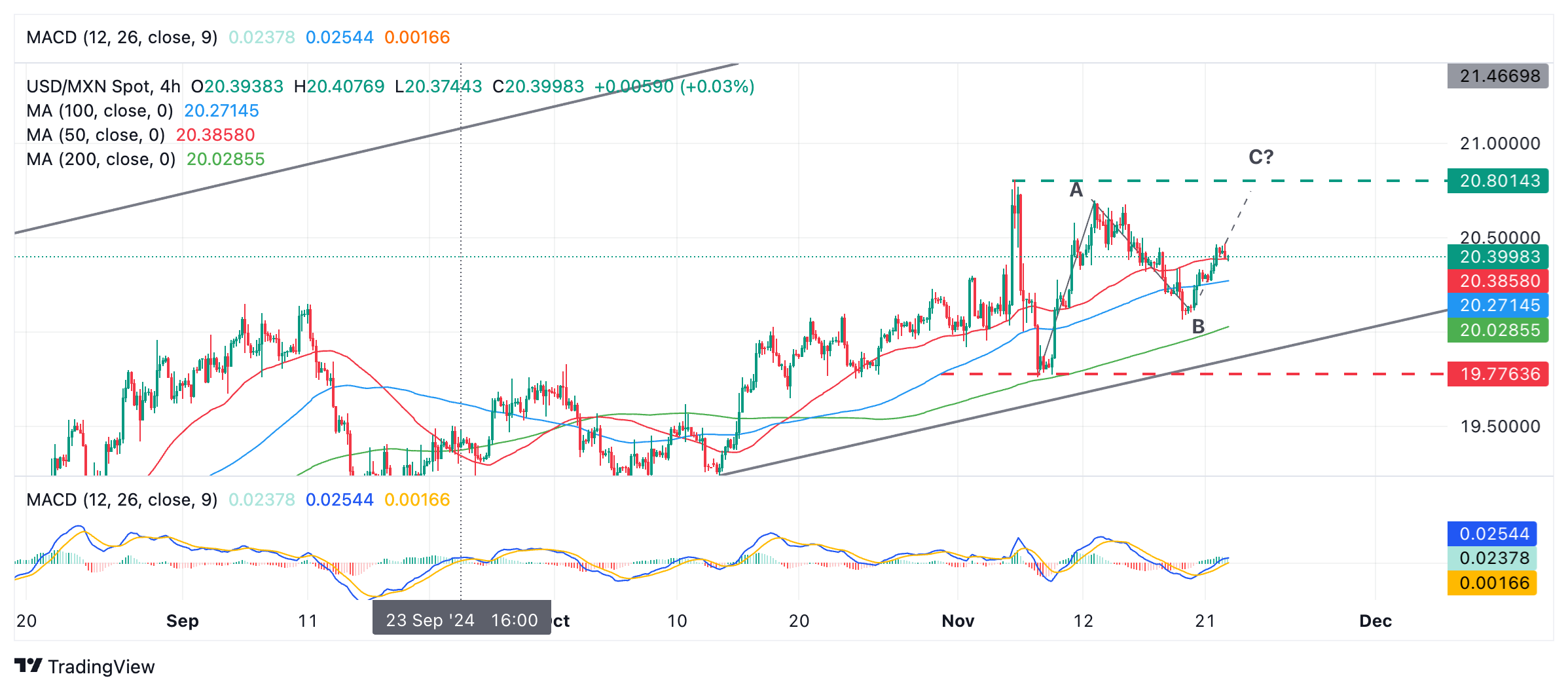
USD/MXN looks range bound in the short term as it oscillates between the 19.70s and 20.80s. The extension of wave C corresponds to an up leg unfolding within this sideways consolidation towards its ceiling (green dashed line).
The (blue) Moving Average Convergence Divergence (MACD) indicator crossed above its red signal line on Wednesday and is now also above the zero line, adding supporting evidence the pair could unfold higher.
A break above the 20.40 November 21 high would confirm wave C extending to at least the same level as the top of wave A at 20.69, possibly even to 20.80 and the range ceiling.
Economic Indicator
1st half-month Core Inflation
The 1st half-month core inflation index released by the Bank of Mexico is a measure of price movements by the comparison between the retail prices of a representative shopping basket of goods and services, excluding taxes and energy. The purchase power of Mexican Peso is dragged down by inflation. The inflation index is a key indicator since it is used by the central bank to set interest rates. Generally speaking, a high reading is seen as positive (or bullish) for the Mexican Peso, while a low reading is seen as negative (or Bearish).
Read more.Last release: Fri Nov 22, 2024 12:00
Frequency: Monthly
Actual: 0.04%
Consensus: 0.17%
Previous: 0.23%
Source: National Institute of Statistics and Geography of Mexico
Author

Joaquin Monfort
FXStreet
Joaquin Monfort is a financial writer and analyst with over 10 years experience writing about financial markets and alt data. He holds a degree in Anthropology from London University and a Diploma in Technical analysis.