Mexican Peso recovers part of election losses
- The Mexican Peso extends its recovery into a second day supported by broad risk appetite.
- The rebound started following market-soothing comments from the Mexican Finmin that the new government would act responsibly.
- USD/MXN approaches 17.34, a key support level. The short-term directional bias is unclear.

The Mexican Peso (MXN) is rising in its key pairs on Thursday as a positive risk tone prevails and helps support the sentiment-sensitive Peso. MXN continues clawing back losses after the 5% depreciation sparked by the Mexican election on Sunday.
EUR/MXN is trading at 19.08, just after the European Central Bank (ECB) decided at its June meeting to cut interest rates by 0.25%, bringing its main refinancing rate down to 4.25%.
USD/MXN is exchanging hands at 17.54, meanwhile, and GBP/MXN at 22.38.
Mexican Peso extends rebound on market optimism
The Mexican Peso rises on Thursday as a wave of risk-on breaks across markets. Wednesday’s US session saw the S&P 500 climb to a new record high of 5,354, the Nasdaq hit a new all-time high of 19,044 and the “magnificent seven” peak after posting 2.24% gains. The surge was driven by a mixture of renewed tech optimism and positive May Institute for Supply Management’s (ISM) Services Purchasing Managers Index (PMI) data for the US.
The positive market mood carried on into the Asian session, with gains for most indices bar the Shanghai Composite. The European bourses are opening on a positive note too, with all major indexes rising off the starting line.
The Mexican Peso’s recovery began late Tuesday after the Mexican Finance Minister Rogelio Ramírez De la O gave an interview in which he sought to calm investor fears about the new left-leaning Morena administration. The party swept to power during Sunday’s elections.
Although not all the votes have been counted – final results are expected on June 8 – estimates suggest Morena has won a supermajority (over two-thirds) in the lower, and possibly the upper, houses of the Mexican parliament. Morena’s new leader Dr. Claudia Sheinbaum has been confirmed as the next president of Mexico.
The Mexican Peso dropped over 5% following the news of Morena’s election victory as investors feared Sheinbaum’s supermajority could enact changes to the constitution that might be market-unfriendly.
On the data front, Mexican Auto Exports rose 13.0% year-over-year in May whilst Auto Production rose 4.9% for the same period; this was lower than April's 14.4% for exports and 21.7% for production.
On Wednesday, Mexican Consumer Confidence for May showed a decline to 46.7 – a seven-month low – from a downwardly revised 47.2 in April, on Wednesday, according to data from INEGI.
Technical Analysis: USD/MXN continues correcting down
USD/MXN continues pulling back after soaring to 18.12 (100-week Simple Moving Average) on Tuesday. It is now trading in the 17.40s, close to the first potential key support level at 17.34 – the midpoint of the long green Marubozu Japanese candlestick pattern formed on Monday’s upsurge.
USD/MXN Daily Chart
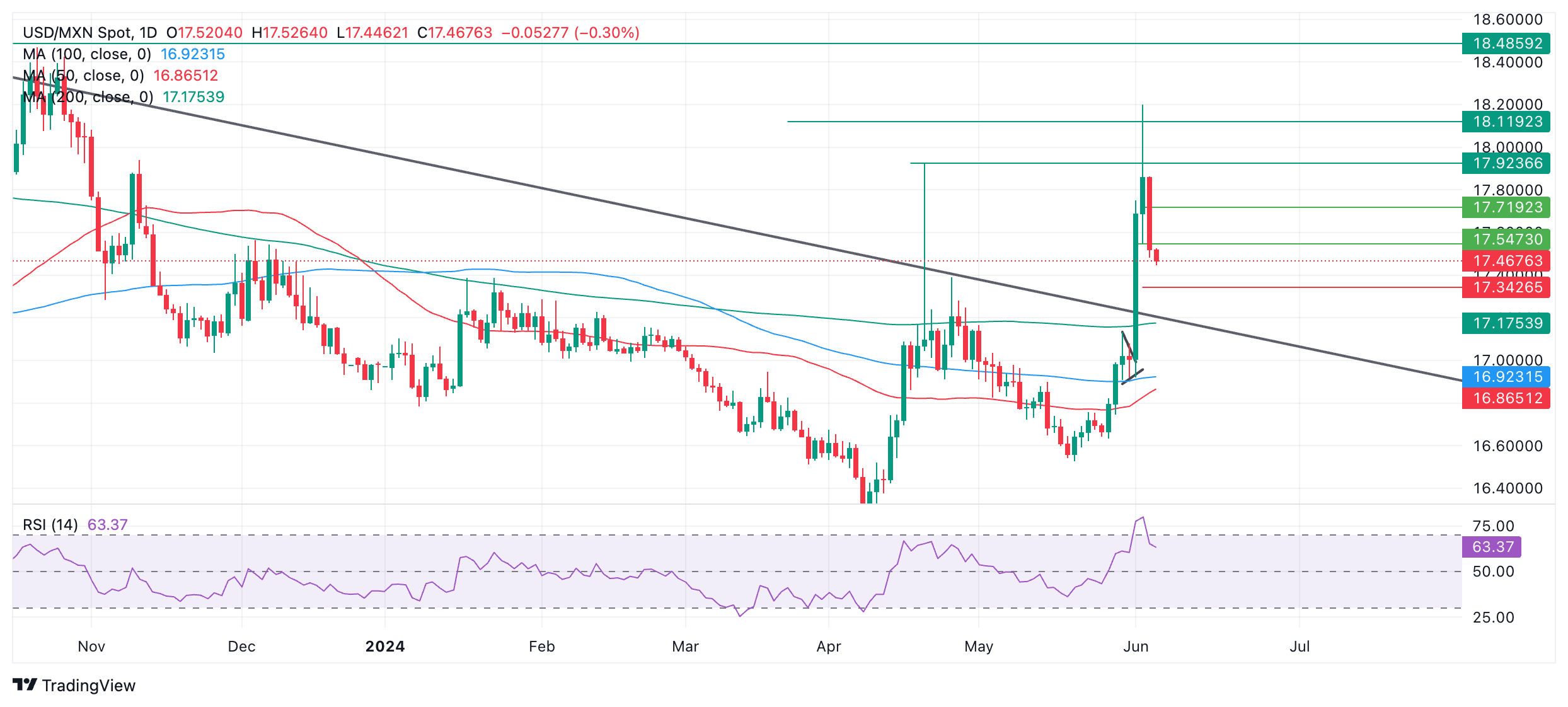
A break below 17.34 would be a bearish sign. The old trendline in the lower 17.00s would then come into view to offer support. If that too was broken, it would confirm a bearish reversal both on a short and intermediate-term basis.
USD/MXN has now moved out of the overbought zone on the Relative Strength Index (RSI), signaling a deeper correction is in play. At the same time, the pair is no longer overbought, which means it could also start rising again.
The deep pullback over the last two days means the short-term bull trend is now doubtful. It is possible to argue that the short-term trend has reversed, however, such was the strength of the moves up on Monday and Tuesday that it could also be argued that bulls continue to have the edge.
What is clear is that there are no signs yet that the correction lower has found a floor.
A key battleground for bulls would be at 17.54, the June 4 higher low, which is known as a “Bearish Breaker”. The future direction of the short-term trend could be decided depending on who prevails at 17.54 assuming bulls mount a recovery attempt.
Assuming bulls succeed, the pair could rise to 17.71, 18.19 (June 4 high) and then 18.49 (October 2023 high).
The intermediate-term trend is still bullish, but the long-term trend is probably still bearish, suggesting moderate background risks continue.
Economic Indicator
ECB Main Refinancing Operations Rate
One of the three key interest rates set by the European Central Bank (ECB), the main refinancing operations rate is the interest rate the ECB charges to banks for one-week long loans. It is announced by the European Central Bank at its eight scheduled annual meetings. If the ECB expects inflation to rise, it will increase its interest rates to bring it back down to its 2% target. This tends to be bullish for the Euro (EUR), since it attracts more foreign capital inflows. Likewise, if the ECB sees inflation falling it may cut the main refinancing operations rate to encourage banks to borrow and lend more, in the hope of driving economic growth. This tends to weaken the Euro as it reduces its attractiveness as a place for investors to park capital.
Read more.Last release: Thu Jun 06, 2024 12:15
Frequency: Irregular
Actual: 4.25%
Consensus: 4.25%
Previous: 4.5%
Source: European Central Bank
Author

Joaquin Monfort
FXStreet
Joaquin Monfort is a financial writer and analyst with over 10 years experience writing about financial markets and alt data. He holds a degree in Anthropology from London University and a Diploma in Technical analysis.