Mexican Peso strengthens amid hawkish Banxico and soft Retail Sales
- Mexican Peso rises 0.26% against US Dollar and dives below 16.60.
- Weak March Retail Sales data from INEGI ahead of Q1 GDP release and Banxico minutes.
- Banxico Deputy Governor Espinosa's hawkish stance contrasts with US Fed's cautious optimism on disinflation.

For the latest news on the Mexican Peso click here.
The Mexican Peso posted solid gains against the US Dollar in Monday trading during the North American session. Although Mexican Retail Sales data plunged, the Mexican currency edged up on Deputy Governor Irene Espinosa's hawkish comments last Friday. The USD/MXN trades at 16.56, down 0.26%.
Mexico’s economic docket should be busier than last week. On Monday, the Instituto Nacional de Estadística Geografía e Informática (INEGI) revealed that Retail Sales in March missed the mark in monthly and yearly figures.
The data comes ahead of the release of Gross Domestic Product (GDP) figures for the first quarter of 2024 on May 23. These figures are expected to show that the Mexican economy is slowing amid higher borrowing costs of 11.00% set by the Bank of Mexico (Banxico) on fears of higher inflation and a depreciation of the Peso.
Later that day, Banxico would release the minutes of its latest monetary policy meeting, followed on Friday by the announcement of the Balance of Trade and the Current Account.
Last Friday, Banxico’s Deputy Governor Irene Espinosa, the dissenter of the latest meeting, made hawkish comments stating that March’s rate cut was premature and that it would hinder inflation convergence to the bank’s goal.
Across the border, the Vice-Chair of the Federal Reserve, Philipp Jefferson, said that the policy rate is restrictive, adding that April’s reading is encouraging. However, it’s too early to tell if the disinflationary process will last.
Daily digest market movers: Mexican Peso soars on Espinosa’s hawkish stance
- Retail Sales in March plunged -0.2% MoM, below February’s 0.5% increase. On a yearly basis, sales plummeted -1.7%, missed estimates of 0%, and trailed the previous month's 3% growth.
- Diverging views surface in Banxico. Governor Victoria Rodriguez Ceja said last Monday that the bank would discuss lowering rates in the upcoming meeting on June 29. Conversely, Deputy Governor Espinosa commented that lowering rates in March might have delayed inflation convergence toward the central bank’s target by two quarters.
- According to Bloomberg, leveraged funds increased its net long Peso positions by 3,780 contracts between May 7 and May 14 via CFTC data. Institutional asset managers, which hold the biggest bullish position in the peso with 146,975 contracts, also added to positive momentum with 2,558 long peso contracts in the same week. That has propelled the Mexican Peso to be the best-performing currency in the world so far.
- Atlanta’ Fed President Raphael Bostic commented that interest rates are likely to remain higher than last decade, adding that Fed is open to all possibilities amid many economic scenarios.
- Data from the Chicago Board of Trade shows investors are expecting 33 basis points (bps) of the Fed’s easing toward the end of the year, down from Friday’s 35 bps.
Technical analysis: Mexican Peso extends its gains as USD/MXN falls below 16.60
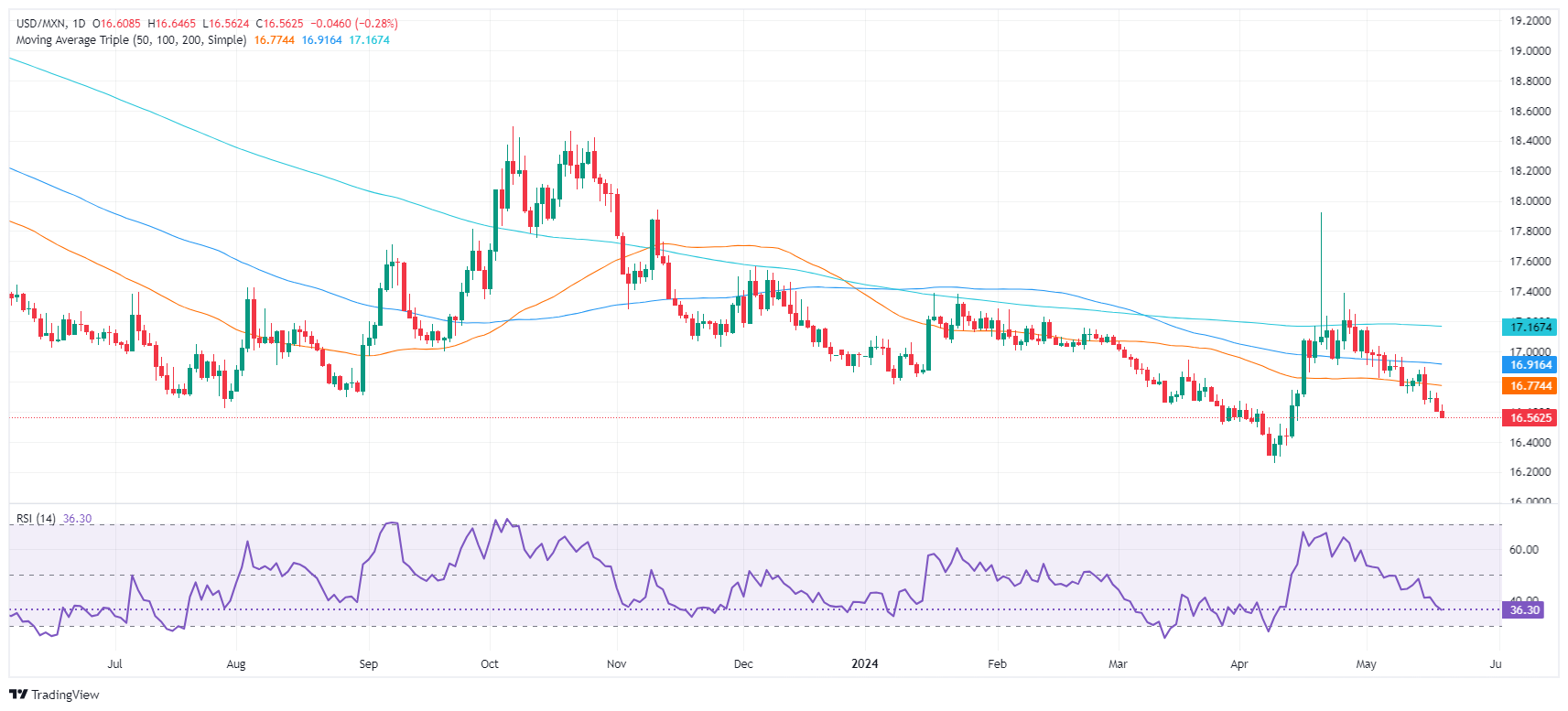
The Mexican Peso continues to rally sharply as the USD/MXN downtrend extends, likely to test the psychological 16.50 figure. Momentum, as depicted by the Relative Strength Index (RSI), favors sellers, yet they seem to take a breather as the downward move stalled.
Once the USD/MXN falls below 16.50, the next stop would be the current year-to-date low of 16.25.
Conversely, if buyers reclaim the 50-day SMA at 16.76, it could exacerbate a rally toward the 100-day SMA at 16.91. Once cleared, the next supply zone would be the 17.00 psychological level. In that event, the next stop would be the 200-day SMA at 17.17.
Mexican Peso FAQs
The Mexican Peso (MXN) is the most traded currency among its Latin American peers. Its value is broadly determined by the performance of the Mexican economy, the country’s central bank’s policy, the amount of foreign investment in the country and even the levels of remittances sent by Mexicans who live abroad, particularly in the United States. Geopolitical trends can also move MXN: for example, the process of nearshoring – or the decision by some firms to relocate manufacturing capacity and supply chains closer to their home countries – is also seen as a catalyst for the Mexican currency as the country is considered a key manufacturing hub in the American continent. Another catalyst for MXN is Oil prices as Mexico is a key exporter of the commodity.
The main objective of Mexico’s central bank, also known as Banxico, is to maintain inflation at low and stable levels (at or close to its target of 3%, the midpoint in a tolerance band of between 2% and 4%). To this end, the bank sets an appropriate level of interest rates. When inflation is too high, Banxico will attempt to tame it by raising interest rates, making it more expensive for households and businesses to borrow money, thus cooling demand and the overall economy. Higher interest rates are generally positive for the Mexican Peso (MXN) as they lead to higher yields, making the country a more attractive place for investors. On the contrary, lower interest rates tend to weaken MXN.
Macroeconomic data releases are key to assess the state of the economy and can have an impact on the Mexican Peso (MXN) valuation. A strong Mexican economy, based on high economic growth, low unemployment and high confidence is good for MXN. Not only does it attract more foreign investment but it may encourage the Bank of Mexico (Banxico) to increase interest rates, particularly if this strength comes together with elevated inflation. However, if economic data is weak, MXN is likely to depreciate.
As an emerging-market currency, the Mexican Peso (MXN) tends to strive during risk-on periods, or when investors perceive that broader market risks are low and thus are eager to engage with investments that carry a higher risk. Conversely, MXN tends to weaken at times of market turbulence or economic uncertainty as investors tend to sell higher-risk assets and flee to the more-stable safe havens.
Author
Christian Borjon Valencia
FXStreet
Markets analyst, news editor, and trading instructor with over 14 years of experience across FX, commodities, US equity indices, and global macro markets.