Mexican Peso trades mixed on the back of negative sentiment and data

Most recent article: Mexican Peso tumbles amid concerns of economic slowdown
- The Mexican Peso trades mixed in its key pairs after poor Mexican data and risk aversion.
- The wide interest-rate differential between Mexico and Western countries continues to favor the Peso in the carry trade.
- USD/MXN hits the conservative target for its range breakout.
The Mexican Peso (MXN) seesaws between marginal gains and losses in its key pairs on Tuesday after shrugging off poor Retail Sales data from Mexico and hawkish commentary from Federal Reserve (Fed) speakers on Monday, and continuing to drift higher.
The wide interest-rate differential between Mexico and most major economies – with relatively higher interest rates in Mexico (11.00%) providing an attractive draw for carry traders – is a key factor driving MXN’s uptrend, with little prospect of the gap closing anytime soon.
USD/MXN is trading at 16.55, EUR/MXN at 17.98 and GBP/MXN at 21.05, at the time of writing.
Mexican Peso shrugs off poor data
The Mexican Peso trades relatively flat on Tuesday despite recent data showing a fall in Mexican Retail Sales on both a monthly and yearly basis.
Whilst the data indicated the high interest rates imposed by the Bank of Mexico (Banxico) are probably having the desired effect of cooling the economy, Banxico has not signaled it is in a hurry to reduce interest rates yet.
Indeed on Friday, the Deputy Governor of Banxico, Irene Espinosa, said she thought interest rates should remain at their current level until inflation had been brought down on a sustainable basis.
Somber market mood caps Peso’s upside
The generally somber market mood on Tuesday is capping the Peso’s upside, however, as investors retreat from risk assets and commodities – MXN included – out of a fear high interest rates are here to stay. Asian stocks are down and Oil, metals and softs are following suit.
The change in sentiment comes as a result of commentary from central bankers, in both the US and Australia, that suggests they are not only reluctant to cut interest rates in the near future but are even discussing raising them.
In the US, Federal Reserve Bank of Cleveland President Loretta Mester said inflation risks were “tilted to the upside”, that the Fed could “even raise them (rates)” if inflation rose, and that it was “no longer appropriate” to expect the Fed to make three cuts this year.
The minutes of the RBA May meeting, released on Tuesday morning, showed that the board of governors discussed the possibility of raising interest rates. It was the first time in many months they had discussed further policy tightening.
Technical Analysis: USD/MXN hits first downside target
USD/MXN – or the number of Pesos that can be bought with one US Dollar – edges lower on Tuesday, continuing its overall bearish bias of recent weeks.
USD/MXN 4-hour Chart
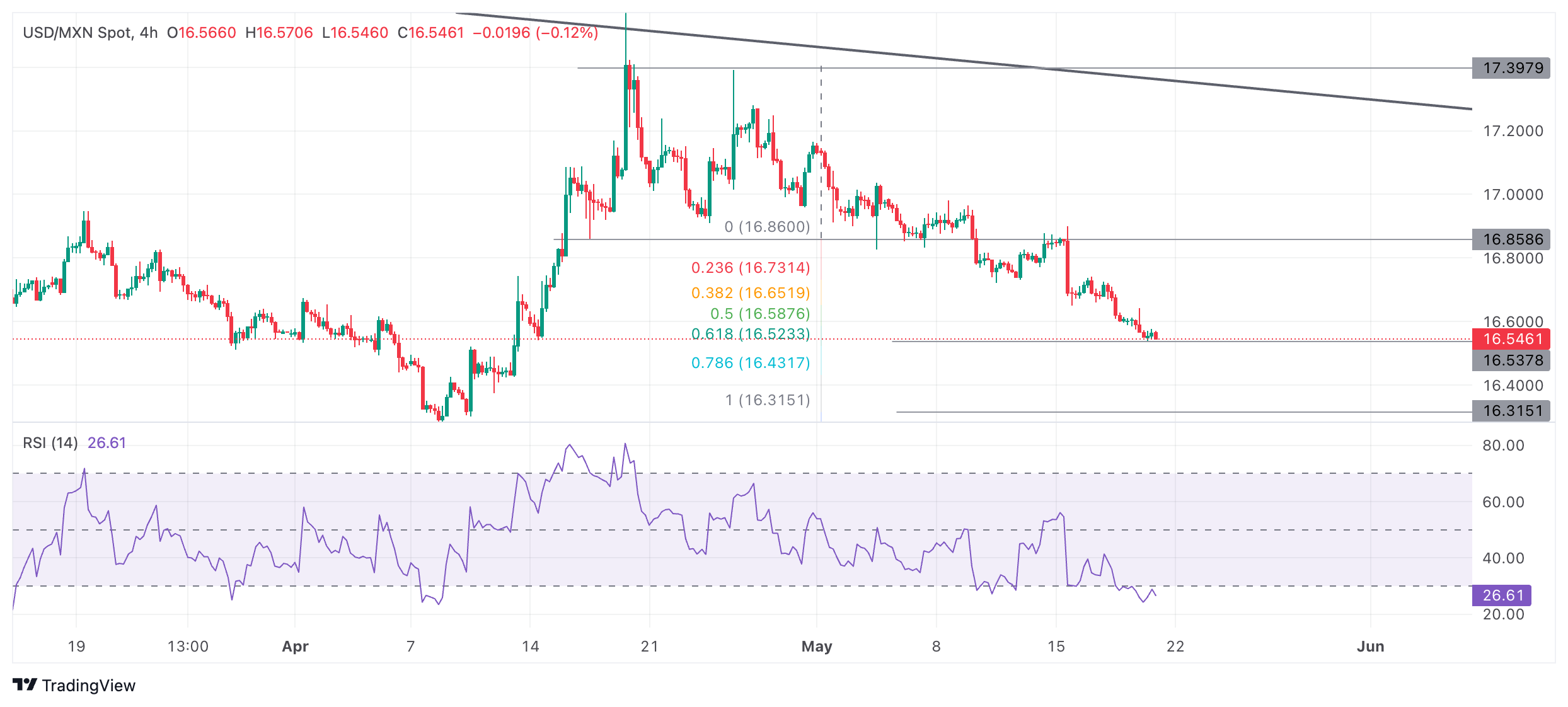
USD/MXN is falling in a short-term downtrend within a descending channel that favors short bets over longs.
The pair has now just reached its conservative price objective for the breakout of the mid-April to May range at 16.54. This is calculated as the 0.618 Fibonacci ratio of the range's height extrapolated lower.
Further bearishness could still see USD/MXN reach 16.34, the more bearish target, calculated by taking the full height of the range and extrapolating it lower.
The Relative Strength Index (RSI) momentum indicator is still oversold, which indicates traders should not add to their short positions. If the RSI exits oversold conditions and returns to neutral territory above 30, it would be a signal to close existing short positions as a correction is probably underway. Once the correction ends, however, the descending channel is expected to continue taking prices lower in line with the dominant downtrend.
Given the medium and long-term trends are also bearish, the odds further favor more downside.
Banxico FAQs
The Bank of Mexico, also known as Banxico, is the country’s central bank. Its mission is to preserve the value of Mexico’s currency, the Mexican Peso (MXN), and to set the monetary policy. To this end, its main objective is to maintain low and stable inflation within target levels – at or close to its target of 3%, the midpoint in a tolerance band of between 2% and 4%.
The main tool of the Banxico to guide monetary policy is by setting interest rates. When inflation is above target, the bank will attempt to tame it by raising rates, making it more expensive for households and businesses to borrow money and thus cooling the economy. Higher interest rates are generally positive for the Mexican Peso (MXN) as they lead to higher yields, making the country a more attractive place for investors. On the contrary, lower interest rates tend to weaken MXN. The rate differential with the USD, or how the Banxico is expected to set interest rates compared with the US Federal Reserve (Fed), is a key factor.
Banxico meets eight times a year, and its monetary policy is greatly influenced by decisions of the US Federal Reserve (Fed). Therefore, the central bank’s decision-making committee usually gathers a week after the Fed. In doing so, Banxico reacts and sometimes anticipates monetary policy measures set by the Federal Reserve. For example, after the Covid-19 pandemic, before the Fed raised rates, Banxico did it first in an attempt to diminish the chances of a substantial depreciation of the Mexican Peso (MXN) and to prevent capital outflows that could destabilize the country.
Author
Joaquin Monfort
FXStreet
Joaquin Monfort is a financial writer and analyst with over 10 years experience writing about financial markets and alt data. He holds a degree in Anthropology from London University and a Diploma in Technical analysis.