Japanese Yen retains negative bias; lacks bearish conviction amid BoJ rate hike bets
- The Japanese Yen attracts some sellers on Tuesday, though the downside seems limited.
- Rising bets for another BoJ rate hike in December should act as a tailwind for the JPY.
- Geopolitical risks, Trump’s tariff threats and suppressed US bond yields favor JPY bulls.

The Japanese Yen (JPY) remains depressed heading into the European session on Tuesday, which, along with a modest US Dollar (USD) strength, assists the USD/JPY pair to stick to its modest gains around the 150.00 psychological mark. The downside for the JPY, however, seems limited amid speculations that the Bank of Japan (BoJ) could hike interest rates again in December. Adding to this, concerns about US President-elect Donald Trump's tariff plans, persistent geopolitical risks and the recent decline in the US Treasury bond yields should act as a tailwind for the lower-yielding JPY.
The USD, on the other hand, seems to struggle to build on the overnight bounce from a nearly three-week low and might further contribute to capping the upside for the USD/JPY pair. Traders might also prefer to move to the sidelines and look for more cues about the Federal Reserve's (Fed) rate-cut path before placing fresh directional bets. Hence, the focus remains on key US macro data, including the Nonfarm Payrolls (NFP) report on Friday. Apart from this, Fed Chair Jerome Powell's speech will be looked upon for the interest rate outlook in the US and provide some meaningful impetus.
Japanese Yen bears seem non-committed on hawkish BoJ bets, trade war fears and geopolitical risks
- Tokyo November Consumer Price Index (CPI) released last week suggested that the underlying inflation is gaining momentum and lifted expectations for a December rate hike by the Bank of Japan.
- BoJ Governor Kazuo Ueda said on Saturday that the central bank will adjust the degree of monetary easing at the appropriate time if it becomes confident that the underlying inflation rises toward 2%.
- Russia fires at least 60 North Korean missiles against Ukraine. North Korean leader Kim Jong Un vowed that his country will invariably support Moscow until Russia achieves a great victory in Ukraine.
- US President-elect Donald Trump has pledged to impose big tariffs against America’s three biggest trading partners and 'BRICS' nations, raising the risk of a second wave of a global trade war.
- Trump reiterated on Monday that he is totally against Nippon Steel's planned $15 billion purchase of American firm US Steel and will block the deal from happening.
- Investors remain concerned that Trump's tariff plans and expansionary policies will reignite inflationary pressures and force the Federal Reserve to stop cutting rates or possibly raise them again.
- The Institute of Supply Management's (ISM) Manufacturing Purchasing Managers Index (PMI) rose to 48.4 in November amid hopes of business-friendly policies from the Trump administration.
- According to the CME Group's FedWatch Tool, traders are currently pricing in a nearly 75% chance that the US central bank will lower borrowing costs again by 25 basis points later this month.
- The benchmark 10-year US Treasury bond yield had fallen to its lowest levels since late October, narrowing the US-Japan yield differential, which should also benefit the lower-yielding Japanese Yen.
- Investors keenly await important US macro releases scheduled at the beginning of a new month for more cues about the Fed's future rate-cut path, which will influence the USD and the USD/JPY pair.
USD/JPY struggles to build on gains beyond the 150.00 psychological mark; upside potential seems limited
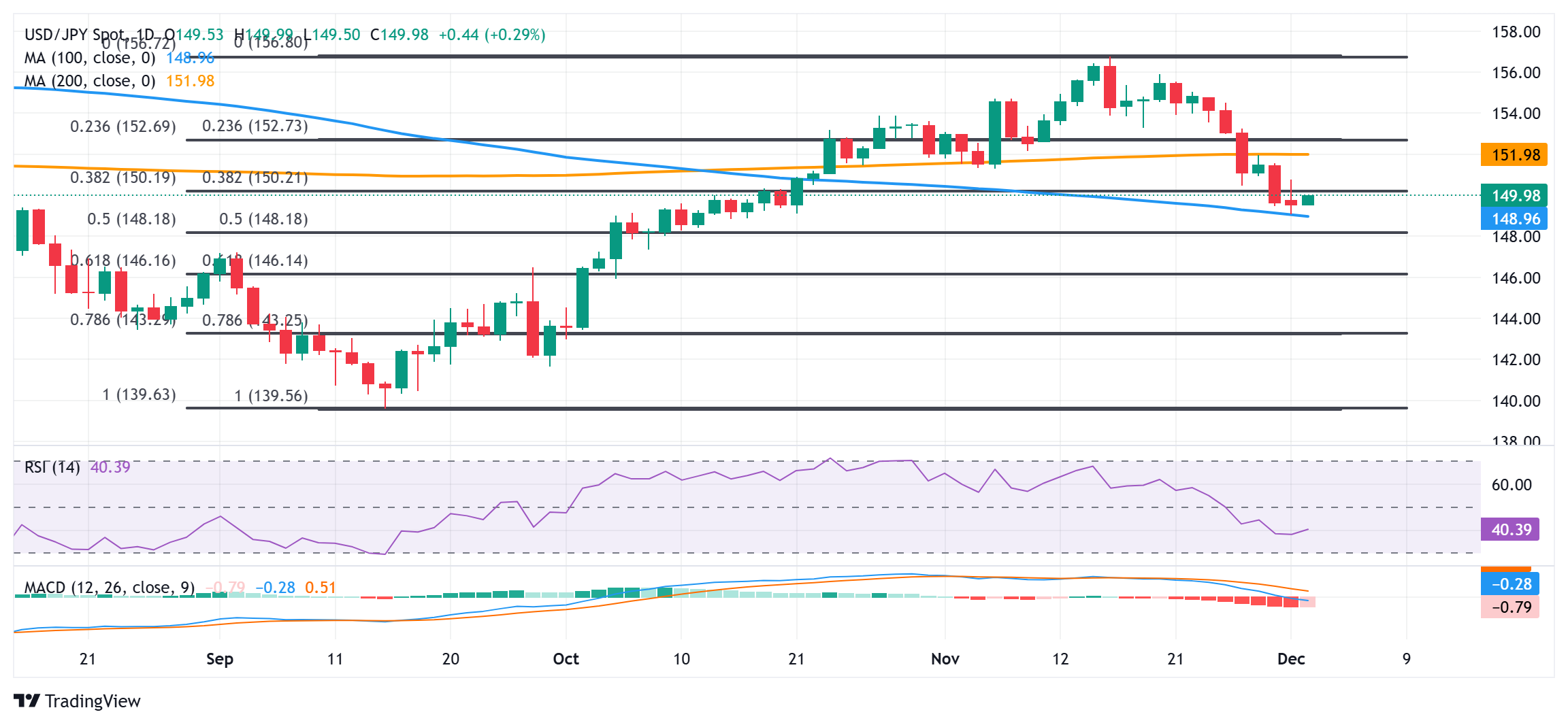
From a technical perspective, last week's breakdown below the 38.2% Fibonacci retracement level of the September-November rally could be seen as a fresh trigger for bearish traders. Moreover, oscillators on the daily chart are holding deep in negative territory and are still away from being in the oversold zone, suggesting that the path of least resistance for the USD/JPY pair remains to the downside. That said, a modest bounce from the 100-day Simple Moving Average (SMA) support, currently pegged near the 149.00 mark, warrants some caution before positioning for deeper losses. A convincing break below the said handle should pave the way for a slide towards the 50% retracement level, around the 148.20 region en route to the 148.00 mark. Some follow-through selling might expose the 61.8% Fibo. level, around the 147.00 round figure, with some intermediate support near the 147.35 area.
On the flip side, a further strength beyond the 150.00 psychological mark now seems to confront stiff resistance near the overnight swing high, around the 150.75 region, ahead of the 151.00 round figure. A sustained strength beyond the latter might trigger a short-covering rally and lift the USD/JPY pair to the 151.65 region en route to the 152.00 mark. The latter represents the very important 200-day Simple Moving Average (SMA) and should act as a key pivotal point, which if cleared decisively will suggest that the recent corrective pullback from a multi-month top has run its course. This, in turn, would shift the near-term bias back in favor of bullish traders.
Fed FAQs
Monetary policy in the US is shaped by the Federal Reserve (Fed). The Fed has two mandates: to achieve price stability and foster full employment. Its primary tool to achieve these goals is by adjusting interest rates. When prices are rising too quickly and inflation is above the Fed’s 2% target, it raises interest rates, increasing borrowing costs throughout the economy. This results in a stronger US Dollar (USD) as it makes the US a more attractive place for international investors to park their money. When inflation falls below 2% or the Unemployment Rate is too high, the Fed may lower interest rates to encourage borrowing, which weighs on the Greenback.
The Federal Reserve (Fed) holds eight policy meetings a year, where the Federal Open Market Committee (FOMC) assesses economic conditions and makes monetary policy decisions. The FOMC is attended by twelve Fed officials – the seven members of the Board of Governors, the president of the Federal Reserve Bank of New York, and four of the remaining eleven regional Reserve Bank presidents, who serve one-year terms on a rotating basis.
In extreme situations, the Federal Reserve may resort to a policy named Quantitative Easing (QE). QE is the process by which the Fed substantially increases the flow of credit in a stuck financial system. It is a non-standard policy measure used during crises or when inflation is extremely low. It was the Fed’s weapon of choice during the Great Financial Crisis in 2008. It involves the Fed printing more Dollars and using them to buy high grade bonds from financial institutions. QE usually weakens the US Dollar.
Quantitative tightening (QT) is the reverse process of QE, whereby the Federal Reserve stops buying bonds from financial institutions and does not reinvest the principal from the bonds it holds maturing, to purchase new bonds. It is usually positive for the value of the US Dollar.
Author

Haresh Menghani
FXStreet
Haresh Menghani is a detail-oriented professional with 10+ years of extensive experience in analysing the global financial markets.