Japanese Yen holds losses despite improved US Dollar, awaits ISM PMI
- The USD/JPY pair reaches a fresh 38-year high of 161.91.
- Japan’s 10-year government bond yield rose to a near 13-year high of 1.11%.
- The US Dollar edges higher due to a recovery in yield on a 2-year Treasury bond.

The Japanese Yen (JPY) loses ground against the US Dollar (USD) on Wednesday. The USD/JPY pair reaches a new high of 161.91, a level not seen since 1986. This upside could be attributed to final data indicating that Japan's business activity turned contractionary in June. Market participants focus on the possibility of foreign exchange (FX) intervention from the Bank of Japan (BoJ), which could support the JPY and limit the upside of the pair.
Japan’s 10-year government bond yield increased to a near 13-year high of 1.11%. Traders continue to evaluate the Bank of Japan's monetary policy outlook amid a sharply depreciating Japanese Yen, which drives up import costs and contributes to inflationary pressures. Reuters, citing two government sources, reported that the Japan Ministry of Finance may introduce a new type of floating-rate bond to help investors mitigate the risks from rising bond yields. This move comes as Japanese officials prepare for more rate hikes by the Bank of Japan.
The US Dollar (USD) extends its losing streak possibly due to the dovish comments from the Federal Reserve's (Fed) officials. The Greenback could limit its downside as US Treasury yields improve with 2-year and 10-year Treasury bonds standing at 4.75% and 4.43%, respectively, at the time of writing. Traders await the release of the US ADP Employment Change, ISM Services PMI for June, and the FOMC Minutes scheduled for Wednesday.
Daily Digest Market Movers: Japanese Yen declines due to softer Services PMI
- The Jibun Bank Japan Services PMI was revised downward to 49.4 in June from May’s 49.8 reading. This marks a reversal from May's 53.8 and represents the first decline in services activity since August 2022.
- The Federal Reserve (Fed) Chair Jerome Powell turned slightly dovish on Tuesday. Powell said that the Fed is getting back on the disinflationary path. However, Powell wants to see further evidence before cutting interest rates as the US economy and the labor market remain strong, per Reuters.
- Chicago Federal Reserve Bank President Austan Goolsbee cautioned on Tuesday during an interview with CNBC, stating, "I see some warning signs that the real economy is weakening." Goolsbee further mentioned that progress toward the Fed's 2% inflation target could accelerate more swiftly than anticipated.
- Philip Wee, Senior FX strategist at DBS, remarked on Tuesday, "The better-than-expected Tankan Survey in June should maintain optimism for a potential second interest rate hike and offer further insights into the plan to scale back JGB purchases at the upcoming Bank of Japan meeting on July 30-31." Japan's Tankan Large Manufacturing Index rose to 13 in the second quarter, up from the previous reading of 11, marking its highest level in two years amidst an improving economic outlook.
- According to the latest Reuters survey conducted from June 25 to July 1, the Bank of Japan is expected to reduce its monthly bond purchases by roughly $100 billion (¥16.00 trillion) in the first year under a quantitative tightening (QT) plan set for release this month. This adjustment would bring the monthly purchases to approximately ¥4.65 trillion, down from the current pace of about ¥6.00 trillion. In the second year, survey respondents anticipate further reductions, with monthly purchases averaging around ¥3.55 trillion.
- Japanese Finance Minister Shunichi Suzuki stated on Tuesday that he is "closely watching FX moves with vigilance." Suzuki refrained from commenting on specific forex levels, noting that there is no change in the government's stance on foreign exchange, according to Reuters.
- On Monday, OCBC strategists Frances Cheung and Christopher Wong noted that “USD/JPY continued to trade near recent highs. This is also near the highest level since 1986. There are expectations that Japanese authorities could soon intervene. While the level of JPY is one factor to consider, officials also focus on the pace of depreciation as the intent of intervention is to curb excessive volatility.”
Technical Analysis: USD/JPY holds ground above 161.50
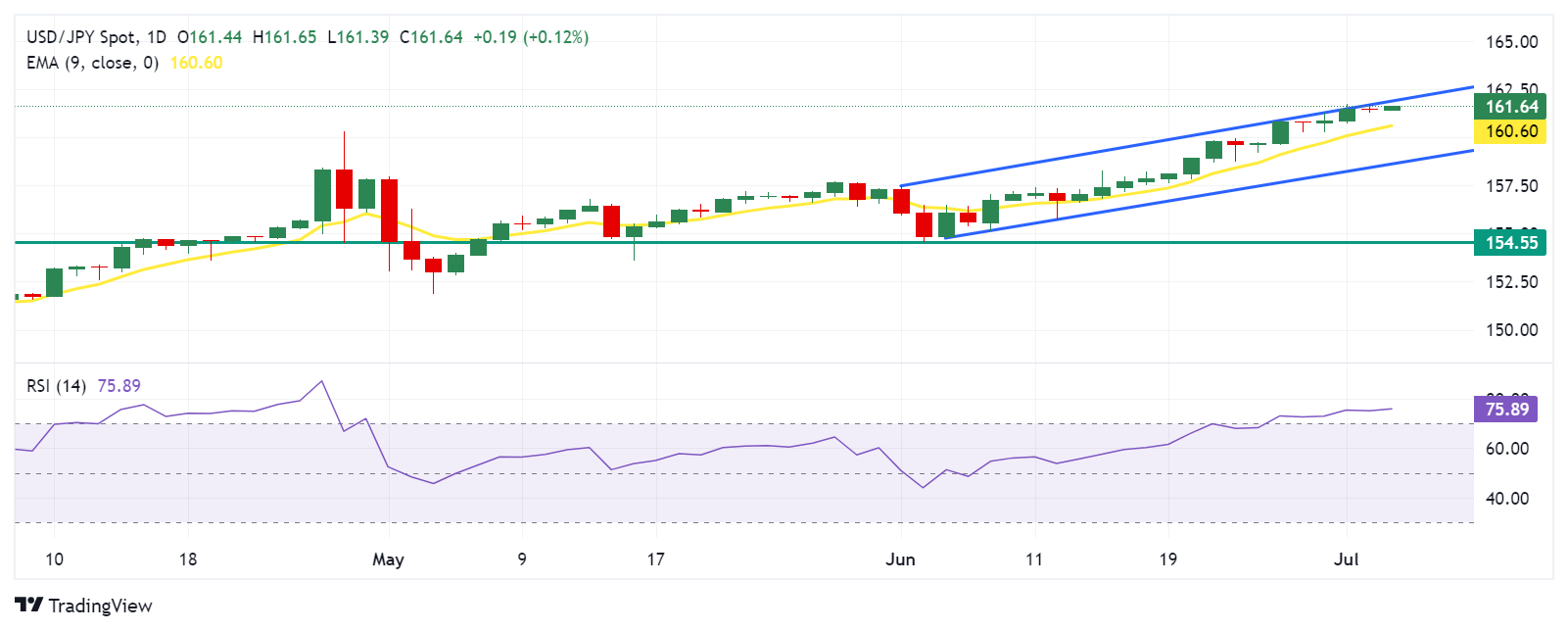
USD/JPY trades around 161.60 on Wednesday. The daily chart analysis indicates a bullish bias, with the pair holding ground near the upper boundary of an ascending channel pattern. However, caution is advised as the 14-day Relative Strength Index (RSI) is above 70, signaling overbought conditions and suggesting a possible correction in the near term.
The USD/JPY pair might test the upper boundary of the ascending channel near 161.80. A breakout above this level could strengthen bullish sentiment, potentially pushing the pair toward the psychological resistance at 162.00.
On the downside, immediate support is seen around the nine-day Exponential Moving Average (EMA) at 160.60. A breach below this level could weaken the bullish bias, potentially guiding USD/JPY toward the lower boundary of the ascending channel near 158.60. Further decline below this channel support could lead to a test of June's low at 154.55.
USD/JPY: Daily Chart
Japanese Yen PRICE Today
The table below shows the percentage change of Japanese Yen (JPY) against listed major currencies today. Japanese Yen was the weakest against the Australian Dollar.
| USD | EUR | GBP | JPY | CAD | AUD | NZD | CHF | |
|---|---|---|---|---|---|---|---|---|
| USD | -0.17% | -0.13% | 0.23% | -0.04% | -0.20% | -0.07% | -0.01% | |
| EUR | 0.17% | 0.06% | 0.37% | 0.11% | -0.04% | 0.10% | 0.15% | |
| GBP | 0.13% | -0.06% | 0.33% | 0.05% | -0.08% | 0.05% | 0.08% | |
| JPY | -0.23% | -0.37% | -0.33% | -0.27% | -0.40% | -0.24% | -0.24% | |
| CAD | 0.04% | -0.11% | -0.05% | 0.27% | -0.16% | -0.02% | 0.03% | |
| AUD | 0.20% | 0.04% | 0.08% | 0.40% | 0.16% | 0.13% | 0.18% | |
| NZD | 0.07% | -0.10% | -0.05% | 0.24% | 0.02% | -0.13% | 0.04% | |
| CHF | 0.00% | -0.15% | -0.08% | 0.24% | -0.03% | -0.18% | -0.04% |
The heat map shows percentage changes of major currencies against each other. The base currency is picked from the left column, while the quote currency is picked from the top row. For example, if you pick the Japanese Yen from the left column and move along the horizontal line to the US Dollar, the percentage change displayed in the box will represent JPY (base)/USD (quote).
Economic Indicator
Jibun Bank Services PMI
The Services Purchasing Managers Index (PMI), released on a monthly basis by Jibun Bank and S&P Global, is a leading indicator gauging business activity in Japan’s services sector. As the services sector dominates a large part of total GDP, the services PMI is an important indicator of the overall economic conditions in Japan. The data is derived from surveys of senior executives at private-sector companies from the services sector. Survey responses reflect the change, if any, in the current month compared to the previous month and can anticipate changing trends in official data series such as Gross Domestic Product (GDP), employment and inflation. A reading above 50 indicates that the services economy is generally expanding, a bullish sign for the Japanese Yen (JPY). Meanwhile, a reading below 50 signals that activity among service providers is generally declining, which is seen as bearish for JPY.
Read more.Last release: Wed Jul 03, 2024 00:30
Frequency: Monthly
Actual: 49.4
Consensus: 49.8
Previous: 49.8
Source: S&P Global
Author

Akhtar Faruqui
FXStreet
Akhtar Faruqui is a Forex Analyst based in New Delhi, India. With a keen eye for market trends and a passion for dissecting complex financial dynamics, he is dedicated to delivering accurate and insightful Forex news and analysis.