Japanese Yen trims a part of modest intraday gains; USD/JPY climbs back above 158.00
- The Japanese Yen strengthens in reaction to strong wage growth data from Japan.
- The uncertainty over the likely timing of the next BoJ rate hike might cap the JPY.
- Hawkish Fed, and elevated US bond yields should support the USD/JPY pair.

The Japanese Yen (JPY) attracts some intraday sellers and lifts the USD/JPY pair back above the 158.00 mark heading into the European session on Thursday. Despite strong wage growth data from Japan, skepticism about the likely timing of when the Bank of Japan (BoJ) will hike interest rates again turns out to be a key factor acting as a headwind for the JPY. Furthermore, the recent widening of the US-Japan yield differential, bolstered by the Federal Reserve's (Fed) hawkish signal, also contributes to capping the lower-yielding JPY.
However, speculations that Japanese authorities might intervene in the market to prop up the domestic currency might hold back the JPY bears from placing aggressive bets. Adding to this, the cautious market mood, geopolitical risks and concerns about US President-elect Donald Trump's protectionist policies should limit losses for the safe-haven JPY. Meanwhile, the flight to safety triggers a modest pullback in the US bond yields, which keeps the US Dollar (USD) bulls on the defensive and might keep a lid on the USD/JPY pair.
Japanese Yen bulls seem reluctant to place aggresive bets despite strong wage growth data from Japan
- Government data released this Thursday showed that base salary, or regular pay, in Japan rose 2.7% in November, marking the fastest increase since 1992, while overtime pay grew 1.6% from a revised 0.7% gain in October.
- Meanwhile, inflation-adjusted real wages fell for the fourth consecutive month, by 0.3% in November. The inflation rate the ministry uses for wage calculation accelerated from 2.6% in October to 3.4% from a year earlier.
- The Bank of Japan has repeatedly said sustained, broad-based wage hikes are a prerequisite for pushing up borrowing costs and the data support prospects for a further rate hike, providing a modest lift to the Japanese Yen.
- In its quarterly regional economic report, the BoJ maintains the assessment for seven of Japan's nine regions and raises assessment for two, and noted that firms are considering specific pace of wage hikes in some regions.
- Investors, however, seem convinced that the BoJ will not pull the trigger at its next monetary policy meeting in January and wait until March amid the uncertainty over US President-elect Donald Trump's protectionist policies.
- CNN reported on Wednesday, citing unnamed sources familiar with the matter, that Trump is considering declaring a national economic emergency to provide legal justification for a series of universal tariffs on allies and adversaries.
- The yield on the benchmark 10-year US government bond shot to its highest level since April 25 in reaction to the news, which, to a larger extent, overshadowed mixed labor market data released from the US on Wednesday.
- The Automatic Data Processing (ADP) reported that US private sector employment rose by 122,000 in December as compared to the 146,000 increase recorded in November and below the market expectation of 140,000.
- Separately, the US Department of Labor reported that the number of Americans filing new applications for unemployment benefits fell to an 11-month low of 201K in the week ending January 4, pointing to a stable labor market.
- Furthermore, the Minutes of the December 17-18 FOMC meeting revealed that policymakers were in favor of slowing the pace of rate cuts amid concerns about slower progress on curbing the pace of inflation toward the 2% target.
- Fed Governor Christopher Waller said that inflation should continue to fall and make further progress towards the 2% target, which should allow the US central bank to further reduce interest rates, though at an uncertain pace.
- Investors will continue to take cues from speeches by a slew of influential FOMC members later this Thursday, though the focus will remain glued to the closely-watched US Nonfarm Payrolls (NFP) report on Friday.
USD/JPY bulls have the upper hand; might aim to reclaim 159.00 and prolong the recent move up
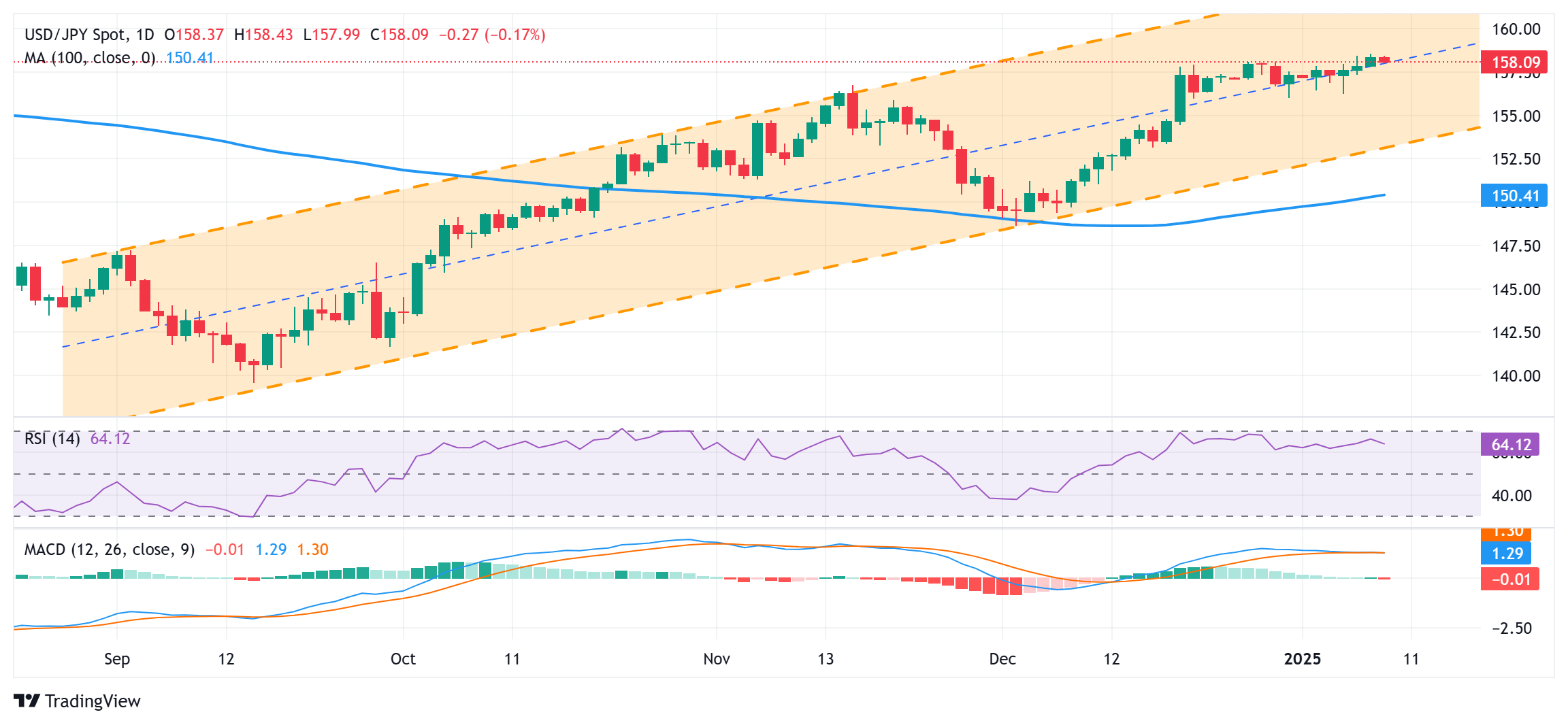
From a technical perspective, any subsequent slide is likely to attract some dip-buying near the 157.55-157.50 horizontal zone. Some follow-through selling, however, could make the USD/JPY pair vulnerable to accelerate the fall further towards the 157.00 mark en route to the next relevant support near the 156.75 region and the weekly low, around the 156.25-156.20 area. This is followed by the 156.00 mark, which if broken decisively might shift the bias in favor of bearish traders.
On the flip side, the 158.55 region, or the multi-month top touched on Wednesday, now seems to act as an immediate hurdle. A sustained strength beyond could lift the USD/JPY pair to the 159.00 mark. The momentum could extend further towards the 159.45 intermediate hurdle before spot prices aim to reclaim the 160.00 psychological mark.
US Dollar FAQs
The US Dollar (USD) is the official currency of the United States of America, and the ‘de facto’ currency of a significant number of other countries where it is found in circulation alongside local notes. It is the most heavily traded currency in the world, accounting for over 88% of all global foreign exchange turnover, or an average of $6.6 trillion in transactions per day, according to data from 2022. Following the second world war, the USD took over from the British Pound as the world’s reserve currency. For most of its history, the US Dollar was backed by Gold, until the Bretton Woods Agreement in 1971 when the Gold Standard went away.
The most important single factor impacting on the value of the US Dollar is monetary policy, which is shaped by the Federal Reserve (Fed). The Fed has two mandates: to achieve price stability (control inflation) and foster full employment. Its primary tool to achieve these two goals is by adjusting interest rates. When prices are rising too quickly and inflation is above the Fed’s 2% target, the Fed will raise rates, which helps the USD value. When inflation falls below 2% or the Unemployment Rate is too high, the Fed may lower interest rates, which weighs on the Greenback.
In extreme situations, the Federal Reserve can also print more Dollars and enact quantitative easing (QE). QE is the process by which the Fed substantially increases the flow of credit in a stuck financial system. It is a non-standard policy measure used when credit has dried up because banks will not lend to each other (out of the fear of counterparty default). It is a last resort when simply lowering interest rates is unlikely to achieve the necessary result. It was the Fed’s weapon of choice to combat the credit crunch that occurred during the Great Financial Crisis in 2008. It involves the Fed printing more Dollars and using them to buy US government bonds predominantly from financial institutions. QE usually leads to a weaker US Dollar.
Quantitative tightening (QT) is the reverse process whereby the Federal Reserve stops buying bonds from financial institutions and does not reinvest the principal from the bonds it holds maturing in new purchases. It is usually positive for the US Dollar.
Author

Haresh Menghani
FXStreet
Haresh Menghani is a detail-oriented professional with 10+ years of extensive experience in analysing the global financial markets.

















