Japanese Yen holds gains as US Dollar edges lower ahead of key economic data
- The Japanese Yen appreciated as Labor Cash Earnings grew by 3.6% YoY in July.
- BoJ Board Member Hajime Takata stated that the domestic economy is recovering moderately although some weak signs were seen.
- The upside in US Treasury yields provides support for the US Dollar.


The Japanese Yen (JPY) holds ground against the US Dollar (USD), buoyed by a second straight month of rising real wages in Japan. In July, Japan’s Labor Cash Earnings grew by 3.6% year-on-year, a deceleration from June's 4.5% increase but the highest since January 1997, surpassing market expectations of 3.1%. This strong performance reinforces speculation that the Bank of Japan (BoJ) may implement another interest rate hike before the end of 2024.
Bank of Japan (BoJ) Board Member Hajime Takata made some comments on the bank’s policy outlook and economic prospects during his speech on Thursday. Japan's economy is recovering moderately although some weak signs were seen. Stock and FX markets have seen big volatility but we still see achievement of our inflation target in sight.
The US Dollar recovers its recent losses, driven by improved US Treasury yields. However, the Greenback faced challenges after July's US JOLTS Job Openings came in below expectations, signaling a further slowdown in the labor market. Traders now await US ISM Services PMI and Initial Jobless Claims scheduled to be released on Thursday.
Daily Digest Market Movers: Japanese Yen remains solid as real wages increased in July
- San Francisco Federal Reserve President Mary Daly stated on Wednesday that "the Fed needs to cut the policy rate as inflation is declining and the economy is slowing." Regarding the size of the potential rate cut in September, Daly noted, "We don't know yet." FXStreet’s FedTracker, which gauges the tone of Fed officials’ speeches on a dovish-to-hawkish scale from 0 to 10 using a custom AI model, rated Daly’s words as neutral with a score of 3.6.
- Atlanta Federal Reserve President Raphael Bostic said that the Fed is in a favorable position but added that they must not maintain a restrictive policy stance for too long, per Reuters. FXStreet’s FedTracker, which gauges the tone of Fed officials’ speeches on a dovish-to-hawkish scale from 0 to 10 using a custom AI model, rated Bostic’s words as neutral with a score of 4.6.
- Japan’s Chief Cabinet Secretary Yoshimasa Hayashi stated on Wednesday that he is "closely monitoring domestic and international market developments with a sense of urgency." Hayashi emphasized the importance of conducting fiscal and economic policy management in close coordination with the Bank of Japan (BoJ).
- US JOLTS Job Openings dropped to 7.673 million in July, down from 7.910 million in June, marking the lowest level since January 2021 and falling short of market expectations of 8.10 million.
- Jibun Bank Services PMI data on Wednesday. The index was revised to 53.7 in August from an initial estimate of 54.0. Although this marks the seventh consecutive month of expansion in the service sector, the latest figure remains unchanged from July.
- The US ISM Manufacturing PMI inched up to 47.2 in August from 46.8 in July, falling short of market expectations of 47.5. This marks the 21st contraction in US factory activity over the past 22 months.
- On Tuesday, Japan announced plans to allocate ¥989 billion to fund energy subsidies in response to rising energy costs and the resulting cost-of-living pressures.
- The US Bureau of Economic Analysis reported on Friday that the headline Personal Consumption Expenditures (PCE) Price Index increased by 2.5% year-over-year in July, matching the previous reading of 2.5% but falling short of the estimated 2.6%. Meanwhile, the core PCE, which excludes volatile food and energy prices, rose by 2.6% year-over-year in July, consistent with the prior figure of 2.6% but slightly below the consensus forecast of 2.7%.
Technical Analysis: USD/JPY remains below 144.00, support appears around seven-month lows
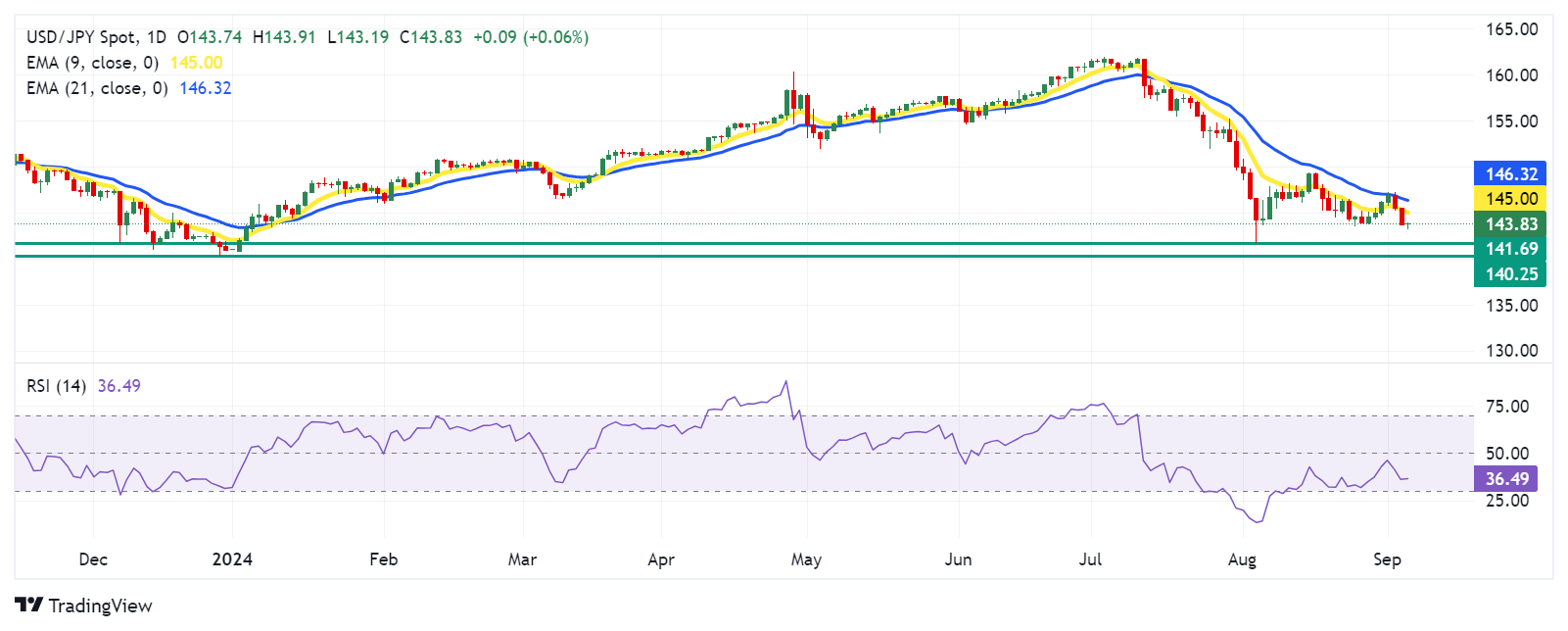
USD/JPY trades around 143.80 on Thursday. An analysis of the daily chart shows that the nine-day Exponential Moving Average (EMA) remains below the 21-day EMA, signaling a sustained bearish trend in the market. Furthermore, the 14-day Relative Strength Index (RSI) is hovering near the 30 level, confirming the ongoing bearish momentum but also suggesting a potential upward correction in the near term.
On the downside, support could be found near the seven-month low of 141.69, recorded on August 5. Additional key support appears at 140.25, which is the lowest level since July 2023.
In terms of resistance, the pair might first encounter a barrier at the nine-day EMA around 145.00, followed by the 21-day EMA at 146.32. A break above these EMAs might diminish the bearish sentiment and help the pair move toward the psychological level of 150.00.
USD/JPY: Daily Chart
Japanese Yen PRICE Today
The table below shows the percentage change of Japanese Yen (JPY) against listed major currencies today. Japanese Yen was the strongest against the Canadian Dollar.
| USD | EUR | GBP | JPY | CAD | AUD | NZD | CHF | |
|---|---|---|---|---|---|---|---|---|
| USD | -0.09% | -0.05% | -0.01% | 0.03% | 0.03% | 0.02% | 0.01% | |
| EUR | 0.09% | 0.04% | 0.10% | 0.15% | 0.12% | 0.15% | 0.10% | |
| GBP | 0.05% | -0.04% | 0.04% | 0.11% | 0.08% | 0.11% | 0.05% | |
| JPY | 0.01% | -0.10% | -0.04% | 0.04% | 0.03% | 0.02% | 0.02% | |
| CAD | -0.03% | -0.15% | -0.11% | -0.04% | 0.00% | 0.00% | -0.03% | |
| AUD | -0.03% | -0.12% | -0.08% | -0.03% | -0.00% | 0.01% | -0.01% | |
| NZD | -0.02% | -0.15% | -0.11% | -0.02% | -0.00% | -0.01% | -0.03% | |
| CHF | -0.01% | -0.10% | -0.05% | -0.02% | 0.03% | 0.01% | 0.03% |
The heat map shows percentage changes of major currencies against each other. The base currency is picked from the left column, while the quote currency is picked from the top row. For example, if you pick the Japanese Yen from the left column and move along the horizontal line to the US Dollar, the percentage change displayed in the box will represent JPY (base)/USD (quote).
Interest rates FAQs
Interest rates are charged by financial institutions on loans to borrowers and are paid as interest to savers and depositors. They are influenced by base lending rates, which are set by central banks in response to changes in the economy. Central banks normally have a mandate to ensure price stability, which in most cases means targeting a core inflation rate of around 2%. If inflation falls below target the central bank may cut base lending rates, with a view to stimulating lending and boosting the economy. If inflation rises substantially above 2% it normally results in the central bank raising base lending rates in an attempt to lower inflation.
Higher interest rates generally help strengthen a country’s currency as they make it a more attractive place for global investors to park their money.
Higher interest rates overall weigh on the price of Gold because they increase the opportunity cost of holding Gold instead of investing in an interest-bearing asset or placing cash in the bank. If interest rates are high that usually pushes up the price of the US Dollar (USD), and since Gold is priced in Dollars, this has the effect of lowering the price of Gold.
The Fed funds rate is the overnight rate at which US banks lend to each other. It is the oft-quoted headline rate set by the Federal Reserve at its FOMC meetings. It is set as a range, for example 4.75%-5.00%, though the upper limit (in that case 5.00%) is the quoted figure. Market expectations for future Fed funds rate are tracked by the CME FedWatch tool, which shapes how many financial markets behave in anticipation of future Federal Reserve monetary policy decisions.
Author
Akhtar Faruqui
FXStreet
Akhtar Faruqui is a Forex Analyst based in New Delhi, India. With a keen eye for market trends and a passion for dissecting complex financial dynamics, he is dedicated to delivering accurate and insightful Forex news and analysis.