Japanese Yen depreciates amid suspected intervention by authorities
- The Japanese Yen could limit its downside as traders remain alert to potential intervention by authorities.
- BoJ data showed that authorities might have spent between ¥3.37 trillion and ¥3.57 trillion on Thursday to support the JPY.
- Fed Chair Jerome Powell mentioned that inflation is on course to meet the Fed’s target sustainably.

The Japanese Yen (JPY) extends its losses on Tuesday with traders remaining on alert after the currency surged about 2% last week on a suspected intervention by Japanese authorities. According to data released by the Bank of Japan (BoJ) on Friday, it's estimated that Japanese authorities may have spent between ¥3.37 trillion to ¥3.57 trillion on Thursday to stem the rapid depreciation of the JPY, as reported by Reuters.
The US Dollar (USD) strengthens amid rising risk aversion triggered by the attempted assassination of former US President Donald Trump on Saturday. However, cooling US inflation strengthened bets for a Federal Reserve rate cut in September, which may limit the upside of the Greenback. Investors will likely observe the US June Retail Sales data, which are set to be released on Tuesday, for further insights.
According to CME Group’s FedWatch Tool, markets now indicate an 85.7% probability of a 25-basis point rate cut at the September Fed meeting, up from 71.0% a week earlier.
Daily Digest Market Movers: Japanese Yen declines despite intervention threats
- Fed Chair Jerome Powell mentioned on Monday that the three US inflation readings of this year "add somewhat to confidence" that inflation is on course to meet the Fed’s target sustainably, suggesting that a shift to interest rate cuts may not be far off.
- Fed Bank of San Francisco President Mary Daly stated that inflation is cooling down in a way that bolsters confidence that it’s on its way to 2%. However, Daly added that more information is needed before making a rate decision.
- US President Joe Biden on Monday addressed the nation from the White House, where he condemned all political violence and called for unity, according to CNBC. Biden further stated that “it’s time to cool it down” and noted not just the weekend attack on Trump but also the possibility of election-year violence on multiple fronts.
- ING’s FX analyst Francesco Pesole observes that Japan’s Ministry of Finance has adjusted its FX intervention strategy. Following the soft US CPI print on Friday, the USD/JPY pair declined approximately 2%, a larger drop compared to other USD pairs. The increase in JPY futures volumes appears to align with indications of FX intervention.
- UBS FX strategists observe that speculative investors hold near-record short positions on the Yen. They suggest that if US economic data continues to indicate a soft landing, USD/JPY could experience periods of pullbacks.
- BBH FX strategists highlight that recent softness in US data poses challenges to their perspective that the backdrop of sustained inflation and strong growth in the US largely remains intact. They note increasing concern among Federal Reserve officials regarding weaknesses in the labor market.
- Japanese Chief Cabinet Secretary Yoshimasa Hayashi stated his readiness to employ all available measures regarding forex. Hayashi noted that the Bank of Japan (BoJ) would determine the specifics of monetary policy. He expects the BoJ to implement appropriate measures to sustainably and steadily achieve the 2% price target, reported by Reuters on Friday.
- On Friday, Japanese Finance Minister Shunichi Suzuki emphasized that rapid foreign exchange (FX) movements are undesirable. Suzuki refrained from commenting on FX intervention and declined to address media reports regarding Japan's FX rate checks, as reported by Reuters.
Technical Analysis: USD/JPY breaks above 158.50
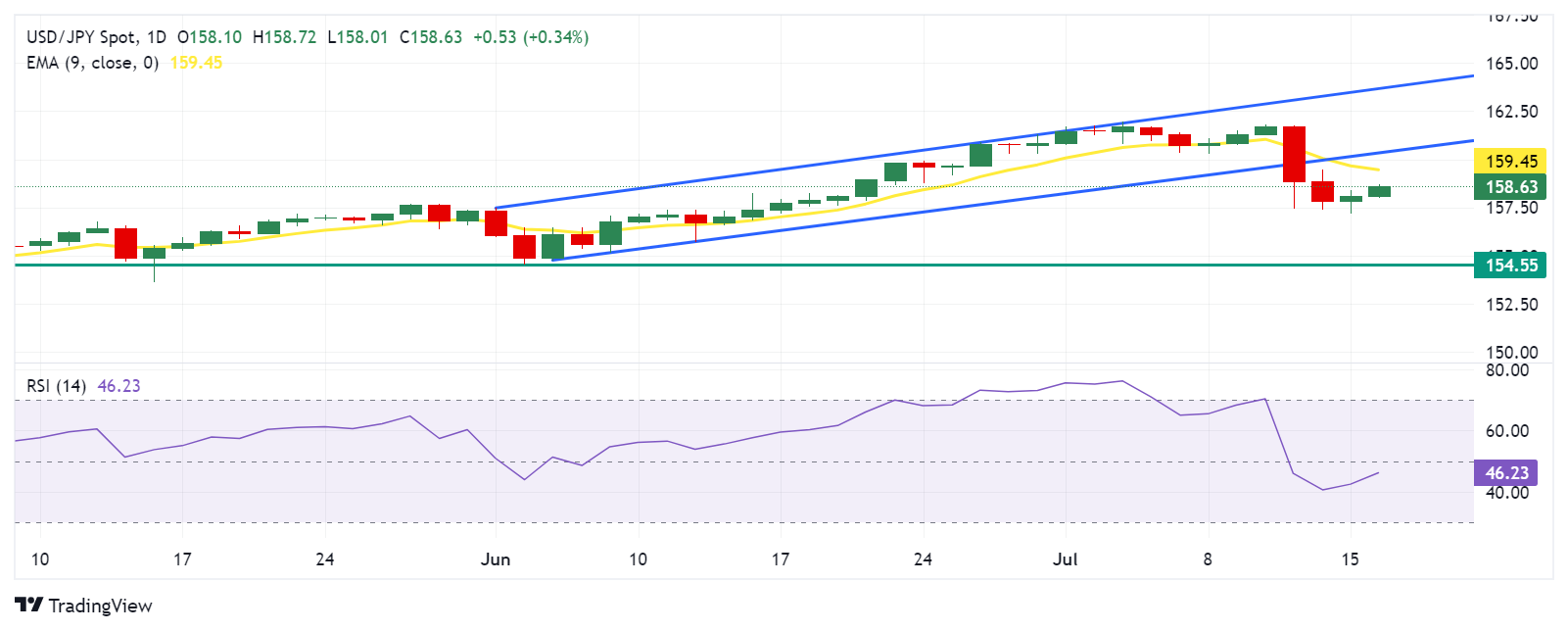
USD/JPY trades around 158.70 on Tuesday. The daily chart analysis indicates a reinforcement of the bullish bias as the pair rises toward the lower boundary of an ascending channel pattern. The 14-day Relative Strength Index (RSI) is also slightly below the 50 level. A further increase could strengthen the bullish trend.
The immediate resistance is observed around the nine-day Exponential Moving Average (EMA) at 159.46, followed by the lower boundary of the ascending channel around 160.30. A return to trading within the ascending channel would likely improve sentiment for the USD/JPY pair, with a potential target toward the upper boundary of the ascending channel near 163.70.
On the downside, the USD/JPY pair could find key support around the psychological level of 158.00. A break below this level could exert pressure on the pair to navigate the region around June's low at 154.55.
USD/JPY: Daily Chart
Japanese Yen FAQs
The Japanese Yen (JPY) is one of the world’s most traded currencies. Its value is broadly determined by the performance of the Japanese economy, but more specifically by the Bank of Japan’s policy, the differential between Japanese and US bond yields, or risk sentiment among traders, among other factors.
One of the Bank of Japan’s mandates is currency control, so its moves are key for the Yen. The BoJ has directly intervened in currency markets sometimes, generally to lower the value of the Yen, although it refrains from doing it often due to political concerns of its main trading partners. The current BoJ ultra-loose monetary policy, based on massive stimulus to the economy, has caused the Yen to depreciate against its main currency peers. This process has exacerbated more recently due to an increasing policy divergence between the Bank of Japan and other main central banks, which have opted to increase interest rates sharply to fight decades-high levels of inflation.
The BoJ’s stance of sticking to ultra-loose monetary policy has led to a widening policy divergence with other central banks, particularly with the US Federal Reserve. This supports a widening of the differential between the 10-year US and Japanese bonds, which favors the US Dollar against the Japanese Yen.
The Japanese Yen is often seen as a safe-haven investment. This means that in times of market stress, investors are more likely to put their money in the Japanese currency due to its supposed reliability and stability. Turbulent times are likely to strengthen the Yen’s value against other currencies seen as more risky to invest in.
Author

Akhtar Faruqui
FXStreet
Akhtar Faruqui is a Forex Analyst based in New Delhi, India. With a keen eye for market trends and a passion for dissecting complex financial dynamics, he is dedicated to delivering accurate and insightful Forex news and analysis.