Japanese Yen rises as Ishiba wins LDP presidential election
- The Japanese Yen recovers its daily losses after Shigeru Ishiba has won the leadership race to become prime minister.
- The Tokyo Consumer Price Index rose 2.2% YoY in September, down from a 2.6% increase in August.
- The US Dollar receives downward pressure from dovish Fedspeak.

The Japanese Yen (JPY) gains ground as former Defense Chief Shigeru Ishiba won the Liberal Democratic Party's (LDP) presidential election to become Japan's prime minister. However, the JPY faced challenges as traders expected the BoJ to ponder before further rate hikes.
The Tokyo Consumer Price Index (CPI) increased 2.2% year-over-year in September, down from a 2.6% rise in August. Meanwhile, the CPI excluding fresh food and energy climbed 1.6% YoY in September, unchanged from the previous reading. The CPI excluding fresh food increased 2.0% as expected, compared to the previous rise of 2.4%.
The US Dollar could face pressure following dovish remarks from Federal Reserve officials. Traders are now expected to closely monitor the US Personal Consumption Expenditures (PCE) Price Index data for August, the Fed’s preferred inflation indicator, on Friday for fresh impetus, which is scheduled for release later in the North American session.
Daily Digest Market Movers: Japanese Yen extends losses amid doubts over BoJ policy outlook
- According to Reuters, Fed Governor Lisa Cook stated on Thursday that she supported last week's 50 basis points (bps) interest rate cut, citing increased "downside risks" to employment.
- US Gross Domestic Product Annualized increased at a rate of 3.0% in the second quarter, as previously estimated, according to the US Bureau of Economic Analysis (BEA) on Thursday. Meanwhile, the GDP Price Index rose 2.5% in the second quarter.
- US Initial Jobless Claims for the week ending September 20 were reported at 218K, according to the US Department of Labor (DoL). This figure came in below the initial consensus of 225K and was lower than the previous week's revised number of 222K (previously reported as 219K).
- On Thursday, the BoJ Monetary Policy Meeting Minutes expressed the members’ consensus on the importance of remaining vigilant regarding the risks of inflation exceeding targets. Several members indicated that raising rates to 0.25% would be suitable as a way to adjust the level of monetary support. A few others suggested that a moderate adjustment to monetary support would also be appropriate.
- Federal Reserve Governor Adriana Kugler said on Wednesday that she “strongly supported” the Fed’s decision to cut the interest rates by a half point last week. Kugler further stated that it will be appropriate to make additional rate cuts if inflation continues to ease as expected, per Bloomberg.
- US Consumer Confidence Index fell to 98.7 in September from a revised 105.6 in August. This figure registered the biggest decline since August 2021.
- On Tuesday, BoJ Governor Kazuo Ueda indicated that the central bank has time to evaluate market and economic conditions before making any policy adjustments, signaling that there is no urgency to raise interest rates again. Ueda also noted that Japan's real interest rate remains deeply negative, which is helping to stimulate the economy and drive up prices.
Technical Analysis: USD/JPY holds position above 145.00, nine-day EMA
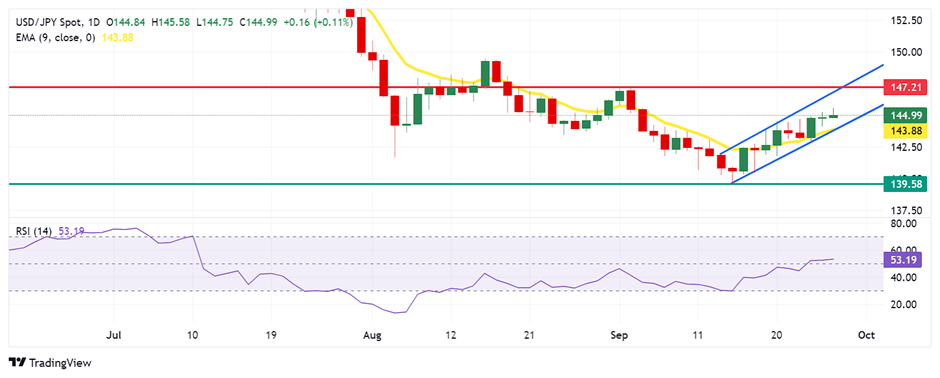
USD/JPY trades around 145.10 on Friday. Analysis of the daily chart shows that the pair is moving upwards within an ascending channel, indicating a bullish bias. Additionally, the 14-day Relative Strength Index (RSI) remains slightly above the 50 level, confirming an emergence of a bullish sentiment.
On the upside, the ongoing bullish bias could lead the USD/JPY pair may explore the region around the upper boundary of the ascending channel at 146.90 level, followed by its five-week high of 147.21 level, which was recorded on September 3.
In terms of support, the USD/JPY pair may test the nine-day Exponential Moving Average (EMA) at the level of 143.89, aligned with the lower boundary of the ascending channel.
USD/JPY: Daily Chart
Japanese Yen PRICE Today
The table below shows the percentage change of Japanese Yen (JPY) against listed major currencies today. Japanese Yen was the strongest against the New Zealand Dollar.
| USD | EUR | GBP | JPY | CAD | AUD | NZD | CHF | |
|---|---|---|---|---|---|---|---|---|
| USD | 0.28% | 0.25% | -0.96% | 0.16% | 0.28% | 0.34% | 0.08% | |
| EUR | -0.28% | -0.04% | -1.28% | -0.15% | 0.01% | 0.05% | -0.17% | |
| GBP | -0.25% | 0.04% | -1.25% | -0.11% | 0.05% | 0.11% | -0.14% | |
| JPY | 0.96% | 1.28% | 1.25% | 1.18% | 1.32% | 1.36% | 1.14% | |
| CAD | -0.16% | 0.15% | 0.11% | -1.18% | 0.11% | 0.19% | -0.06% | |
| AUD | -0.28% | -0.01% | -0.05% | -1.32% | -0.11% | 0.07% | -0.22% | |
| NZD | -0.34% | -0.05% | -0.11% | -1.36% | -0.19% | -0.07% | -0.24% | |
| CHF | -0.08% | 0.17% | 0.14% | -1.14% | 0.06% | 0.22% | 0.24% |
The heat map shows percentage changes of major currencies against each other. The base currency is picked from the left column, while the quote currency is picked from the top row. For example, if you pick the Japanese Yen from the left column and move along the horizontal line to the US Dollar, the percentage change displayed in the box will represent JPY (base)/USD (quote).
Japanese Yen FAQs
The Japanese Yen (JPY) is one of the world’s most traded currencies. Its value is broadly determined by the performance of the Japanese economy, but more specifically by the Bank of Japan’s policy, the differential between Japanese and US bond yields, or risk sentiment among traders, among other factors.
One of the Bank of Japan’s mandates is currency control, so its moves are key for the Yen. The BoJ has directly intervened in currency markets sometimes, generally to lower the value of the Yen, although it refrains from doing it often due to political concerns of its main trading partners. The current BoJ ultra-loose monetary policy, based on massive stimulus to the economy, has caused the Yen to depreciate against its main currency peers. This process has exacerbated more recently due to an increasing policy divergence between the Bank of Japan and other main central banks, which have opted to increase interest rates sharply to fight decades-high levels of inflation.
The BoJ’s stance of sticking to ultra-loose monetary policy has led to a widening policy divergence with other central banks, particularly with the US Federal Reserve. This supports a widening of the differential between the 10-year US and Japanese bonds, which favors the US Dollar against the Japanese Yen.
The Japanese Yen is often seen as a safe-haven investment. This means that in times of market stress, investors are more likely to put their money in the Japanese currency due to its supposed reliability and stability. Turbulent times are likely to strengthen the Yen’s value against other currencies seen as more risky to invest in.
Author

Akhtar Faruqui
FXStreet
Akhtar Faruqui is a Forex Analyst based in New Delhi, India. With a keen eye for market trends and a passion for dissecting complex financial dynamics, he is dedicated to delivering accurate and insightful Forex news and analysis.