Japanese Yen remains subdued as BoJ is expected to maintain its current policy in June
- The Japanese Yen edges lower as the BoJ is expected to maintain its current interest rates on Friday.
- The stable Japanese equity market has undermined the JPY.
- The US Dollar holds ground due to reduced odds of the two Fed rate cuts in 2024.

The Japanese Yen (JPY) edges lower for the third consecutive trading day on Tuesday. The USD/JPY pair received support from a stronger US Dollar (USD) as investors remained cautious ahead of the Federal Reserve's (Fed) decision, along with the US inflation figures for May on Wednesday.
The Japanese Yen struggled after mixed data was released on Monday. Japan's Gross Domestic Product (GDP) Annualized showed that the economy contracted less than expected in the first quarter. Meanwhile, the GDP (QoQ) shrank in Q1, matching flash data. Additionally, the stable performance in the equity market has undermined the JPY. Investors are looking forward to the Bank of Japan’s (BoJ) policy decision on Friday.
The US Dollar Index (DXY), which measures the value of the US Dollar (USD) against six major currencies, maintains its position due to the reduced likelihood of the two Federal Reserve (Fed) interest rate cuts in 2024. The CME FedWatch Tool indicates that the likelihood of a Fed rate cut in September by at least 25 basis points has decreased to nearly 49.0%, down from 59.5% a week earlier.
Daily Digest Market Movers: Japanese Yen edges lower due to dovish BoJ
- Nearly two-thirds of economists surveyed in a Reuters poll on Tuesday anticipate that the Bank of Japan will opt to commence tapering its monthly bond purchases at Friday's policy meeting. This decision marks a significant initial move aimed at gradually reducing the central bank's burgeoning balance sheet. Takeshi Minami, Chief Economist at Norinchukin Research Institute said, "There is no longer any reason to continue large-scale purchases of government bonds since it has been judged that a 2% rise in prices is within reach."
- The Nikkei 225 Index climbed on Tuesday, marking its second consecutive session of gains. This uptrend mirrored the positive performance on Wall Street, where technology stocks propelled equity markets higher.
- Japan Finance Minister Shunichi Suzuki said on Tuesday it is important to continue efforts to achieve economic growth and attain fiscal health to retain confidence in the country's fiscal policy, per Reuters.
- Japan’s 10-year government bond yield moves above 1.02% ahead of the Bank of Japan’s (BoJ) policy meeting on Friday. The central bank is expected to maintain its current interest rates, while traders are closely watching for any potential reduction in the bank’s monthly bond purchases.
- On Monday, Japan’s Gross Domestic Product (GDP) Annualized contracted by 1.8% in the first quarter, compared to a previous decline of 2.0%. The figures slightly exceeded market forecasts of a 1.9% decrease. Meanwhile, Japan's GDP (QoQ) shrank by 0.5%, which is in line with the flash data.
- Rabobank suggested in its weekly report that the Federal Reserve may cut rates in September and December, more likely because of a deteriorating economy than because of progress on inflation. This is because they think that the US economy is entering a stagflationary phase with persistent inflation and an economic slowdown that is likely to end in a mild recession later this year.
- According to the US Bureau of Labor Statistics (BLS) on Friday, May's US Nonfarm Payrolls (NFP) increased by 272,000, up from 165,000 in April. The wage inflation, as measured by the Average Hourly Earnings, rose 4.1% YoY in May from 4.0% (revised from 3.9%) in April, above the market consensus of 3.9%.
- According to Reuters, while speaking to parliament on Thursday, Bank of Japan (BoJ) Governor Kazuo Ueda stated that inflation expectations are gradually rising but have yet to reach 2%. Ueda said, "We are still scrutinizing market developments since the March decision. As we proceed in exiting our massive monetary stimulus, it's appropriate to reduce bond purchases."
Technical Analysis: USD/JPY maintains a position around 157.00
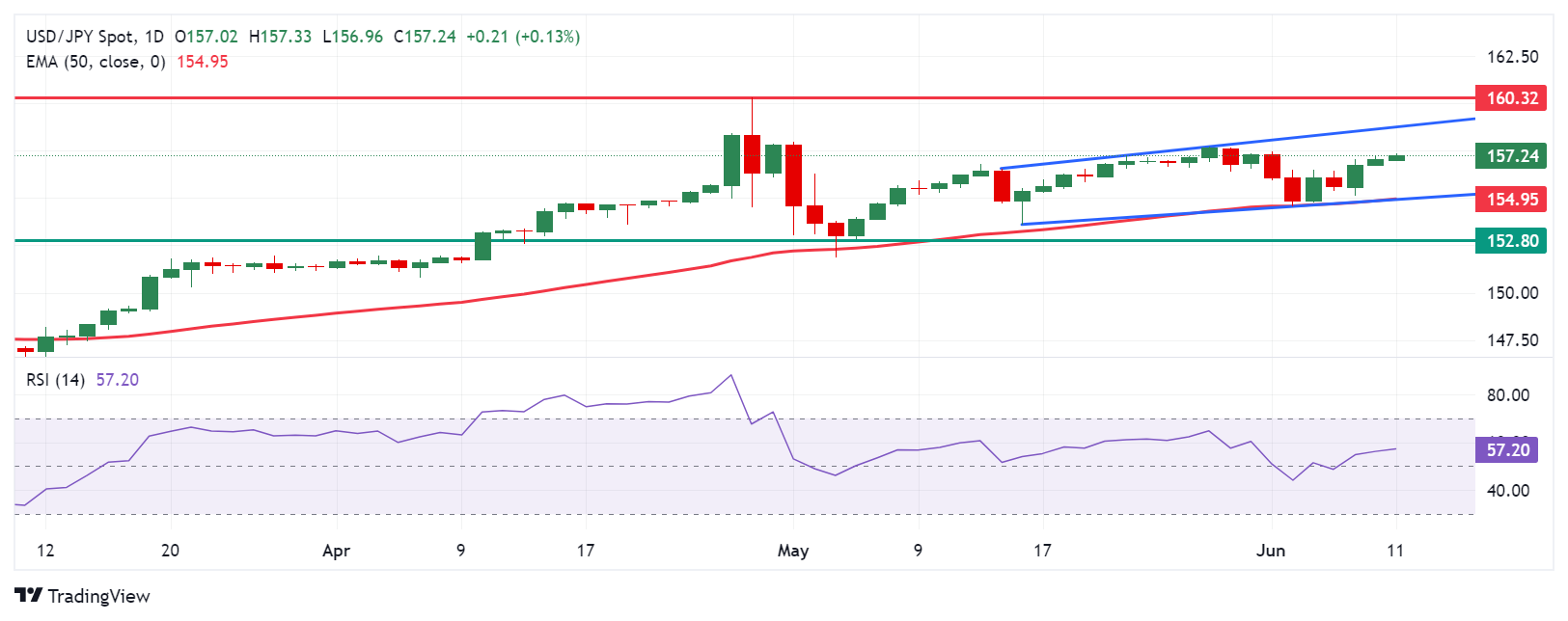
USD/JPY trades around 157.20 on Tuesday. Analysis of the daily chart reveals a bullish inclination as the pair consolidates within an ascending channel pattern. Additionally, the 14-day Relative Strength Index (RSI) sits above the 50 level, indicating a propensity for upward momentum.
A significant hurdle is noticeable at the psychological level of 158.00. A breakthrough above this level could provide support, potentially guiding the USD/JPY pair toward the vicinity of the upper boundary near the level of 158.60. Further resistance is observed at 160.32, marking its highest level in over thirty years.
To the downside, the lower boundary of the ascending channel, approximately at the level of 154.90, stands out as the primary support, coinciding with the 50-day Exponential Moving Average (EMA) at 154.86. A breach below this level might intensify downward pressure on the USD/JPY pair, potentially directing it toward the throwback support area around 152.80.
USD/JPY: Daily Chart
Japanese Yen price today
The table below shows the percentage change of the Japanese Yen (JPY) against listed major currencies today. Japanese Yen was the weakest against the Pound Sterling.
| USD | EUR | GBP | CAD | AUD | JPY | NZD | CHF | |
| USD | 0.14% | -0.01% | 0.05% | 0.11% | 0.13% | 0.01% | 0.03% | |
| EUR | -0.14% | -0.16% | -0.08% | -0.01% | 0.00% | -0.11% | -0.12% | |
| GBP | 0.02% | 0.18% | 0.07% | 0.20% | 0.15% | 0.06% | 0.05% | |
| CAD | -0.03% | 0.09% | -0.06% | 0.07% | 0.10% | -0.01% | -0.02% | |
| AUD | -0.10% | 0.02% | -0.15% | -0.08% | 0.01% | -0.08% | -0.10% | |
| JPY | -0.14% | 0.01% | -0.16% | -0.09% | 0.01% | -0.11% | -0.11% | |
| NZD | -0.01% | 0.10% | -0.06% | 0.01% | 0.08% | 0.10% | -0.01% | |
| CHF | -0.03% | 0.12% | -0.05% | 0.02% | 0.08% | 0.10% | 0.00% |
The heat map shows percentage changes of major currencies against each other. The base currency is picked from the left column, while the quote currency is picked from the top row. For example, if you pick the Euro from the left column and move along the horizontal line to the Japanese Yen, the percentage change displayed in the box will represent EUR (base)/JPY (quote).
Japanese Yen FAQs
The Japanese Yen (JPY) is one of the world’s most traded currencies. Its value is broadly determined by the performance of the Japanese economy, but more specifically by the Bank of Japan’s policy, the differential between Japanese and US bond yields, or risk sentiment among traders, among other factors.
One of the Bank of Japan’s mandates is currency control, so its moves are key for the Yen. The BoJ has directly intervened in currency markets sometimes, generally to lower the value of the Yen, although it refrains from doing it often due to political concerns of its main trading partners. The current BoJ ultra-loose monetary policy, based on massive stimulus to the economy, has caused the Yen to depreciate against its main currency peers. This process has exacerbated more recently due to an increasing policy divergence between the Bank of Japan and other main central banks, which have opted to increase interest rates sharply to fight decades-high levels of inflation.
The BoJ’s stance of sticking to ultra-loose monetary policy has led to a widening policy divergence with other central banks, particularly with the US Federal Reserve. This supports a widening of the differential between the 10-year US and Japanese bonds, which favors the US Dollar against the Japanese Yen.
The Japanese Yen is often seen as a safe-haven investment. This means that in times of market stress, investors are more likely to put their money in the Japanese currency due to its supposed reliability and stability. Turbulent times are likely to strengthen the Yen’s value against other currencies seen as more risky to invest in.
Author

Akhtar Faruqui
FXStreet
Akhtar Faruqui is a Forex Analyst based in New Delhi, India. With a keen eye for market trends and a passion for dissecting complex financial dynamics, he is dedicated to delivering accurate and insightful Forex news and analysis.

















