Japanese Yen retains intraday bullish bias; USD/JPY slides back below 150.00
- The Japanese Yen attracts fresh buyers amid wavering expectations for a December BoJ rate hike.
- A softer USD exerts additional pressure on USD/JPY despite dovish remarks by BoJ's Nakamura.
- Bets for a less dovish Fed act as a tailwind for the US bond yields and might cap gains for the JPY.

The Japanese Yen (JPY) builds on the intraday ascent heading into the European session on Thursday and has now reversed the overnight against its American counterpart. Expectations that the Bank of Japan (BoJ) will deliver an interest rate hike this month, along with persistent geopolitical tensions and concerns about US President-elect Donald Trump's tariff plans, drive some haven flows towards the JPY.
Furthermore, the recent decline in the US Treasury bond yields is seen as another factor underpinning the lower-yielding JPY, which seems unaffected by BoJ board member Toyoaki Nakamura's dovish remarks. Apart from this, a modest US Dollar (USD) downtick drags the USD/JPY pair below the 150.00 psychological mark. That said, bets for a less dovish Federal Reserve (Fed) might act as a tailwind for the USD and the pair.
Japanese Yen reverses Wednesday losses despite BoJ member Nakamura's dovish remarks
- Stronger Tokyo Consumer Price Index for November and Bank of Japan Governor Kazuo Ueda's hawkish remarks last week lifted bets for another interest rate hike in December.
- BoJ board member Toyoaki Nakamura said that he is not confident about the sustainability of wage growth and sees a chance that inflation may miss 2% from fiscal 2025 onward.
- Nakamura added that there should not be a preset idea on when to raise interest rates as Japan's economy is still in recovery and not yet at expansionary phase.
- Russia's Deputy Foreign Minister Sergei Ryabkov cautioned that Russia could escalate its military actions in Ukraine if the US and its allies fail to acknowledge its boundaries.
- Investors remain concerned that US President-elect Donald Trump's tariff plans would trigger the second wave of global trade wars and its effects on the global economy.
- The Institute for Supply Management’s (ISM) Services PMI dropped to a three-month low level of 52.1 in November, from 56.0 in the prior month and missing estimates.
- The benchmark 10-year US Treasury bond yield slipped on Wednesday and registered its lowest closing level since October 21, though the downside remains limited.
- The Federal Reserve's Beige Book showed on Wednesday that economic activity increased slightly in November as businesses grew more upbeat about demand prospects.
- St. Louis Fed President Alberto Musalem said that it might be possible to pause rate cuts at the upcoming meetings, but they are keeping all options open for the December meeting.
- Fed Chair Jerome Powell said the US central bank can take a little more cautious approach in cutting interest rates toward neutral as the economy remains in good shape.
- San Francisco Fed President Mary Daly reiterated that the central bank does not need to be urgent on rate cuts and there's a lot more work to do to achieve 2% inflation.
- This, along with speculations that Trump's policies will reignite inflation, triggers a modest bounce in the US bond yields and acts as a tailwind for the US Dollar.
- Traders now look to the release of the usual US Weekly Initial Jobless Claims. The focus, however, remains on the US Nonfarm Payrolls (NFP) report on Friday.
USD/JPYcould find some support near 149.55-149.50 ahead of 100-day SMA pivotal point
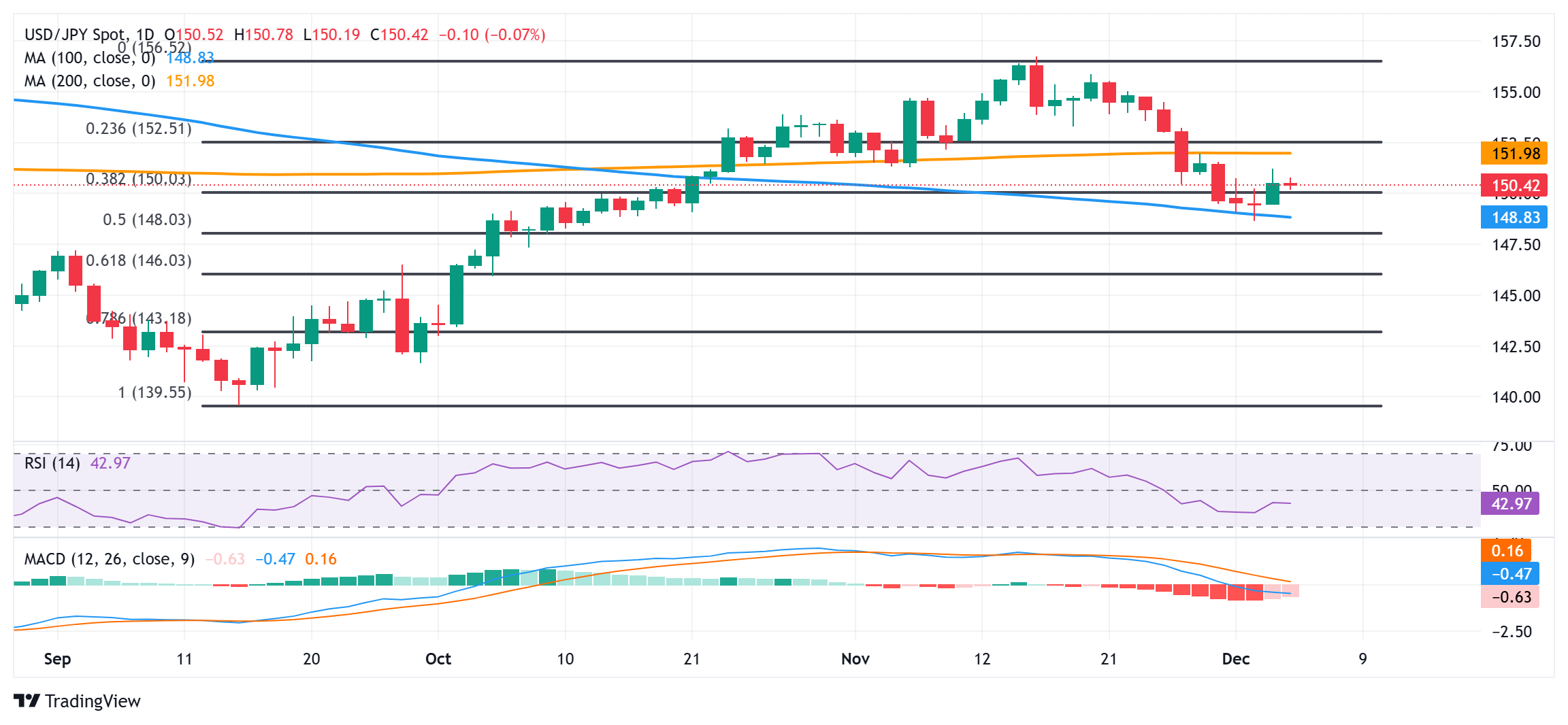
From a technical perspective, the USD/JPY pair showed resilience below the 100-day Simple Moving Average (SMA) earlier this week and the subsequent recovery from its lowest level since October 11 supports prospects for additional gains. That said, oscillators on the daily chart are holding in negative territory and are still far from being in the oversold zone. This, in turn, suggests that any further move up beyond the overnight swing high, around the 151.20-151.25 region, is likely to remain capped near the 152.00 mark. The latter coincides with the very important 200-day SMA and should act as a key pivotal point. A sustained strength beyond will suggest that the recent corrective decline from a multi-month high touched in November has run its course and shift the bias in favor of bullish traders.
On the flip side, weakness below the 150.00 psychological mark now seems to find decent support near the 149.55-149.50 horizontal zone. The next relevant support is pegged near the 149.00 mark ahead of the 100-day SMA, currently around the 148.80 region. A sustained break and acceptance below the latter will be seen as a fresh trigger for bearish traders and drag the USD/JPY pair to the 148.10-148.00 region en route to the 147.35-147.30 zone and the 147.00 round figure.
US Dollar PRICE Today
The table below shows the percentage change of US Dollar (USD) against listed major currencies today. US Dollar was the strongest against the Canadian Dollar.
| USD | EUR | GBP | JPY | CAD | AUD | NZD | CHF | |
|---|---|---|---|---|---|---|---|---|
| USD | -0.14% | -0.12% | -0.51% | 0.04% | 0.03% | -0.18% | -0.07% | |
| EUR | 0.14% | 0.02% | -0.38% | 0.18% | 0.16% | -0.05% | 0.06% | |
| GBP | 0.12% | -0.02% | -0.40% | 0.15% | 0.15% | -0.06% | 0.03% | |
| JPY | 0.51% | 0.38% | 0.40% | 0.56% | 0.55% | 0.31% | 0.43% | |
| CAD | -0.04% | -0.18% | -0.15% | -0.56% | -0.01% | -0.22% | -0.13% | |
| AUD | -0.03% | -0.16% | -0.15% | -0.55% | 0.00% | -0.21% | -0.12% | |
| NZD | 0.18% | 0.05% | 0.06% | -0.31% | 0.22% | 0.21% | 0.08% | |
| CHF | 0.07% | -0.06% | -0.03% | -0.43% | 0.13% | 0.12% | -0.08% |
The heat map shows percentage changes of major currencies against each other. The base currency is picked from the left column, while the quote currency is picked from the top row. For example, if you pick the US Dollar from the left column and move along the horizontal line to the Japanese Yen, the percentage change displayed in the box will represent USD (base)/JPY (quote).
Author

Haresh Menghani
FXStreet
Haresh Menghani is a detail-oriented professional with 10+ years of extensive experience in analysing the global financial markets.