Japanese Yen buying remains unabated, USD/JPY slides below 152.00 ahead of US data
- The Japanese Yen draws haven flows amid concerns over Trump’s tariff plans and geopolitical risks.
- The USD languishes near the weekly low amid sliding US bond yields and weighs on the USD/JPY pair.
- BoJ rate-hike uncertainty warrants caution for the JPY bulls ahead of the crucial US inflation data.

The Japanese Yen (JPY) buying remains uninterrupted on Wednesday, which, along with a modest US Dollar (USD) weakness, drags the USD/JPY pair below the 152.00 mark, or a three-week low during the early European session. Against the backdrop of geopolitical risks stemming from the protracted Russia-Ukraine war, concerns about US President-elect Donald Trump's tariff plans turn out to be key factors driving flows towards the safe-haven JPY.
Furthermore, expectations that Trump's US Treasury Secretary nominee, Scott Bessent will restrain budget deficits continue to drag the US Treasury bond yields lower. This, in turn, keeps the USD bulls on the defensive near the weekly low and offers additional support to the lower-yielding JPY. That said, the uncertainty over the Bank of Japan's (BoJ) rate-hike plans could act as a headwind for the JPY ahead of Wednesday's important US macro releases.
Japanese Yen bulls retain near-term control amid flight to safety, sliding US bond yields
- Concerns that US President-elect Donald Trump's tariffs would trigger trade wars, and impact the global economy, continue to drive some haven flows towards the Japanese Yen.
- Scott Bessent's nomination as the US Treasury secretary provided some respite to US bond investors and dragged the benchmark 10-year US Treasury yield to a two-week low on Monday.
- Data released on Tuesday showed broadening service-sector inflation in Japan, keeping the door open for another rate hike by the Bank of Japan at its next policy meeting in December.
- Japanese Prime Minister Shigeru Ishiba said on Tuesday that he would ask companies to implement significant wage hikes at the annual "Shuntō" negotiations next spring.
- The November FOMC meeting minutes revealed that the Committee could pause its easing of the policy rate and hold it at a restrictive level if inflation remained elevated.
- Officials expressed confidence that inflation is easing and the labor market is strong, which should allow the Federal Reserve to cut rates further, albeit at a gradual pace.
- According to the CME Group's FedWatch Tool, traders are currently pricing in a 63% chance that the Fed will lower borrowing costs by 25 basis points in December.
- The US Dollar struggles to gain any meaningful traction and languishes near the weekly low touched on Tuesday, exerting additional pressure on the USD/JPY pair.
- Lebanon-based Hezbollah militant group said that it launched drones towards Israel on Tuesday night, while Israel launched air strikes on Beirut's southern suburbs.
- Moments later, US President Joe Biden announced that Lebanon and Israel have agreed to the ceasefire deal, which comes into effect from 02:00 GMT this Wednesday.
- Traders now look forward to the first revision of the US Q3 GDP print and the US Personal Consumption Expenditure (PCE) Price Index for some meaningful impetus.
- The market attention will then shift to a slew of Japanese macro data, including Tokyo's Core CPI report, due for release during the Asian session on Friday.
USD/JPY acceptance below the 152.00 pivotal support sets the stage for deeper losses
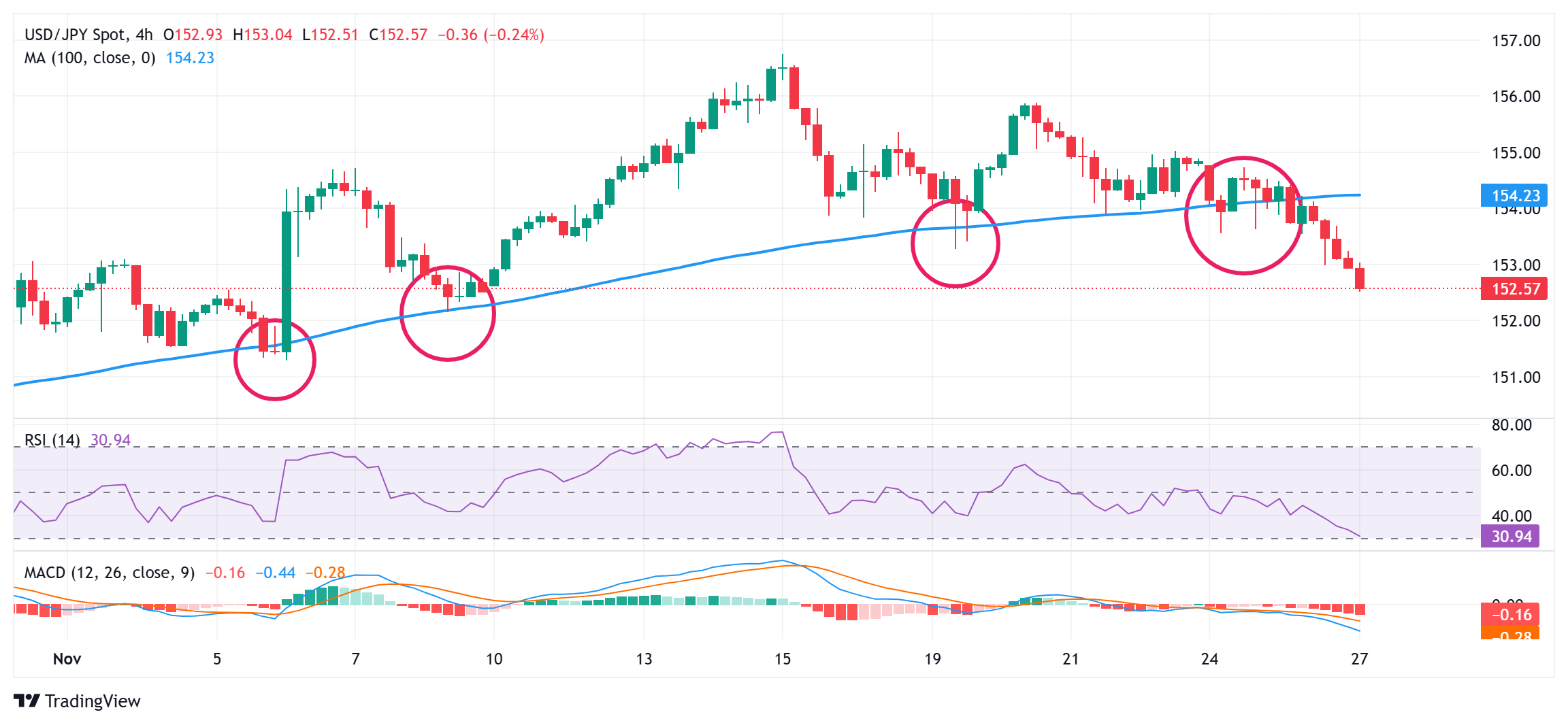
From a technical perspective, the overnight close below the 100-period Simple Moving Average (SMA) on the 4-hour chart and the subsequent downfall favors bearish traders. Moreover, oscillators on the daily chart have just started gaining negative traction and support prospects for a further USD/JPY depreciating move. Hence, some follow-through weakness towards the very important 200-day SMA, currently pegged around the 152.00 mark, looks like a distinct possibility. A convincing break below the latter could expose the monthly swing low, around the 151.30-151.25 region.
On the flip side, the 153.00 round figure might now act as an immediate hurdle ahead of the 153.25-153.30 region. A sustained strength beyond the latter might trigger a short-covering rally and allow the USD/JPY pair to reclaim the 154.00 mark. The upward trajectory could extend further towards the 154.60 intermediate hurdle en route to the 155.00 psychological mark and the next relevant hurdle near the 155.35-155.40 area.
Economic Indicator
Gross Domestic Product Annualized
The real Gross Domestic Product (GDP) Annualized, released quarterly by the US Bureau of Economic Analysis, measures the value of the final goods and services produced in the United States in a given period of time. Changes in GDP are the most popular indicator of the nation’s overall economic health. The data is expressed at an annualized rate, which means that the rate has been adjusted to reflect the amount GDP would have changed over a year’s time, had it continued to grow at that specific rate. Generally speaking, a high reading is seen as bullish for the US Dollar (USD), while a low reading is seen as bearish.
Read more.Next release: Wed Nov 27, 2024 13:30 (Prel)
Frequency: Quarterly
Consensus: 2.8%
Previous: 2.8%
Source: US Bureau of Economic Analysis
The US Bureau of Economic Analysis (BEA) releases the Gross Domestic Product (GDP) growth on an annualized basis for each quarter. After publishing the first estimate, the BEA revises the data two more times, with the third release representing the final reading. Usually, the first estimate is the main market mover and a positive surprise is seen as a USD-positive development while a disappointing print is likely to weigh on the greenback. Market participants usually dismiss the second and third releases as they are generally not significant enough to meaningfully alter the growth picture.
Author

Haresh Menghani
FXStreet
Haresh Menghani is a detail-oriented professional with 10+ years of extensive experience in analysing the global financial markets.