Intel gains for third straight session on Amazon partnership
- Intel stock rises 7% on Tuesday after CEO announces new partnership with Amazon.
- Intel will help to design and fabricate AI chips for AWS data centers.
- The deal is said to be multiyear and in the billions of dollars.
- Intel will postpone construction of fabrication plants in Poland and Germany.
Intel (INTC) is really having a moment. On Monday, Intel stock garnered a 6.4% advance on the back of $3 billion in funding via the Secure Enclave program of the US Department of Defense.
On Tuesday, INTC shares have risen 7% after it emerged that Amazon (AMZN) had chosen Intel’s foundry unit to produce a new suite of custom artificial intelligence (AI) chips for its Amazon Web Services (AWS) cloud computing business.
In a note to employees, CEO Pat Gelsinger called the deal a multi-billion dollar partnership for chip design and fabrication services.
The Dow Jones Industrial Average (DJIA), of which Intel is the smallest member, opened 0.3% higher on Tuesday before pulling lower. The performance was behind the S&P 500, 0.4%, and the NASDAQ Composite, 0.6%, but represented a new all-time high for the index.
The market begins Tuesday on a chummy note after US Retail Sales for August rose 0.1% MoM, whereas -0.2% has been expected. The print shows that a recession isn’t imminent but also isn’t high enough to scare Fed governors away from cutting 50 basis points from the fed funds rate on Wednesday, as many now expect.
Intel stock news
Amazon’s AWS unit has been experimenting with designing its own data center chips over the past few years and is now putting several of them into use. Intel already produces Xeon Scalable processors for AWS and now will also make custom Xeon 6 chips using the Intel 3 node.
The new partnership will see Intel utilizing its 18A process to create an "artificial intelligence fabric chip" for AWS in partnership with both company’s chip designers. Next, Gelsinger told employees that Intel would use its 18AP and 14A manufacturing processes to aid AWS in further chip projects.
This Amazon partnership follow’s Monday’s news that an additional $3 billion will be allotted to Intel for a secure manufacturing program wherein Intel will focus on chip design and fabrication related to US military products. Though the funding also comes from the CHIPS & Science Act of 2022, this $3 billion stands outside of the $8.5 billion already set aside for Intel’s foundry investments.
Gelsinger also said he would postpone foundry investments in Poland and Germany.
In a Reuters report on Tuesday, German Chancellor Olaf Scholz said that Intel will “stick with it” in regard to its proposed $33 billion fabrication plant in Magdeburg, even though Intel has decided to postpone construction for two years while it gets its house in order.
KeyBanc Capital Markets analyst John Vinh said he was “encouraged” by the announcements since it shows that management is being aggressive in terms of cost control.
Intel stock forecast
Intel stock is rising for its third consecutive session. It's hard to say whether this rally has legs, since all the gains have been news-related. Either way, bulls are now staring at the $24.90 level as a possible endpoint. That level showed support on separate occasions in late 2022 and early 2023. A break above here would also sent INTC above the 50-day Simple Moving Average (SMA) for the first time since late July.
One good sign, however, is that INTC stock broke above other recent range highs on August 2 and August 30, so it is showing that a short-term rally is clearly here for now.
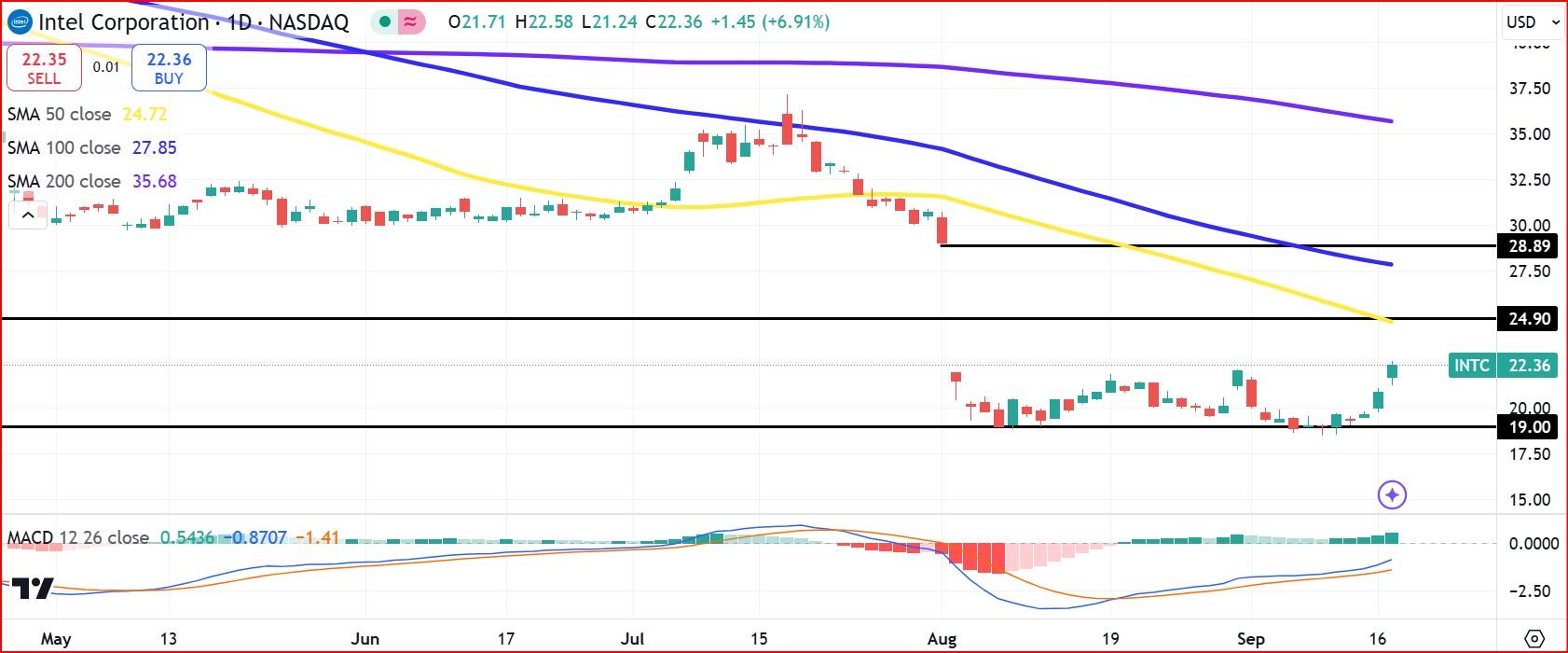
INTC daily stock chart
Author

Clay Webster
FXStreet
Clay Webster grew up in the US outside Buffalo, New York and Lancaster, Pennsylvania. He began investing after college following the 2008 financial crisis.