Gold gains while markets await Trump over the gradual tariff scheme roll out
- Gold is still up on the day this Tuesday ahead of the US trading session.
- Traders are on edge over possible comments from President-elect Donald Trump over gradual tariff implementation.
- Gold attempts to avoid trading back into a broader-term pennant formation with limited upside.

Gold’s price (XAU/USD) is seeing concerns fade to the background over the Federal Reserve (Fed) policy rate which took over sentiment on Monday, with prices recovering slightly and trading near $2,670 at the time of writing on Tuesday. That sentiment from Monday changed again into a sigh of relief on headlines that the President-elect Donald Trump administration is considering a very gradual implementation of its tariff plans. Sources close to the matter disclosed that the Trump administration is very much concerned about an inflation shock and wants to avoid it at all costs.
On the economic data front, some cautionary warnings need to be issued. In the runup to the US Consumer Price Index (CPI) on Wednesday, the Producer Price Index (PPI) will be released this Tuesday. Traders will need to watch out for some knee-jerk reactions in yields, as a surprise upside beat in PPI numbers could spill over into expectations for a hot CPI release.
A hot PPI and CPI print would cause US yields to surge again and offset the reaction seen this Tuesday on the gradual tariff implementation news. For the Fed policy rate projections, this would mean the chances of any rate cut in 2025 would diminish further and might even head to nil.
Daily digest market movers: Softer for now
- Sources at President-elect Donald Trump’s administration are discussing slowly ramping up tariffs in a gradual approach trying to avoid a spike in inflation, according to people familiar with the matter, Bloomberg reports.
- The US 10-year benchmark rate falls to 4.753% at the time of writing on Tuesday, fading from its fresh 14-month high of 4.802% seen on Monday.
- The CME (Chicago Mercantile Exchange) Fedwatch tool currently shows that the Federal Reserve will keep rate expectations steady until its meeting on June 18, when odds of keeping rates unchanged at current levels stand at 47.2%, compared to 52.8% for lower rates.
- The Commodity Futures Trading Commission (CFTC) released the Gold NC Net Positions on Monday. The current position came in positive at $254,900, compared to the previous at $247,300. This means a surge in long-positioning from speculative traders. The report provides information on the size and direction of the positions taken across all maturities, participants primarily based in Chicago and New York futures markets. Forex traders focus on "non-commercial" or speculative positions to determine whether a trend remains healthy or not, as well as market sentiment towards a certain asset.
Technical Analysis: Look at the daily close
Gold has slipped back into the broader pennant chart formation in which it has been trading since November. The risk now is that the upside pennant border becomes a resistance again. A firm rejection from here could set off another downward move, towards $2,650 and lower.
On the downside, the 55-day Simple Moving Average (SMA) at $2,650 is the first support. Further down, the 100-day SMA at $2,635 is the next in line. Ultimately, the ascending trend line at the lower boundary of the pennant should contain the price action from falling, standing at $2,615 for now.
On the upside, the October 23 low at $2,708 is the next pivotal level to look out for. Once that level is cleared, though still quite far off, the all-time high of $2,790 is the key upside level.
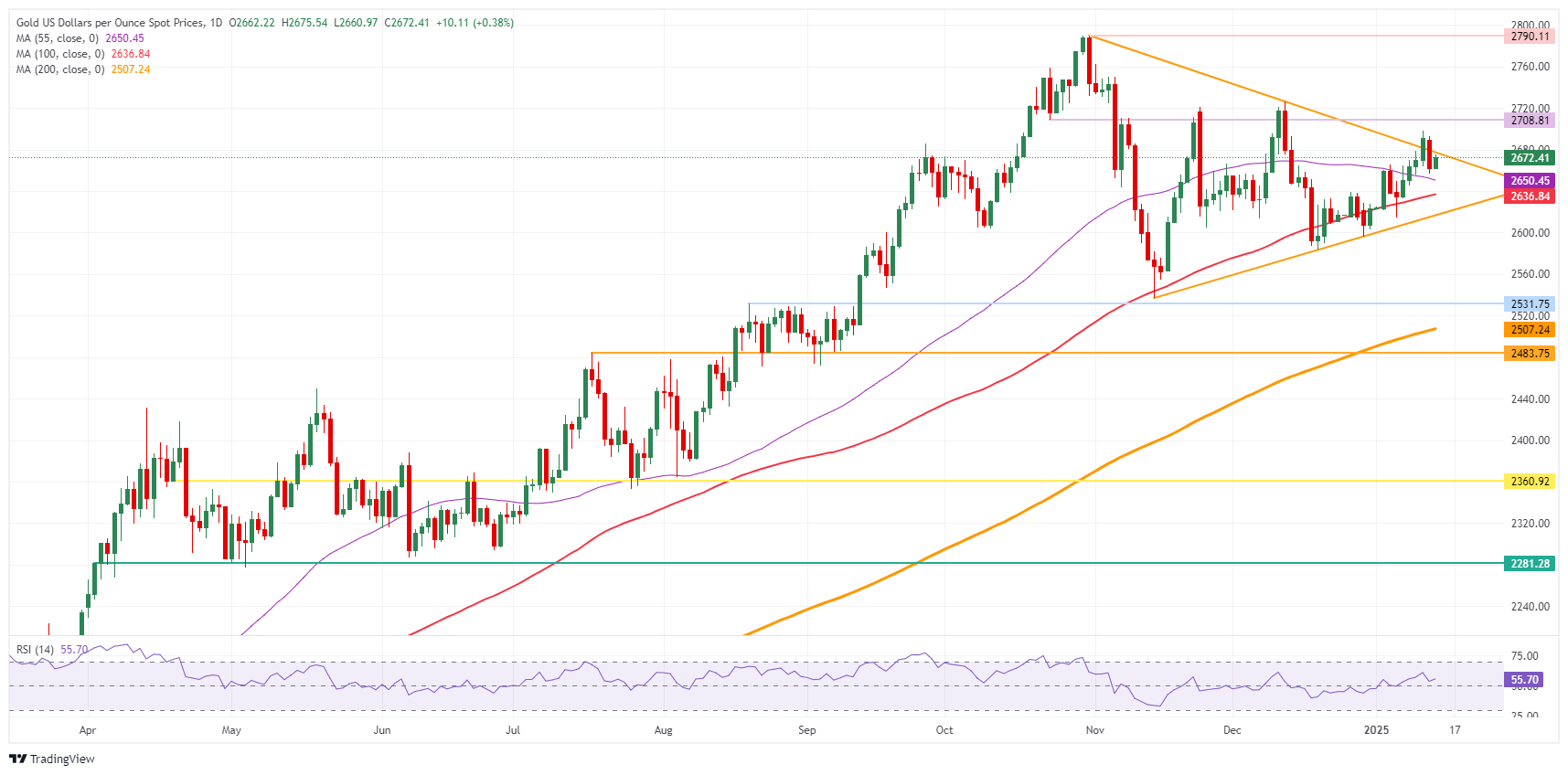
XAU/USD: Daily Chart
Gold FAQs
Gold has played a key role in human’s history as it has been widely used as a store of value and medium of exchange. Currently, apart from its shine and usage for jewelry, the precious metal is widely seen as a safe-haven asset, meaning that it is considered a good investment during turbulent times. Gold is also widely seen as a hedge against inflation and against depreciating currencies as it doesn’t rely on any specific issuer or government.
Central banks are the biggest Gold holders. In their aim to support their currencies in turbulent times, central banks tend to diversify their reserves and buy Gold to improve the perceived strength of the economy and the currency. High Gold reserves can be a source of trust for a country’s solvency. Central banks added 1,136 tonnes of Gold worth around $70 billion to their reserves in 2022, according to data from the World Gold Council. This is the highest yearly purchase since records began. Central banks from emerging economies such as China, India and Turkey are quickly increasing their Gold reserves.
Gold has an inverse correlation with the US Dollar and US Treasuries, which are both major reserve and safe-haven assets. When the Dollar depreciates, Gold tends to rise, enabling investors and central banks to diversify their assets in turbulent times. Gold is also inversely correlated with risk assets. A rally in the stock market tends to weaken Gold price, while sell-offs in riskier markets tend to favor the precious metal.
The price can move due to a wide range of factors. Geopolitical instability or fears of a deep recession can quickly make Gold price escalate due to its safe-haven status. As a yield-less asset, Gold tends to rise with lower interest rates, while higher cost of money usually weighs down on the yellow metal. Still, most moves depend on how the US Dollar (USD) behaves as the asset is priced in dollars (XAU/USD). A strong Dollar tends to keep the price of Gold controlled, whereas a weaker Dollar is likely to push Gold prices up.
Author

Filip Lagaart
FXStreet
Filip Lagaart is a former sales/trader with over 15 years of financial markets expertise under its belt.