Gold price uptrend set to extends above $2,500 as Fed rate cut looms
- Gold rises post-Powell's Jackson Hole comments on potential September policy easing.
- Powell cites inflation control, labor market concerns; Daly echoes rate cut expectations.
- US Durable Goods Orders jump 9.9% in July, showing economic strength; Middle East tensions boost Gold's appeal.
- US 10-year yields reach 3.81%; traders scale back on 50 bps cut bets, await Nonfarm Payrolls for more insights.

Gold extended its gains on Monday amid increasing bets that the US Federal Reserve (Fed) will begin to ease policy in September. This is a certainty following Fed Chair Jerome Powell's speech at Jackson Hole, when he said, “The time has come for policy to adjust." The XAU/USD trades at $2,516 per troy ounce, up by a minimal 0.16%.
Last Friday, Jerome Powell said that he was confident that inflation was on its way toward the Fed’s 2% goal and expressed worries about a weaker labor market, indicating that employment risks were skewed to the upside.
Powell gave the green light on interest rate cuts, adding that further cooling in the labor market is unwelcome.
Powell’s comments were echoed by San Francisco Fed President Mary Daly, who said, “The time to adjust policy is upon us. It's hard to imagine anything could derail a September rate cut.”
Daly added that it’s premature to know the size of interest rate cuts, yet stated that if the economy weakens “more than anticipated, we will need to be more aggressive.”
US Durable Goods Orders jumped from a -6.9% contraction in June to a 9.9% MoM expansion in July, exceeding the forecast for a 4% increase. This was the most significant gain since May 2020, hinting the economy is still resilient despite showing some signs of slowing down.
Bullion prices got a lifeline from rising tensions in the Middle East as the Israel-Hezbollah conflict escalated over the weekend. Fears that the conflict could broaden would be positive for the golden metal.
US Treasury bond yields had recovered as the US 10-year benchmark note climbed one basis point to 3.81%. Meanwhile, traders decreased their bets that the Fed would cut rates by 50 bps at the September meeting.
The CME FedWatch Tool shows that market participants had fully priced in a 25 bps cut, while odds for a larger size stand at 30%, down from 36.5 % last Friday.
Now, with the Fed shifting toward the jobs market, the August Nonfarm Payrolls report will be the last piece of the puzzle to determine the size of the cut.
Daily digest market movers: Gold price advances ahead of next week’s US inflation report
- If US economic data continues to be soft, the Gold price uptrend will remain, which would increase speculation about a bigger rate cut.
- On Tuesday, the US Conference Board will reveal Consumer Confidence for August, which is expected to improve from 100.3 to 100.6.
- Gross Domestic Product (GDP) figures for Q2 in the second estimate are expected to improve from 1.4% to 2.8%.
- On Friday, the Fed’s favorite inflation gauge, the Core Personal Consumption Expenditures (PCE) Price Index, will be revealed. It is expected to rise from 2.6% to 2.7% YoY.
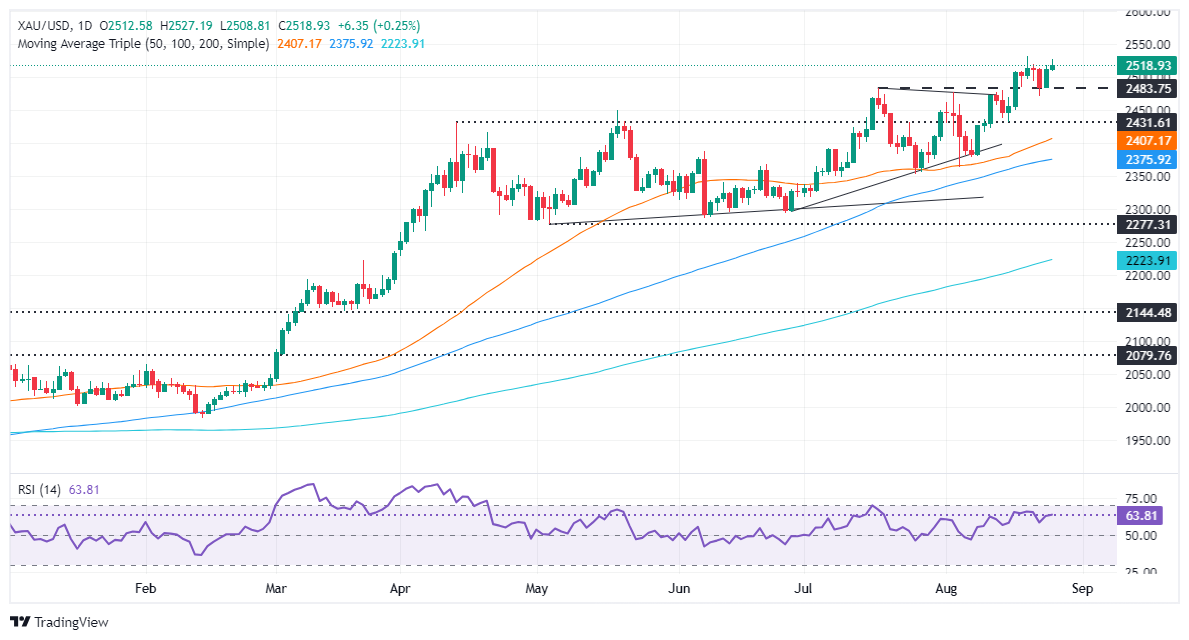
Technical outlook: Gold’s uptrend is intact as buyers eye $2,550
Gold’s uptrend remains in play, yet buyers have failed to reclaim the all-time high (ATH) of $2,531. A breach of the latter will expose the $2,550 mark, followed by the $2,600 mark.
On the flip side, if Gold achieves a daily close below $2,500, this will sponsor a test of the previous all-time high (ATH) of $2,483. If surpassed, Gold’s next support would be the May 20 peak of $2,450, followed by the 50-day Simple Moving Average (SMA) at $2,406.
Gold FAQs
Gold has played a key role in human’s history as it has been widely used as a store of value and medium of exchange. Currently, apart from its shine and usage for jewelry, the precious metal is widely seen as a safe-haven asset, meaning that it is considered a good investment during turbulent times. Gold is also widely seen as a hedge against inflation and against depreciating currencies as it doesn’t rely on any specific issuer or government.
Central banks are the biggest Gold holders. In their aim to support their currencies in turbulent times, central banks tend to diversify their reserves and buy Gold to improve the perceived strength of the economy and the currency. High Gold reserves can be a source of trust for a country’s solvency. Central banks added 1,136 tonnes of Gold worth around $70 billion to their reserves in 2022, according to data from the World Gold Council. This is the highest yearly purchase since records began. Central banks from emerging economies such as China, India and Turkey are quickly increasing their Gold reserves.
Gold has an inverse correlation with the US Dollar and US Treasuries, which are both major reserve and safe-haven assets. When the Dollar depreciates, Gold tends to rise, enabling investors and central banks to diversify their assets in turbulent times. Gold is also inversely correlated with risk assets. A rally in the stock market tends to weaken Gold price, while sell-offs in riskier markets tend to favor the precious metal.
The price can move due to a wide range of factors. Geopolitical instability or fears of a deep recession can quickly make Gold price escalate due to its safe-haven status. As a yield-less asset, Gold tends to rise with lower interest rates, while higher cost of money usually weighs down on the yellow metal. Still, most moves depend on how the US Dollar (USD) behaves as the asset is priced in dollars (XAU/USD). A strong Dollar tends to keep the price of Gold controlled, whereas a weaker Dollar is likely to push Gold prices up.
Author

Christian Borjon Valencia
FXStreet
Markets analyst, news editor, and trading instructor with over 14 years of experience across FX, commodities, US equity indices, and global macro markets.

















