Gold price advances as traders remain unsure of US election outcome
- Gold gains as investors seek refuge amid election-related uncertainty and global tension.
- US Treasury yields steady; rising real yields slightly cap Gold’s advance.
- Analysts warn prolonged election result could further boost Gold prices in the coming days.

Gold prices increased during the New York session as Americans kept going to the polls amidst one of the closest of the US presidential elections this century. Risk appetite has improved, yet the golden metal post gains of over 0.22% due to uncertainty linked to election jitters and the Middle East.
The XAU/USD traded at $2,741 after bouncing off daily lows of $2,724. US Treasury bond yields had pared some of their gains, particularly the 10-year benchmark note, which remained unchanged at 4.289%. US real yields, which inversely correlate against Bullion, are up five basis points to 2.00%, capping the advance of the non-yielding metal.
Market players continued to cling to safe-haven assets outside of the Greenback amidst political uncertainty on the US election results. Gold, the Yen, and the Swiss Franc remain on the front foot, with most polls showing Democratic candidate Kamala Harris and Republican Donald Trump too close to call.
Commerzbank analysts wrote in a note, “Should the election result be uncertain for days or even weeks, Gold would benefit from the resulting uncertainty.”
A Reuters poll on Monday showed concerns that the US could face a similar election crisis like the one that followed Trump’s 2020 election defeat.
By Thursday, the Federal Reserve (Fed) is expected to lower borrowing costs by 25 basis points to the 4.50%-4.75% range.
The US economic schedule revealed that the Balance of Trade deficit widened in September. Following that data, US business activity showed mixed signs. S&P Global reported a dip in October’s service activity, while the Institute for Supply Management’s (ISM) Services PMI showed improvement for the same period.
Daily Digest Market Movers: Gold price consolidates amid US presidential election
- The US Bureau of Economic Analysis reported that the trade deficit widened in September to $-84.4 billion, up from a revised $-70.8 billion and slightly exceeding economists' forecast of $-84.1 billion.
- The US S&P Global Services PMI for October came in at 55.0, below the forecast of 55.3 and down from September's 55.2.
- The ISM Services PMI for October rose to 56, up from 54.9 in September and surpassing expectations for a deceleration to 53.8.
- The Federal Open Market Committee (FOMC) is expected to implement a 25 bps rate cut on November 7.
- Data from the Chicago Board of Trade, based on the December fed funds rate futures contract, indicates that investors estimate 49 basis points (bps) of Fed easing by the end of the year.
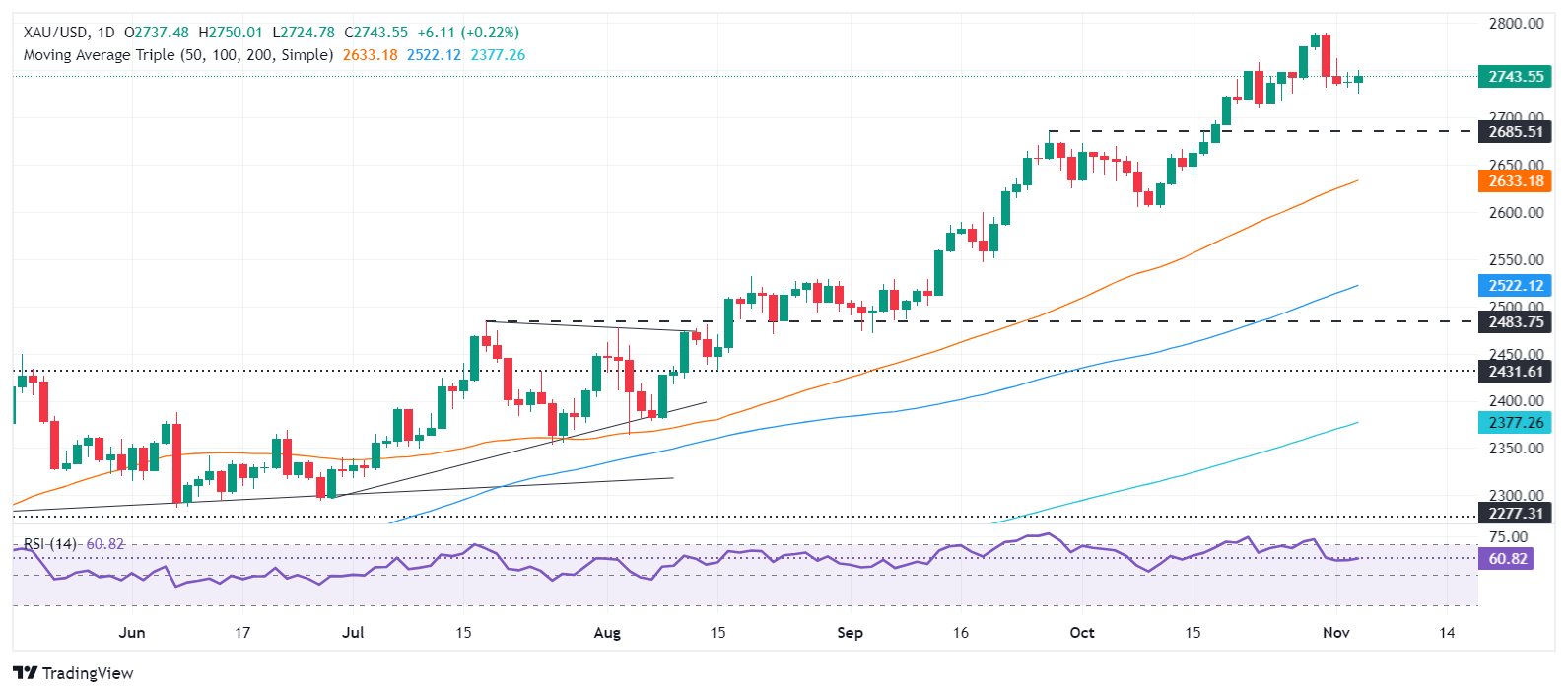
XAU/USD Technical Outlook: Gold price hovers below $2,750
Gold prices are consolidating, with the XAU and USD fluctuating at around $2,724 to $2,749 as traders await the first results of the US election.
Momentum favors buyers, as the uptrend remains intact. The Relative Strength Index (RSI) is bullish and, despite stabilizing, is almost flat.
Gold buyers must reclaim the key psychological level of $2,750 to maintain a bullish momentum. Clearing this level would set the stage for a potential move to the all-time high of $2,790. However, an additional downside is likely if XAU/USD closes below $2,750 on the daily chart.
The initial support is at the October 23 low of $2,708, with further support at $2,700. Beyond that, the next levels are the former resistance turned support at $2,685 — the September 26 swing high — and the 50-day Simple Moving Average (SMA) at $2,628.
Gold FAQs
Gold has played a key role in human’s history as it has been widely used as a store of value and medium of exchange. Currently, apart from its shine and usage for jewelry, the precious metal is widely seen as a safe-haven asset, meaning that it is considered a good investment during turbulent times. Gold is also widely seen as a hedge against inflation and against depreciating currencies as it doesn’t rely on any specific issuer or government.
Central banks are the biggest Gold holders. In their aim to support their currencies in turbulent times, central banks tend to diversify their reserves and buy Gold to improve the perceived strength of the economy and the currency. High Gold reserves can be a source of trust for a country’s solvency. Central banks added 1,136 tonnes of Gold worth around $70 billion to their reserves in 2022, according to data from the World Gold Council. This is the highest yearly purchase since records began. Central banks from emerging economies such as China, India and Turkey are quickly increasing their Gold reserves.
Gold has an inverse correlation with the US Dollar and US Treasuries, which are both major reserve and safe-haven assets. When the Dollar depreciates, Gold tends to rise, enabling investors and central banks to diversify their assets in turbulent times. Gold is also inversely correlated with risk assets. A rally in the stock market tends to weaken Gold price, while sell-offs in riskier markets tend to favor the precious metal.
The price can move due to a wide range of factors. Geopolitical instability or fears of a deep recession can quickly make Gold price escalate due to its safe-haven status. As a yield-less asset, Gold tends to rise with lower interest rates, while higher cost of money usually weighs down on the yellow metal. Still, most moves depend on how the US Dollar (USD) behaves as the asset is priced in dollars (XAU/USD). A strong Dollar tends to keep the price of Gold controlled, whereas a weaker Dollar is likely to push Gold prices up.
Author

Christian Borjon Valencia
FXStreet
Markets analyst, news editor, and trading instructor with over 14 years of experience across FX, commodities, US equity indices, and global macro markets.