Gold lower after Trump defends Dollar, threatens BRICS with tariffs
- Gold is trading lower on Monday after President-elect Donald Trump threatened the BRICS nations with 100% tariffs.
- Trump warned he would use the tariffs if BRICS tried to replace the USD with its own currency.
- The US Dollar rises, weighing on Gold, although increased geopolitical risk provides supportive inflows into the yellow metal.

Gold (XAU/USD) falls and trades in the $2,640s on Monday due to a stronger US Dollar (USD). However, the downside is limited as geopolitical risks remain elevated, driving continued safe-haven demand for the precious metal.
Gold pulls back at the start of the trading week after President-elect Donald Trump threatened to raise 100% tariffs on the BRICS trading bloc of nations if they go ahead with plans to replace the USD with their own currency.
His comments strengthened the US Dollar, which tends to negatively impact Gold since the precious metal is mainly priced and traded in USD.
Gold pulls back on Trump spat with BRICS
Gold weakens on Monday after Donald Trump issued a warning to the BRICS emerging-market trading bloc that he will place 100% tariffs if they go ahead with plans to replace the US Dollar with their own currency.
“The idea that the BRICS Countries are trying to move away from the Dollar while we stand by and watch is OVER,” Trump posted on Truth Social on Saturday afternoon. “We require a commitment from these Countries that they will neither create a new BRICS Currency, nor back any other Currency to replace the mighty US Dollar or, they will face 100% Tariffs, and should expect to say goodbye to selling into the wonderful U.S. Economy,” he added.
The BRICS – which includes Brazil, Russia, India, China, South Africa, Egypt, Iran, the United Arab Emirates, and Ethiopia – has been steadily reducing its reliance on the USD as a medium of exchange, using the currencies of its members instead.
It has even been suggested that it could develop its own Gold-backed BRICS currency for trading purposes, replacing the Dollar altogether.
Some BRICS countries, such as China and India, have also been hoarding Gold. This may be because they want to launch a Gold-backed currency to replace the US Dollar.
Trump’s warning threatens to derail their plans if members become fearful of the fallout of a global trade war with the US, and this could also be weighing on Gold price.
Gold underpinned by haven flows
On the other side, Gold continues to benefit from an elevated level of geopolitical risk, which drives safety inflows and acts as a counterweight to the depressing influence of Trump’s word hail.
Despite agreeing to a ceasefire last week, the Lebanese authorities reported an Israeli military drone strike on a bulldozer carrying out fortification work at an army base on the Syrian border on Monday. Furthermore, in Gaza, an Israeli strike killed another 15 people, according to Reuters.
In Syria, civil war has erupted, bringing yet more instability to the region, with Turkish-backed rebel forces taking Syria’s second city, Aleppo.
Meanwhile, French government bonds are continuing their sell-off in Europe, reaching levels last seen over a decade ago during the sovereign debt crisis. This comes amid increased political risk as the government tries to get a controversial Budget passed.
French Prime Minister Michel Barnier’s minority government wants to bring the deficit down by making spending cuts but risks being ousted in a vote of no confidence led by the French far-right National Rally party, which is pushing back against the proposed spending cuts.
Technical Analysis: XAU/USD declining within sideways market
Gold trades along a major trendline as it continues its overall range-bound development.
XAU/USD 4-hour Chart
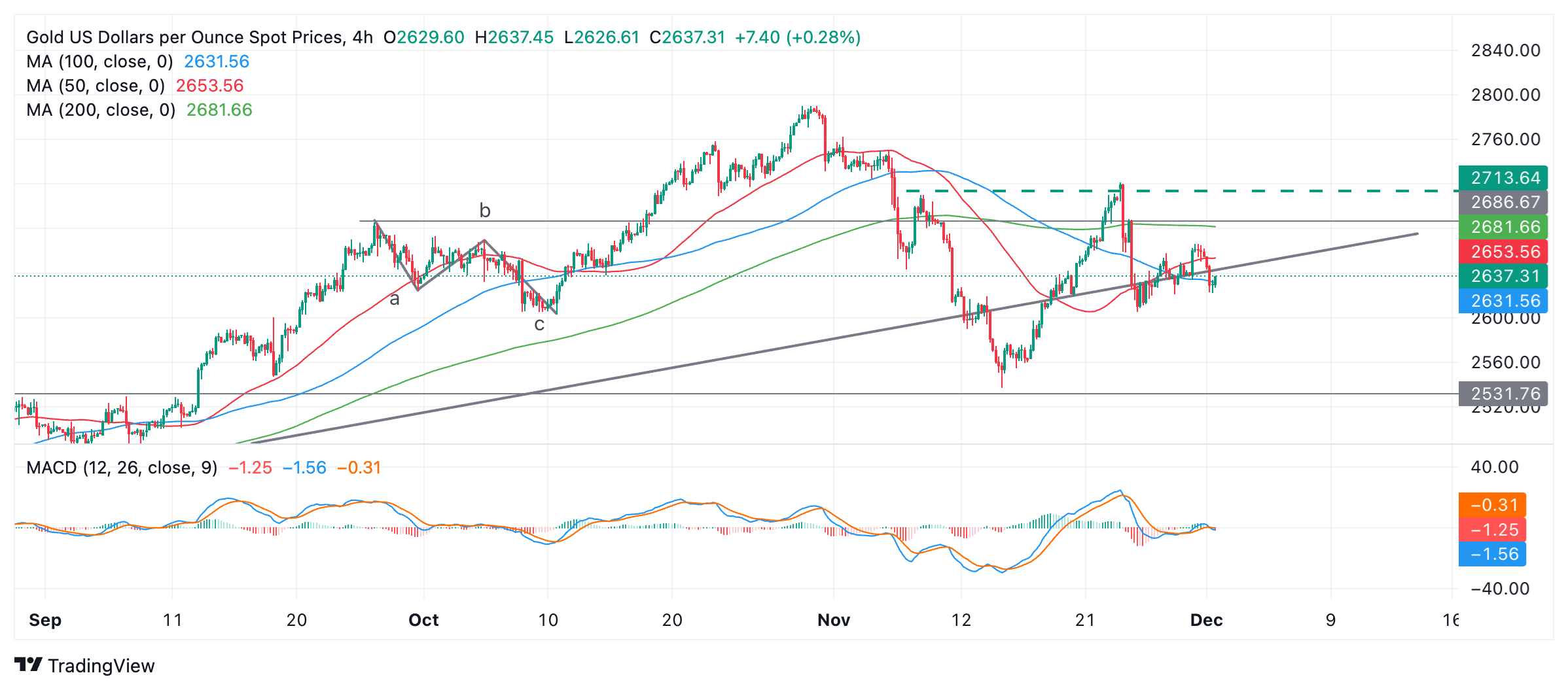
Gold’s short-term trend is sideways, and given the maxim that “the trend is your friend,” the odds favor a continuation of the current mode.
Within this sideways market, the chart looks poised to go lower. The fall from the November 25 high looks incomplete, and despite support from the trendline, more downside seems likely. A break below $2,605 (November 26 low) would confirm a follow-through lower towards the range lows in the $2,530s.
The (blue) Moving Average Convergence Divergence (MACD) indicator is also crossing below its red signal line, providing a sell signal. The general shape of the indicator could indicate further downside on the cards, supporting the bearish near-term outlook.
Gold FAQs
Gold has played a key role in human’s history as it has been widely used as a store of value and medium of exchange. Currently, apart from its shine and usage for jewelry, the precious metal is widely seen as a safe-haven asset, meaning that it is considered a good investment during turbulent times. Gold is also widely seen as a hedge against inflation and against depreciating currencies as it doesn’t rely on any specific issuer or government.
Central banks are the biggest Gold holders. In their aim to support their currencies in turbulent times, central banks tend to diversify their reserves and buy Gold to improve the perceived strength of the economy and the currency. High Gold reserves can be a source of trust for a country’s solvency. Central banks added 1,136 tonnes of Gold worth around $70 billion to their reserves in 2022, according to data from the World Gold Council. This is the highest yearly purchase since records began. Central banks from emerging economies such as China, India and Turkey are quickly increasing their Gold reserves.
Gold has an inverse correlation with the US Dollar and US Treasuries, which are both major reserve and safe-haven assets. When the Dollar depreciates, Gold tends to rise, enabling investors and central banks to diversify their assets in turbulent times. Gold is also inversely correlated with risk assets. A rally in the stock market tends to weaken Gold price, while sell-offs in riskier markets tend to favor the precious metal.
The price can move due to a wide range of factors. Geopolitical instability or fears of a deep recession can quickly make Gold price escalate due to its safe-haven status. As a yield-less asset, Gold tends to rise with lower interest rates, while higher cost of money usually weighs down on the yellow metal. Still, most moves depend on how the US Dollar (USD) behaves as the asset is priced in dollars (XAU/USD). A strong Dollar tends to keep the price of Gold controlled, whereas a weaker Dollar is likely to push Gold prices up.
Author

Joaquin Monfort
FXStreet
Joaquin Monfort is a financial writer and analyst with over 10 years experience writing about financial markets and alt data. He holds a degree in Anthropology from London University and a Diploma in Technical analysis.