Gold price stumbles below $2,500 as market participants eye NFP report
Most recent article: Gold edges lower as traders fold arms ahead of labor market data
- Gold prices fall during a quiet North American session with US markets closed for Labor Day.
- Upcoming US economic reports — ISM PMIs, JOLTS job openings, ADP Employment Change, and Nonfarm Payrolls — set to influence Fed rate decision.
- Fed Chair Powell at Jackson Hole noted that inflation was easing but increasing employment risks, raising recession concerns.
- Geopolitical tensions linger as President Biden may propose a ceasefire deal between Israel and Hamas, potentially affecting markets.
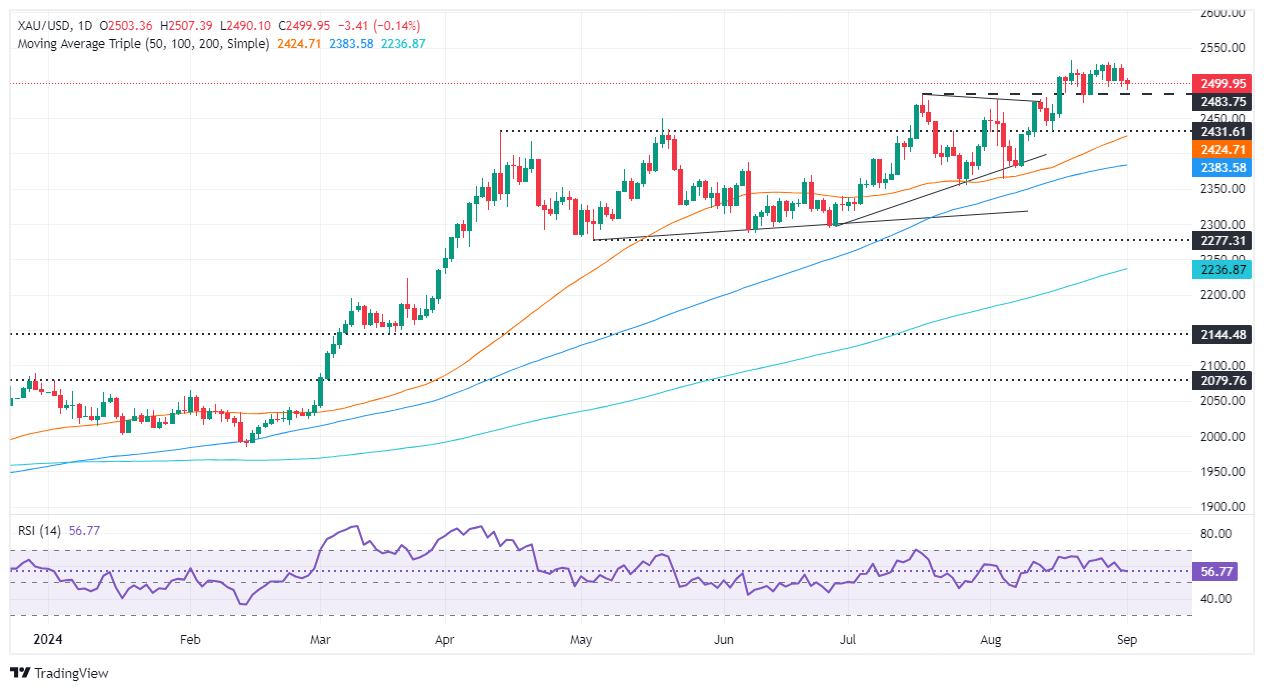
Gold prices dipped during the North American session amid thin volumes due to US markets being closed during Labor Day observance. Conversely, the Greenback remains firm as traders brace for a jobs report that could influence the Federal Reserve's decision on the size of September’s rate cut. The XAU/USD trades at $2,499, down by 0.14%.
The US economic docket will be busy this week with the release of the Institute for Supply Management’s (ISM) Manufacturing and Services PMIs, JOLTS job openings, the ADP National Employment Change, and the Nonfarm Payrolls (NFP) figures.
During his speech at Jackson Hole, Federal Reserve Chairman Jerome Powell commented that the risks of inflation are skewed to the downside, while the employment risks are tilted to the upside.
Last Friday, the Fed’s preferred inflation gauge, the Core Personal Consumption Expenditures Price Index (PCE), remained unchanged at around 2.5%, hinting that inflation remains controlled. On the other hand, during the last four NFP reports, the Unemployment Rate has risen from around 3.8% to 4.3%, spurring fears among Fed officials that the labor market could be cooling faster than expected.
That reignited recession fears, which had faded following last week’s solid US data. Initial Jobless Claims fell from their levels in late July, Retail Sales rose sharply, and the economy grew at a 3% pace, according to the second estimate of the second quarter's Gross Domestic Product (GDP) print.
After the data, Bullion prices drooped as investors bought the US Dollar on waning recession fears.
Despite this, geopolitical risks loom even though US President Biden is considering presenting Israel and Hamas a final proposal for a hostage release and ceasefire in Gaza deal later this week, according to Axios sources.
Daily digest market movers: Gold price traders await busy US economic calendar
- ISM Manufacturing PMI for August is expected to improve from 46.8 to 47.8. The Services PMI is estimated to expand from 51.4 to 51.5
- July’s JOLTS job openings are expected at 8.10 million, down from 8.184 million in June.
- Private hiring, revealed by the ADP National Employment Change report, is foreseen increasing from 122K in July to 150K in August.
- August’s NFP figures are expected to rise from 114K to 163K, while the Unemployment Rate could dip, according to the consensus, from 4.3% to 4.2%.
- December 2024 Chicago Board of Trade (CBOT) fed funds future rates contract hints that investors are eyeing 97 basis points of Fed easing this year.
Technical outlook: Gold price set to dive further below $2,500
Gold prices are upwardly biased, though momentum has shifted negatively, as shown by the Relative Strength Index (RSI). Although the RSI is bullish, its slope aims downward, approaching the neutral level. Therefore, in the short term, XAU/USD is downwardly biased.
If XAU/USD drops below $2,500, the next support would be the August 22 low at $2,470. Once surpassed, the next stop would be the confluence of the August 15 swing low and the 50-day Simple Moving Average (SMA) near the $2,424-$2,431 area.
Conversely, if XAU/USD stays above $2,500, the next resistance would be the ATH, and the following resistance would be the $2,550 mark. A breach of the latter will expose $2,600.
Gold FAQs
Gold has played a key role in human’s history as it has been widely used as a store of value and medium of exchange. Currently, apart from its shine and usage for jewelry, the precious metal is widely seen as a safe-haven asset, meaning that it is considered a good investment during turbulent times. Gold is also widely seen as a hedge against inflation and against depreciating currencies as it doesn’t rely on any specific issuer or government.
Central banks are the biggest Gold holders. In their aim to support their currencies in turbulent times, central banks tend to diversify their reserves and buy Gold to improve the perceived strength of the economy and the currency. High Gold reserves can be a source of trust for a country’s solvency. Central banks added 1,136 tonnes of Gold worth around $70 billion to their reserves in 2022, according to data from the World Gold Council. This is the highest yearly purchase since records began. Central banks from emerging economies such as China, India and Turkey are quickly increasing their Gold reserves.
Gold has an inverse correlation with the US Dollar and US Treasuries, which are both major reserve and safe-haven assets. When the Dollar depreciates, Gold tends to rise, enabling investors and central banks to diversify their assets in turbulent times. Gold is also inversely correlated with risk assets. A rally in the stock market tends to weaken Gold price, while sell-offs in riskier markets tend to favor the precious metal.
The price can move due to a wide range of factors. Geopolitical instability or fears of a deep recession can quickly make Gold price escalate due to its safe-haven status. As a yield-less asset, Gold tends to rise with lower interest rates, while higher cost of money usually weighs down on the yellow metal. Still, most moves depend on how the US Dollar (USD) behaves as the asset is priced in dollars (XAU/USD). A strong Dollar tends to keep the price of Gold controlled, whereas a weaker Dollar is likely to push Gold prices up.
Author

Christian Borjon Valencia
FXStreet
Markets analyst, news editor, and trading instructor with over 14 years of experience across FX, commodities, US equity indices, and global macro markets.