Gold price refreshes lifetime highs as US Dollar eases, focus shifts to US NFP
- Gold price clings to gains on subdued US Dollar
- 10-year US yields rise further as traders pare Fed rate cut expectations for June.
- The US NFP report will guide the next big move for Gold.


Gold price (XAU/USD) refreshes all-time highs above $2,270 in Tuesday’s early New York session as the United States Bureau of Labor Statistics (BLS) has reported steady JOLTS Job Openings for February. US employers posted fresh 8.756 million job openings, similar to expectations of 8.74 million and the prior reading of 8.748 million in January, revised lower from 8.748 million. The US Dollar Index (DXY) fell slightly after refreshing four-month highs of 105.00 to 104.70.
Gold seems not ready to surrender gains on expectations that February’s core Personal Consumption Expenditure Price Index (PCE) figure, the lowest in two years, will keep the Fed on track to cut interest rates three times this year.
Going forward, the Gold price could face pressure to maintain higher levels as US bond yields have extended their upside, with 10-year US Treasury yields up to 4.34%. The rise in yields came as investors scaled back their expectations that the Federal Reserve (Fed) will pivot to rate cuts in June. Higher yields on interest-bearing assets increase the opportunity cost of holding investments in non-yielding assets, such as Gold.
This week, investors will focus on the US Nonfarm Payrolls (NFP) for March, which will be published on Friday. The labor market data could give clues about when the Fed could start reducing interest rates.
Daily digest market movers: Gold price exhibits strength after steady US Job Openings data
- Gold price prints a fresh all-time high above $2,270 despite multiple headwinds. The improved outlook of the US Dollar due to strong United States Manufacturing PMI and a decline in bets supporting a rate cut by the Federal Reserve in June failed to push the Gold price down.
- The divergence between the economic prospects of the US and other developed economies has strengthened the US Dollar outlook. While major developed economies struggled to deliver meager growth in 2023, the US economy grew at a robust pace of 2.5%. Adding to this, the US Manufacturing PMI has returned to expansion, strengthening the economic outlook further.
- On Monday, the US Institute for Supply Management (ISM) reported that its Manufacturing PMI came in above the 50.0 threshold at 50.3, better than expectations of 48.4 and the prior reading of 47.8. The Manufacturing PMI returned to expansion after contracting for 16 straight months.
- The US strong economic outlook has dented market expectations for the Fed to begin reducing interest rates from June. According to the CME FedWatch tool, traders are pricing in a 63% chance that the Fed will trim interest rates in June, down from 70% a week ago.
- Still, investors seem to be confident about three rate cuts this year as projected by the Fed in its latest dot plot. Fed Chair Jerome Powell said on Friday after the release of the US core PCE Price Index data for February that the latest US inflation data was "along the lines of what we would like to see." However, Powell also acknowledged that there is no need for the Fed to rush for rate cuts.
Technical Analysis: Gold price climbs above $2,270
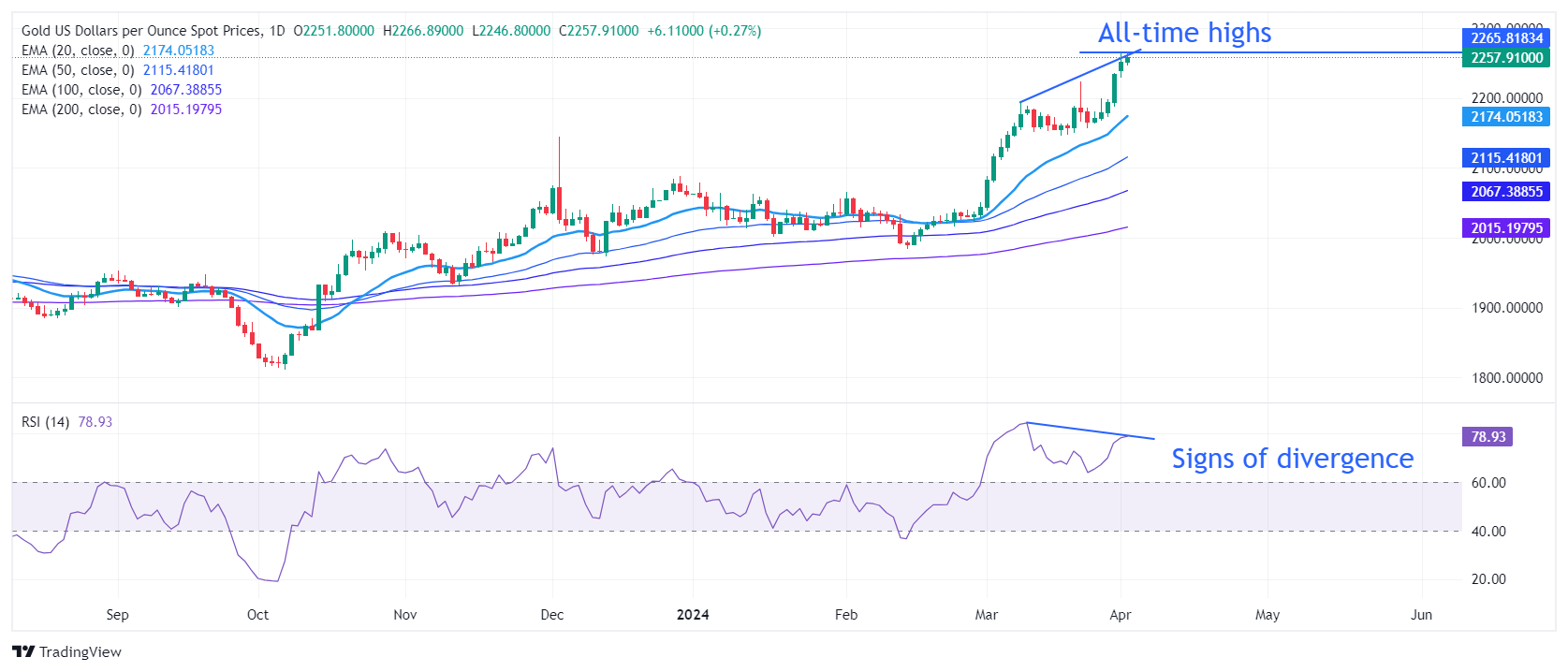
Gold price trades higher, near all-time highs around $2,270. The precious metal strengthened after breaking above the prior lifetime high of $2,223 on March 21. More upside in the Gold price is possible as it is trading in an unchartered territory. All short-to-long term Exponential Moving Averages (EMAs) are sloping higher, suggesting strong near-term demand.
The 14-period Relative Strength Index (RSI) hovers near 78.00, indicating a strong upside momentum. However, signs of divergence between prices and the RSI and overbought levels could result in a correction.
Employment FAQs
Labor market conditions are a key element to assess the health of an economy and thus a key driver for currency valuation. High employment, or low unemployment, has positive implications for consumer spending and thus economic growth, boosting the value of the local currency. Moreover, a very tight labor market – a situation in which there is a shortage of workers to fill open positions – can also have implications on inflation levels and thus monetary policy as low labor supply and high demand leads to higher wages.
The pace at which salaries are growing in an economy is key for policymakers. High wage growth means that households have more money to spend, usually leading to price increases in consumer goods. In contrast to more volatile sources of inflation such as energy prices, wage growth is seen as a key component of underlying and persisting inflation as salary increases are unlikely to be undone. Central banks around the world pay close attention to wage growth data when deciding on monetary policy.
The weight that each central bank assigns to labor market conditions depends on its objectives. Some central banks explicitly have mandates related to the labor market beyond controlling inflation levels. The US Federal Reserve (Fed), for example, has the dual mandate of promoting maximum employment and stable prices. Meanwhile, the European Central Bank’s (ECB) sole mandate is to keep inflation under control. Still, and despite whatever mandates they have, labor market conditions are an important factor for policymakers given its significance as a gauge of the health of the economy and their direct relationship to inflation.
Author
Sagar Dua
FXStreet
Sagar Dua is associated with the financial markets from his college days. Along with pursuing post-graduation in Commerce in 2014, he started his markets training with chart analysis.