Gold price rallies ahead of Fed Minutes release and after Trump mulls imposing emergency tariffs
- A second positive day in a row for Gold prices on Wednesday, fueled by yields and geopolitics.
- CNN released an article stating that President-elect Donald Trump mulls imposing economic state of emergency to justify imposing global tariffs.
- Gold price remains in steady trading in a broad pennant technical formation, though starting to test upside levels.

Gold’s price (XAU/USD) are higher for a second consecutive day after headlines came out over President-elect Donald Trump, and after the Institute of Supply Management (ISM) revealed on Tuesday that the prices paid component in the Services sector is turning red hot. The ISM Services Prices Paid index rose to 64.4 in December from 58.2 the previous month. Meanwhile yields rally and equities sink after CNN issues an article that President-elect Donald Trump is mulling issuing an economic state of emergency in order to impose quickly a scheme of universal tariffs, according to several cited sources close to the matter.
On the economic data front, this Wednesday, all eyes will be on the Minutes from the Federal Open Market Committee (FOMC). Traders will look for clues about the interest rate path and comments from policymakers from the last Federal Reserve (Fed) meeting in December. Meanwhile, the US Treasury will allocate a 10-year Note, with the benchmark rate just hitting a nine-month high at 4.697%.
Daily digest market movers: Plucking the Minutes for clues
- President-elect Donald Trump is mulling declaring a national economic emergency to provide legal justification for a large scheme of universal tariffs, sources familiar with the matter told CNN, Bloomberg reports.
- Christopher J. Waller, member of the Board of Governors of the Federal Reserve system, speaks on the US economic outlook at an event in Paris. Fed's Waller said he believes inflation will continue to cool toward the central bank’s 2% target, prompting his support for additional interest-rate cuts this year.
- At 18:00 GMT, the US Treasury will allocate a 10-year Note. The size of the auction, the already elevated rate levels, and the fact that recent shorter-term auctions faced tepid demand, where demand is normally plentiful, are raising concerns in the market.
- At 19:00 GMT, the Fed will release the FOMC Minutes from its policy decision in December.
- In the fallout of the ISM Services Purchasing Managers Index (PMI) release for December, traders quickly pushed back the first possible rate cut from the Fed in 2025 to July. An interest rate cut was foreseen for June before the data came out.
- President-elect Donald Trump reiterated at a press conference in Mar-a-Lago that US rates will need to come down, according to Bloomberg.
Technical Analysis: Gold digging
The Gold price is testing the waters on the upside. After a few failed attempts to break above the 55-day Simple Moving Average (SMA), Gold is willing to finally snap above it. With help from the ISM data, the upcoming US bond auctions could be the catalysts needed to finally see the Gold price sprint higher.
On the downside, the 100-day Simple Moving Average (SMA) at $2,630 is holding again after a false break on Monday. Further down, the ascending trend line of the pennant pattern should provide support around $2,610 as it did in the past three occasions. In case that support line snaps, a quick decline to $2,531 (August 20, 2024, high) could come back into play as support level.
On the upside, the 55-day SMA at $2,654 is the first level to beat and is being tested at the time of writing. It will not be an easy task as it was already proved twice last week as a firm resistance. In case it breaks through, $2,686 will be the ultimate upside level in the form of the descending trendline in the pennant formation.
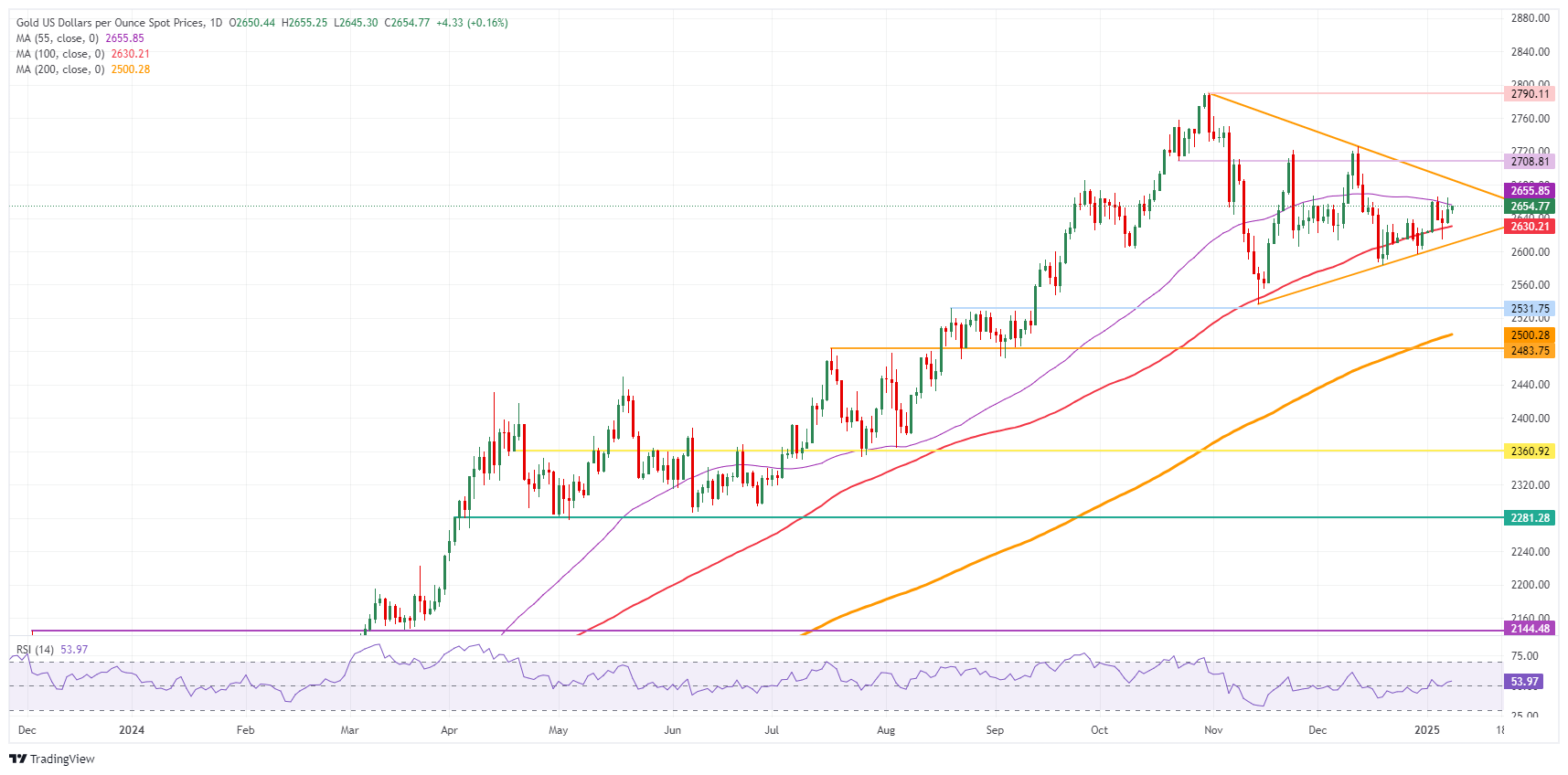
XAU/USD: Daily Chart
Gold FAQs
Gold has played a key role in human’s history as it has been widely used as a store of value and medium of exchange. Currently, apart from its shine and usage for jewelry, the precious metal is widely seen as a safe-haven asset, meaning that it is considered a good investment during turbulent times. Gold is also widely seen as a hedge against inflation and against depreciating currencies as it doesn’t rely on any specific issuer or government.
Central banks are the biggest Gold holders. In their aim to support their currencies in turbulent times, central banks tend to diversify their reserves and buy Gold to improve the perceived strength of the economy and the currency. High Gold reserves can be a source of trust for a country’s solvency. Central banks added 1,136 tonnes of Gold worth around $70 billion to their reserves in 2022, according to data from the World Gold Council. This is the highest yearly purchase since records began. Central banks from emerging economies such as China, India and Turkey are quickly increasing their Gold reserves.
Gold has an inverse correlation with the US Dollar and US Treasuries, which are both major reserve and safe-haven assets. When the Dollar depreciates, Gold tends to rise, enabling investors and central banks to diversify their assets in turbulent times. Gold is also inversely correlated with risk assets. A rally in the stock market tends to weaken Gold price, while sell-offs in riskier markets tend to favor the precious metal.
The price can move due to a wide range of factors. Geopolitical instability or fears of a deep recession can quickly make Gold price escalate due to its safe-haven status. As a yield-less asset, Gold tends to rise with lower interest rates, while higher cost of money usually weighs down on the yellow metal. Still, most moves depend on how the US Dollar (USD) behaves as the asset is priced in dollars (XAU/USD). A strong Dollar tends to keep the price of Gold controlled, whereas a weaker Dollar is likely to push Gold prices up.
Author

Filip Lagaart
FXStreet
Filip Lagaart is a former sales/trader with over 15 years of financial markets expertise under its belt.