Gold ignores US Dollar strength, march toward YTD high
- XAU/USD climbs as falling US Treasury yields boost demand for non-yielding assets.
- Traders anticipate rate cuts from major central banks as inflation cools with the ECB expected to act on October 17.
- Geopolitical uncertainty and upcoming US elections fuel demand for Gold as a safe-haven asset amidst economic slowdown fears.

Gold prices rose during the mid-North American session on Wednesday, underpinned by the drop in US Treasury yields and the shrug off recent US Dollar strength. Expectations that major central banks would cut rates amid soft inflation readings weighed on bond yields and boosted the non-yielding metal. At the time of writing, the XAU/USD trades at $2,674, up by 0.46%.
Market sentiment has improved lately, as portrayed by three of the four US equity indices trading in the green. US Treasury bond yields had extended their fall, a tailwind for Bullion prices, which hit $2,685, the year-to-date (YTD) high, yet lacked the strength to push prices toward $2,700.
During the European session, inflation in the UK tumbled below the Bank of England’s (BoE) 2% goal. Hence, the BoE is expected to resume its easing cycle in tune with the Federal Reserve and the European Central Bank. Traders expect the ECB to lower rates on October 17 as inflation aimed toward the bank’s target and also on fears the bloc's economy is at risk of hitting a recession.
Gold climbed as traders seeking safety bought the dip amid woes that the global economy could be headed for a slowdown and uncertainty on upcoming US elections.
UBS analysts wrote, “We anticipate uncertainty and volatility to rise until the next US administration is settled,” and suggested that gold and oil could be “effective portfolio hedges.”
In the meantime, according to the CME FedWatch tool, traders see a 96% chance of a 25-basis-point US rate cut in November.
The lack of economic data keeps traders focused on Middle East developments and China’s stimulus program.
Market participants' attention turns to upcoming US Retail Sales, Industrial Production data, and Initial Jobless Claims due later this week.
Daily digest market movers: Gold price climbs as investors eye key US data
- Gold prices remained underpinned by the fall of the US 10-year Treasury bond yield.
- The 10-year benchmark note rate is down two basis points to 4.014%.
- Despite that, overall US Dollar strength has capped Bullion’s rally toward $2,700.
- The US Dollar Index, which tracks the buck’s value against a basket of six currencies, gains 0.34% to 103.57.
- Data from the Chicago Board of Trade, based on the December fed funds rate futures contract, indicates that investors are pricing in 50 basis points (bps) of easing by the Fed in the last two months of 2024.
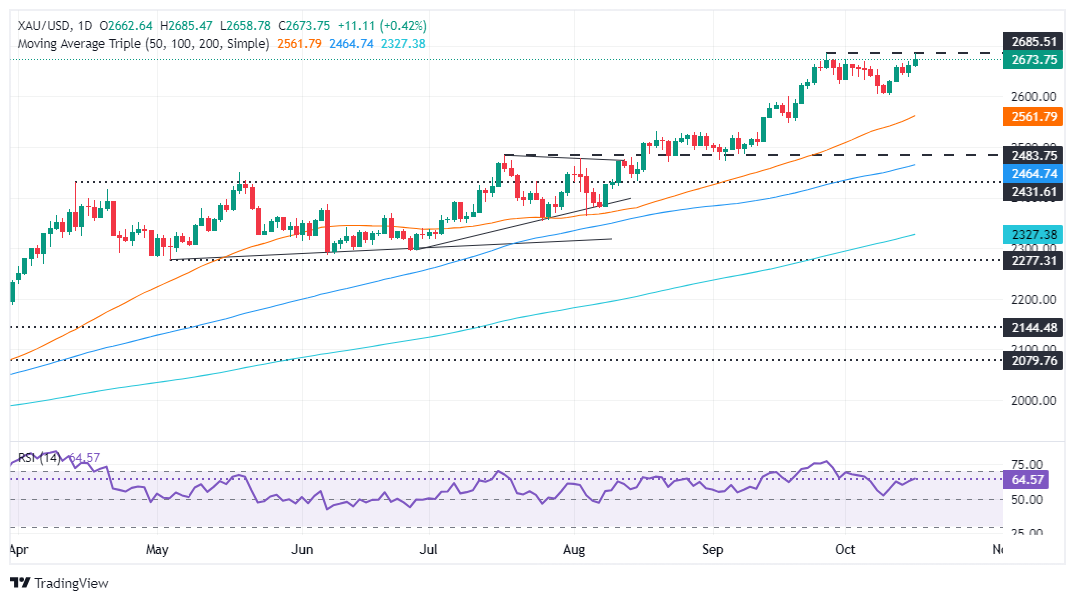
XAU/USD technical outlook: Gold price surges above $2,670, eyes on YTD peak
The uptrend of Gold remains in place, with buyers launching their first attack to the YTD high of $2,685, yet they fell short of cracking the latter. Momentum remains bullish, as shown by the Relative Strength Index (RSI), opening the door for higher prices.
Therefore, Gold’s first resistance is the YTD high at $2,685. Once cleared, a move to $2,700 is on the cards, followed by $2,750 and $2,800.
Conversely, if XAU/USD falls below the October 4 high at $2,670, a retracement toward $2,650 is on the cards. On further weakness, the next support would be $2,600, followed by the 50-day Simple Moving Average (SMA) at $2,561.
Gold FAQs
Gold has played a key role in human’s history as it has been widely used as a store of value and medium of exchange. Currently, apart from its shine and usage for jewelry, the precious metal is widely seen as a safe-haven asset, meaning that it is considered a good investment during turbulent times. Gold is also widely seen as a hedge against inflation and against depreciating currencies as it doesn’t rely on any specific issuer or government.
Central banks are the biggest Gold holders. In their aim to support their currencies in turbulent times, central banks tend to diversify their reserves and buy Gold to improve the perceived strength of the economy and the currency. High Gold reserves can be a source of trust for a country’s solvency. Central banks added 1,136 tonnes of Gold worth around $70 billion to their reserves in 2022, according to data from the World Gold Council. This is the highest yearly purchase since records began. Central banks from emerging economies such as China, India and Turkey are quickly increasing their Gold reserves.
Gold has an inverse correlation with the US Dollar and US Treasuries, which are both major reserve and safe-haven assets. When the Dollar depreciates, Gold tends to rise, enabling investors and central banks to diversify their assets in turbulent times. Gold is also inversely correlated with risk assets. A rally in the stock market tends to weaken Gold price, while sell-offs in riskier markets tend to favor the precious metal.
The price can move due to a wide range of factors. Geopolitical instability or fears of a deep recession can quickly make Gold price escalate due to its safe-haven status. As a yield-less asset, Gold tends to rise with lower interest rates, while higher cost of money usually weighs down on the yellow metal. Still, most moves depend on how the US Dollar (USD) behaves as the asset is priced in dollars (XAU/USD). A strong Dollar tends to keep the price of Gold controlled, whereas a weaker Dollar is likely to push Gold prices up.
Author

Christian Borjon Valencia
FXStreet
Markets analyst, news editor, and trading instructor with over 14 years of experience across FX, commodities, US equity indices, and global macro markets.