Gold price surges on Trump policy, bulls target all-time highs
- Gold hits new 2025 highs amid rising investor anxiety from Trump's trade rhetoric.
- Despite a rise in the US Dollar Index, Gold's ascent signals strong safe-haven demand.
- Geopolitical tensions in the Middle East escalate, alongside potential US economic measures against Russia.

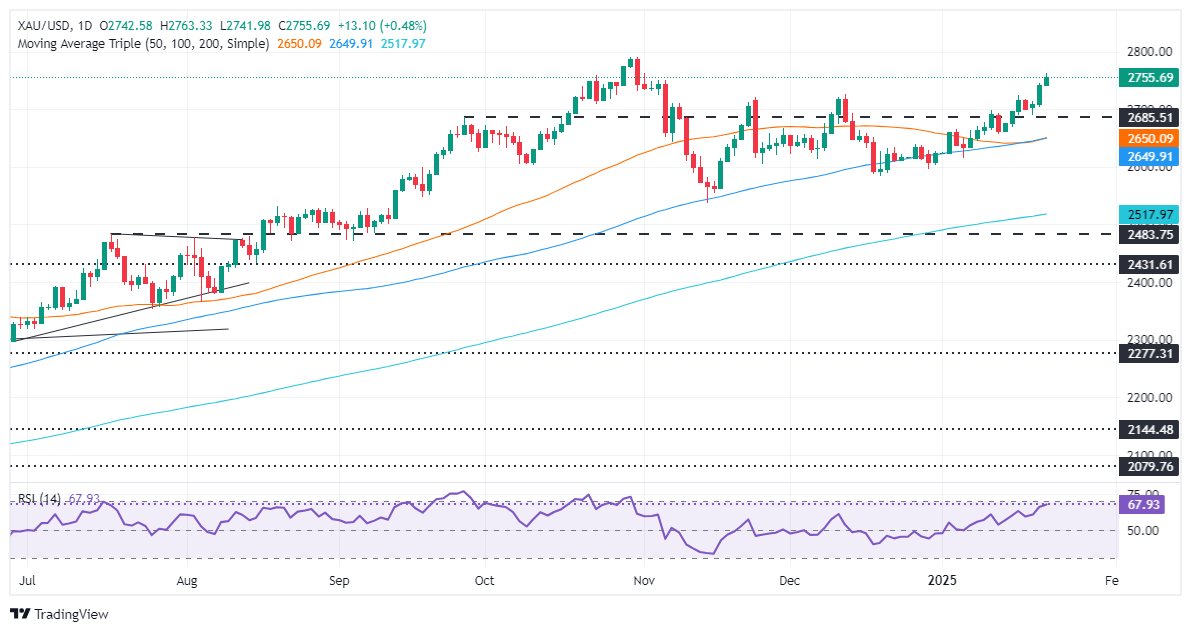
Gold price advances over 0.39% late in the North American session, with the precious metal climbing decisively above the psychological $2,650 figure with buyers setting their sights at the record high of $2,790. At the time of writing, the XAU/SD trades at $2,755 after bouncing off daily lows of $2,741.
The non-yielding metal extended its gains as United States (US) President Donald Trump trade rhetoric broadened from Mexico, Canada and China to the Eurozone. Consequently, as traders grow uncertain about the “trade war” outcome, bought Bullion which has climbed to its highest level during 2025, at $2,763.
The US Dollar Index (DXY), which measures the performance of the Greenback against a basket of six peers and usually correlates inversely to Gold, rises 0.08%, up at 108.16.
A scarce economic docket in the United States keeps traders adrift to geopolitical developments, with Trump grabbing the headlines.
In his Truth account, President Trump said that he’s not looking to hurt Russia, invited President Vladimir Putin to end the war soon and warned that if he doesn’t, he would have to impose taxes, tariffs and sanctions on Russian goods imported to the US.
The US 10-year Treasury bond yield was marginally up during the day, capping Bullion prices advance.
In the Middle East, the ceasefire agreement between Israel and Hamas was set aside as Israel launched a drone attack in the Hasbaya area in southern Lebanon, according to Lebanese press cited by an Israeli journalist Kai.
This week, the US economic docket will feature Initial Jobless Claims data, S&P Global Flash PMIs and housing data.
Daily digest market movers: Gold price soars amid high US yields
- Gold price rises as real yields ascends one basis points. Measured by the 10-year Treasury Inflation-Protected Securities (TIPS) yield sits at 2.18%.
- President Trump confirmed that universal tariffs on all imports to the US are under consideration as well and will come at a later stage, Reuters reports.
- "(Trump) has been perhaps just a shade less hawkish on tariffs as feared, which helps — less/lower tariffs is taken to indicate lower inflation hence potential for more rate cuts," said Tai Wong, an independent metals trader quoted by Reuters.
- Market participants are pricing in near-even odds that the Fed will cut rates twice by the end of 2025, with the first reduction occurring in June.
XAU/USD technical outlook: Gold price clears $2,750, bulls eye record high
Gold prices are set to challenge record high of $2,790 amid ongoing US trade policies uncertainty. The daily chart suggests that XAU/USD could touch the $2,800 level sooner rather than later. A decisive breach of the latter would expose the psychological $2,850 and $2,900 price levels.
On the downside, if bears drag Bullion prices below the $2,750 figure, the 50 and 100-day Simple Moving Averages (SMAs) emerge as support levels, each at $2,648 and $2,647. If surpassed, up next lies the 200-day SMA at $2,515.
Gold FAQs
Gold has played a key role in human’s history as it has been widely used as a store of value and medium of exchange. Currently, apart from its shine and usage for jewelry, the precious metal is widely seen as a safe-haven asset, meaning that it is considered a good investment during turbulent times. Gold is also widely seen as a hedge against inflation and against depreciating currencies as it doesn’t rely on any specific issuer or government.
Central banks are the biggest Gold holders. In their aim to support their currencies in turbulent times, central banks tend to diversify their reserves and buy Gold to improve the perceived strength of the economy and the currency. High Gold reserves can be a source of trust for a country’s solvency. Central banks added 1,136 tonnes of Gold worth around $70 billion to their reserves in 2022, according to data from the World Gold Council. This is the highest yearly purchase since records began. Central banks from emerging economies such as China, India and Turkey are quickly increasing their Gold reserves.
Gold has an inverse correlation with the US Dollar and US Treasuries, which are both major reserve and safe-haven assets. When the Dollar depreciates, Gold tends to rise, enabling investors and central banks to diversify their assets in turbulent times. Gold is also inversely correlated with risk assets. A rally in the stock market tends to weaken Gold price, while sell-offs in riskier markets tend to favor the precious metal.
The price can move due to a wide range of factors. Geopolitical instability or fears of a deep recession can quickly make Gold price escalate due to its safe-haven status. As a yield-less asset, Gold tends to rise with lower interest rates, while higher cost of money usually weighs down on the yellow metal. Still, most moves depend on how the US Dollar (USD) behaves as the asset is priced in dollars (XAU/USD). A strong Dollar tends to keep the price of Gold controlled, whereas a weaker Dollar is likely to push Gold prices up.
Author

Christian Borjon Valencia
FXStreet
Markets analyst, news editor, and trading instructor with over 14 years of experience across FX, commodities, US equity indices, and global macro markets.
















