Gold climbs above $2,700 as Fed rate cut hammers US yields
- Gold benefited from Fed’s dovish rate cut and hints of flexibility in future policy direction.
- Powell signals rate cuts could adapt to labor market shifts, keeping investors cautious.
- Upcoming UoM Consumer Sentiment report and inflation expectations may further impact gold's momentum.

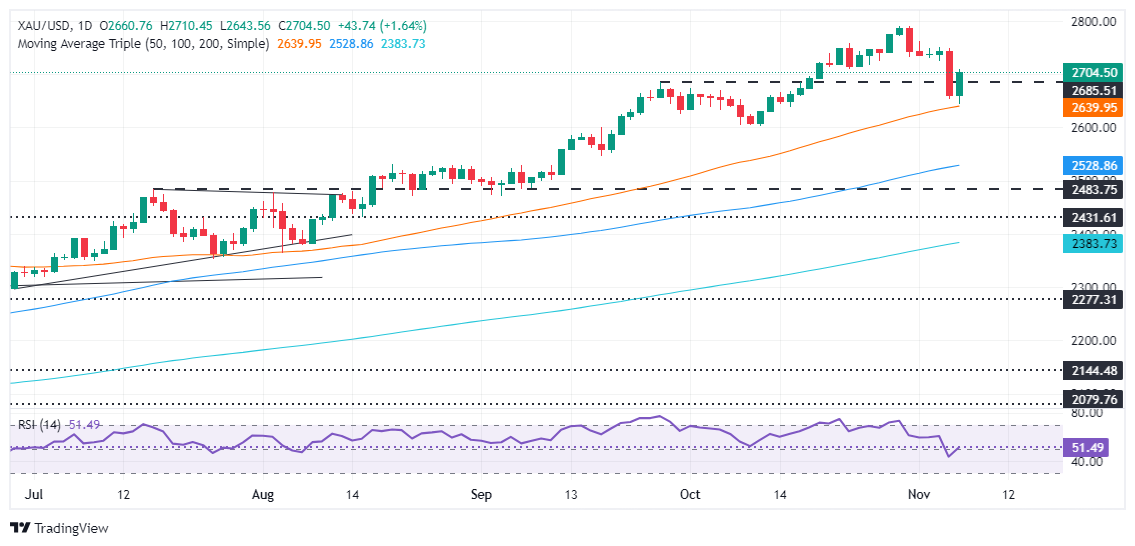
Gold prices climbed above $2,700 after the Federal Reserve (Fed) decided to lower interest rates and acknowledged that US election effects would not be felt in the near term. At the time of writing, XAU/USD trades at $2704, up more than 1.7%.
Wall Street extended its gain after the Fed reduced the federal funds rate by a quarter of a percentage point on a unanimous decision. In the monetary policy statement, officials recognized the solid economic expansion, although labor market conditions softened. They acknowledged that inflation has moved closer to the Fed’s 2% goal but remains somewhat elevated.
Fed policymakers also noted that the risks of meeting their dual mandate are “roughly balanced” but acknowledged uncertainty in the economic outlook. They will remain vigilant to risks on both sides of the mandate.
In his press conference, Jerome Powell avoided giving specific guidance on future rate moves, leaving room for flexibility at the December meeting and beyond. He emphasized that the Fed could afford to take its time to lower rates due to the strong economy. He acknowledged that policy remains restrictive, even after today’s rate cut, as officials aim to bring rates to neutral levels.
Regarding the pace of rate cuts, Powell mentioned that the Fed could speed up if the labor market weakens or slows down as it nears neutral. However, he clarified that no final decisions have been made yet.
Earlier, the US Bureau of Labor Statistics (BLS) reported an anticipated increase in the number of Americans filing for unemployment benefits compared to the previous week.
Ahead of the week, the US economic schedule will feature the University of Michigan (UoM) Consumer Sentiment for November on Friday, alongside a review of inflation expectations.
Daily Digest Market Movers: Gold price rallies boosted by lower US Real yields
- Gold prices soared sharply as US real yields, which inversely correlate against Bullion, tumbled over eleven basis points, down to 1.95%.
- In the meantime, the US Dollar Index (DXY), which tracks the buck’s performance against six peers, plunges 0.76% to 104.31. Yields, particularly the 10-year benchmark note coupon, fall ten basis points to 4.33%.
- The Bureau of Labor Statistics reported that U.S. Initial Jobless Claims rose from 218K to 221K for the week ending November 2, aligning with expectations.
- Earlier in the week, data indicated a widening trade deficit and a slight slowdown in business activity. S&P Global noted a decline in October's service sector activity, while the ISM Services PMI showed improvement for the same month.
- According to the Chicago Board of Trade's December fed funds rate futures, investors anticipate 49 basis points of Fed rate cuts by the end of the year.
XAU/USD Technical Outlook: Gold price tumbles with sellers eyeing $2,650
Gold rebounded at around the 50-day Simple Moving Average (SMA) at $2,639 and aimed towards $2,700, but buyers lacked the strength to push prices higher. The first key resistance area for bulls would be $2,700. If cleared, the next stop would be the 20-day SMA at $2,716, ahead of $2,750, followed by October 23 high at $2,758.
On the other hand, a drop below the November 6 low of $2,652 could push the yellow metal to challenge $2,639, ahead of testing the October 10 low of $2,603.23. Momentum shifted neutral as the Relative Strength Index (RSI) turned bullish but shows signs of consolidation.
Economic Indicator
Fed Interest Rate Decision
The Federal Reserve (Fed) deliberates on monetary policy and makes a decision on interest rates at eight pre-scheduled meetings per year. It has two mandates: to keep inflation at 2%, and to maintain full employment. Its main tool for achieving this is by setting interest rates – both at which it lends to banks and banks lend to each other. If it decides to hike rates, the US Dollar (USD) tends to strengthen as it attracts more foreign capital inflows. If it cuts rates, it tends to weaken the USD as capital drains out to countries offering higher returns. If rates are left unchanged, attention turns to the tone of the Federal Open Market Committee (FOMC) statement, and whether it is hawkish (expectant of higher future interest rates), or dovish (expectant of lower future rates).
Read more.Last release: Thu Nov 07, 2024 19:00
Frequency: Irregular
Actual: 4.75%
Consensus: 4.75%
Previous: 5%
Source: Federal Reserve
Author

Christian Borjon Valencia
FXStreet
Markets analyst, news editor, and trading instructor with over 14 years of experience across FX, commodities, US equity indices, and global macro markets.















