Gold price prolongs its agony and sinks below $2,300
- Gold drops pressured by strong USD and rising Treasury yields.
- DXY hits new monthly peak at 106.13, 10-year yield is up 5.5 bps.
- Fed’s Bowman hints at steady policy and possible hikes if inflation falters.
- Upcoming PCE report expected to show mild inflation decline.

Gold price slumped more than 0.91% on Wednesday as the Greenback soars, underpinned by high US Treasury yields, ahead of the release of the Personal Consumption Expenditures (PCE) Price Index report on Friday. Investors are beginning to price out less easing by the Federal Reserve (Fed), sponsoring the buck’s last leg up. The XAU/USD trades at $2,297 after hitting a daily high of $2,323.
The US Dollar Index (DXY) hit a new monthly high of 106.13 due to the jump in US yields. The 10-year Treasury note yield gains five and a half basis points (bps) at 4.304%.
Fed Governor Michele Bowmanstated on Tuesday that monetary policy will remain steady for “some time” and added that a rate hike would be needed “should progress on inflation stall or even reverse.”
Focus this week will be on the Fed’s preferred gauge for inflation, the May PCE, which is expected to drop from 2.7% to 2.6% YoY, while core PCE is foreseen at 2.6% YoY, down from 2.8%.
Other data will be released, such as the Gross Domestic Product (GDP) Q1 2024 final reading, Durable Goods Orders and Initial Jobless Claims.
Daily digest market movers: Gold price extends its losses on strong US Dollar
- On Monday, San Francisco Fed President Mary Daly leaned dovish as she said, “At this point, inflation is not the only risk we face,” expressing worries about the labor market.
- Fed Governor Lisa Cook was neutral on Tuesday, saying that inflation was most likely to fall “sharply” next year, adding that it would be necessary to ease policy to keep the Fed’s dual mandate more balanced.
- On Thursday, the US economic docket will feature the release of Q1 GDP, expected to end at 1.4% QoQ, down from last year’s Q4 3.4%.
- Durable Goods Orders for May are expected to contract from 0.7% to -0.1%.
- According to CME FedWatch Tool, odds for a 25-basis-point Fed rate cut in September are at 56.3%, down from 59.5% last Tuesday.
- The December 2024 fed funds rate futures contract implies the Fed will ease policy by just 35 basis points (bps) toward the end of the year.
Technical analysis: Gold price respects Head-and-Shoulders neckline, prints new low below $2,300
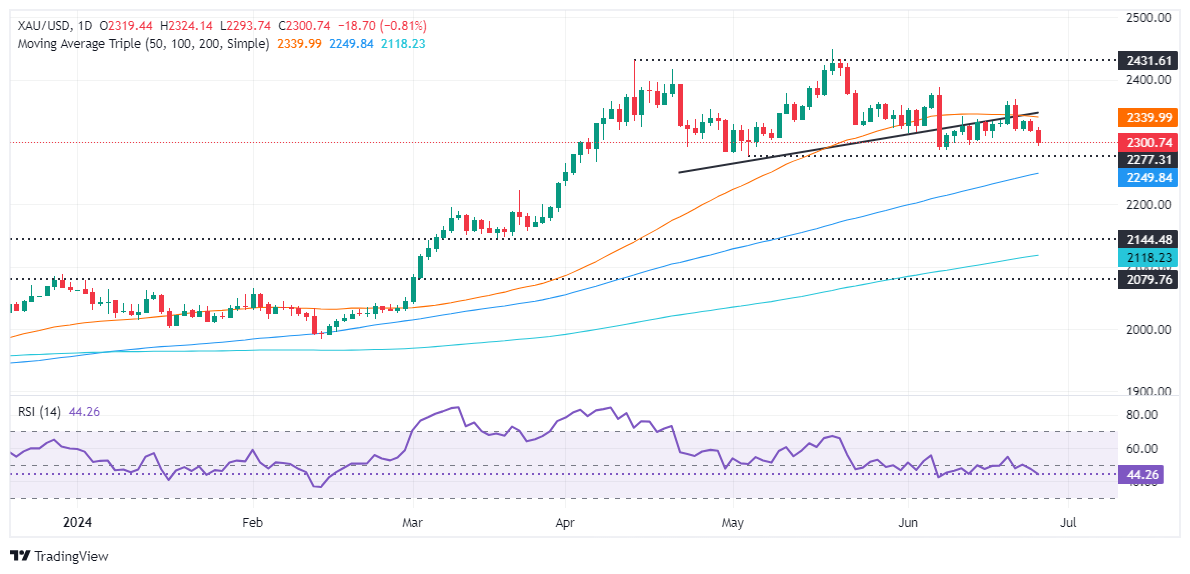
Gold price remains bearishly biased as the Head-and-Shoulders chart pattern remains in play. The XAU/USD spot price has been unable to crack the neckline, validating the chart pattern, which hints that further downside is expected.
Therefore, the XAU/USD next support would be $2,300. Once cleared, the non-yielding metal would fall to $2,277, the May 3 low, followed by the March 21 high of $2,222. Further losses lie underneath, with sellers eyeing the Head-and-Shoulders chart pattern objective from $2,170 to $2,160.
Conversely, if Gold reclaims $2,350, that will expose additional key resistance levels like the June 7 cycle high of $2,387, ahead of challenging the $2,400 figure.
Economic Indicator
Personal Consumption Expenditures - Price Index (YoY)
The Personal Consumption Expenditures (PCE), released by the US Bureau of Economic Analysis on a monthly basis, measures the changes in the prices of goods and services purchased by consumers in the United States (US). The YoY reading compares prices in the reference month to a year earlier. Price changes may cause consumers to switch from buying one good to another and the PCE Deflator can account for such substitutions. This makes it the preferred measure of inflation for the Federal Reserve. Generally, a high reading is bullish for the US Dollar (USD), while a low reading is bearish.
Read more.Next release: Fri Jun 28, 2024 12:30
Frequency: Monthly
Consensus: 2.6%
Previous: 2.7%
Source: US Bureau of Economic Analysis
Author

Christian Borjon Valencia
FXStreet
Markets analyst, news editor, and trading instructor with over 14 years of experience across FX, commodities, US equity indices, and global macro markets.


![How Wall Street rigs the game [Video]](https://editorial.fxsstatic.com/images/i/market-chaos-01.jpg)