Gold price shines as geopolitical tensions outweigh faded US rate cut hopes
- Gold price exhibits strength as geopolitical tensions keep safe-have demand firm.
- The US Dollar bounces back after Fed Williams deliver a hawkish ineterst rate outlook
- Fed Mester is confident about policy normalisation but cautioned that it should not be done in a hurry.

Gold price (XAU/USD) rebounds to $2,380 in Thursday’s early American session after posting losses on Wednesday. The precious metal holds gains amid fears that Middle East tensions could worsen and spread beyond Gaza if Israel responds brutally to Iran.
According to The Times, Israel’s Prime Minister Benjamin Netanyahu has clarified that “their state will do everything necessary to defend itself,” according to The Times. The comments from PM Netanyahu came after his conversation with foreign ministers from the United Kingdom and Germany.
The recovery in Gold has not been impacted by rise in US Treasury yields, which are influenced by the Federal Reserve’s (Fed) interest rate outlook. 10-year US bond yields rises to 4.64%, aiming to recapture more than five-month high of 4.70%. Generaaly, lower yields on interest-bearing assets diminish the cost of holding non-yielding assets such as Gold.
Daily digest market movers: Gold price holds gains despite rebound in US Dollar
- Gold price recovers majority of Wednesday’s losses and rises higher to $2,380 as investors remain worried about geopolitical tensions. Traders continue to gung-ho for Gold amid fears that Israel could retaliate to Iran’s attack on their territory in which the Iranian military launched hundreds of drones and missiles.
- The US Dollar rebounds despite other central banks from developed nations are also expected to delay their rate cut plans due to persistent price pressures. The US Dollar Index (DXY), which tracks the US Dollar’s value against six major currencies, recovers after correcting to 105.75.
- The near-term demand for the US Dollar remains firm as Federal Reserve (Fed) policymakers see interest rates remaining higher for a longer period until they get convincing data that inflation will return sustainably to the desired rate of 2%.
- In Thursday's New York session, New York Federal Reserve President John Williams has delivered a hawkish interest rate guidance. Fed Williams doesn't see urgency for rate cuts and warned that the central bank is ready to hike again if data suggests.
- On Wednesday, Cleveland Fed Bank President Loretta Mester also argued for keeping the monetary policy framework restrictive. Mester remained optimistic that the Fed will eventually gain the confidence to lower interest rates and start normalising policy again, but that shouldn’t be done quickly.
- On the economic data front, the US Department of Labor has posted steady Individual Jobless Claims for the week ending April 12. Individuals claiming jobless benefits for the first time were similar to previous week's reading of 212K, slightly lower than the estimates of 215K
Technical Analysis: Gold price aims to recapture $2,400
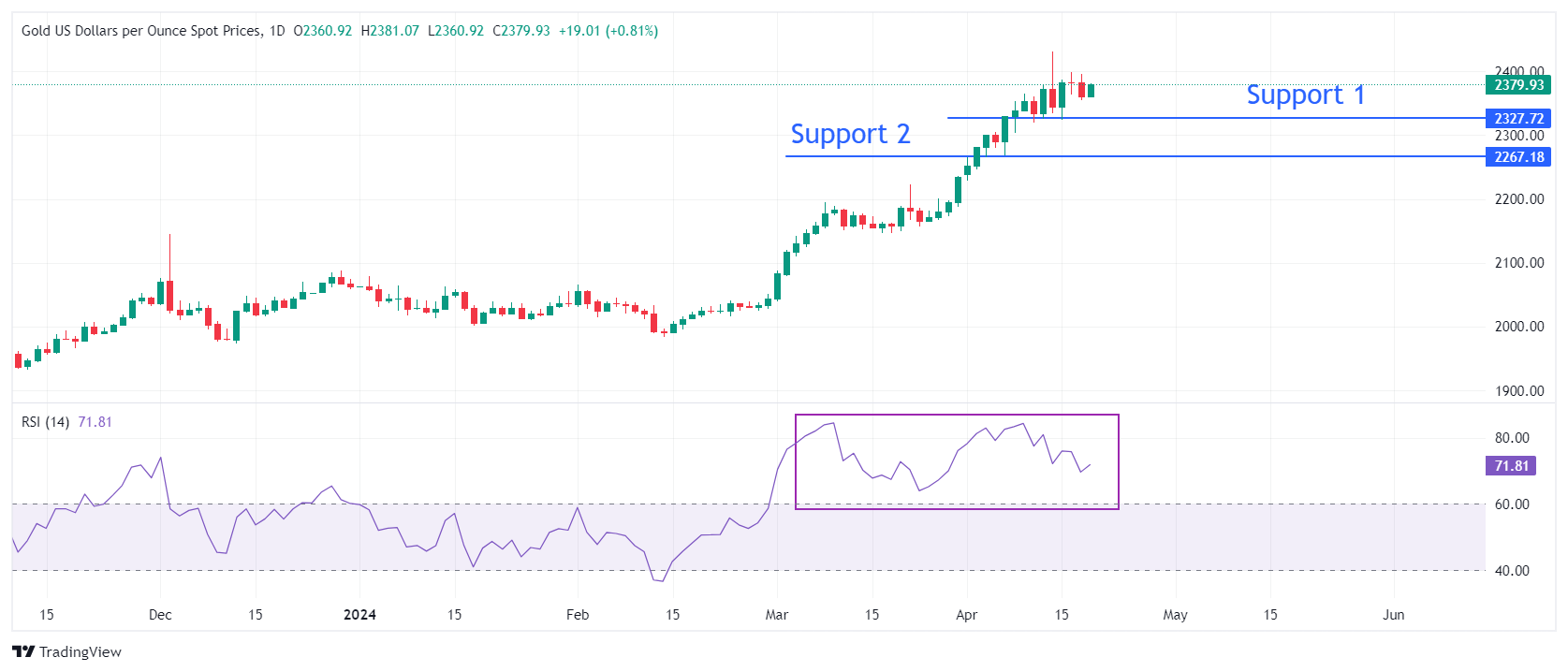
Gold price advances to $2,380 in Thursday’s London session after edging down on Wednesday. The precious metal remains inside the $2,350-2,400 trading range from the last two trading sessions. The upside in the precious metal remains limited as momentum oscillators are cooling down after turning extremely overbought. The 14-period Relative Strength Index (RSI) on the daily chart drops slightly after peaking around 85.00. The broader-term demand is intact as the RSI remains in the bullish range of 60.00-80.00.
On the downside, April 5 low near $2,268 and March 21 high at $2,223 will be major support areas for the Gold price.
Fed FAQs
Monetary policy in the US is shaped by the Federal Reserve (Fed). The Fed has two mandates: to achieve price stability and foster full employment. Its primary tool to achieve these goals is by adjusting interest rates. When prices are rising too quickly and inflation is above the Fed’s 2% target, it raises interest rates, increasing borrowing costs throughout the economy. This results in a stronger US Dollar (USD) as it makes the US a more attractive place for international investors to park their money. When inflation falls below 2% or the Unemployment Rate is too high, the Fed may lower interest rates to encourage borrowing, which weighs on the Greenback.
The Federal Reserve (Fed) holds eight policy meetings a year, where the Federal Open Market Committee (FOMC) assesses economic conditions and makes monetary policy decisions. The FOMC is attended by twelve Fed officials – the seven members of the Board of Governors, the president of the Federal Reserve Bank of New York, and four of the remaining eleven regional Reserve Bank presidents, who serve one-year terms on a rotating basis.
In extreme situations, the Federal Reserve may resort to a policy named Quantitative Easing (QE). QE is the process by which the Fed substantially increases the flow of credit in a stuck financial system. It is a non-standard policy measure used during crises or when inflation is extremely low. It was the Fed’s weapon of choice during the Great Financial Crisis in 2008. It involves the Fed printing more Dollars and using them to buy high grade bonds from financial institutions. QE usually weakens the US Dollar.
Quantitative tightening (QT) is the reverse process of QE, whereby the Federal Reserve stops buying bonds from financial institutions and does not reinvest the principal from the bonds it holds maturing, to purchase new bonds. It is usually positive for the value of the US Dollar.
Author

Sagar Dua
FXStreet
Sagar Dua is associated with the financial markets from his college days. Along with pursuing post-graduation in Commerce in 2014, he started his markets training with chart analysis.


![How Wall Street rigs the game [Video]](https://editorial.fxsstatic.com/images/i/market-chaos-01.jpg)