Gold price weekly uptrend remains uninterrupted despite positive risk tone
- Gold price attracts buyers for the fourth consecutive day and climbs to over a one-week high.
- Geopolitical risks stemming from the Russia-Ukraine conflict benefit the safe-haven XAU/USD.
- Elevated US bond yields could underpin the US Dollar and cap the non-yielding yellow metal.

Gold price (XAU/USD) adds to its intraday gains and climbs to a fresh one-and-half-week high, around the $2,664-2,665 area during the first half of the European session on Thursday. The uptrend witnessed since the beginning of the current week is fueled by geopolitical risks stemming from the worsening Russia-Ukraine war, which tends to benefit the safe-haven precious metal. Apart from this, a modest US Dollar (USD) downtick acts as a tailwind for the commodity.
Meanwhile, expectations that US President-elect Donald Trump's proposed tariffs could spur inflationary pressures and limit the scope of the Federal Reserve (Fed) to cut interest rates remain supportive of elevated US Treasury bond yields. This, along with a generally positive risk tone might hold back traders from placing aggressive bullish bets around the XAU/USD. Next on tap is the US macro data, which, along with Fed speaks, should provide a fresh impetus to the precious metal.
Gold price continues to attract haven flows amid worsening Russia-Ukraine conflict
- Geopolitical tensions intensified after Russian President Vladimir Putin lowered the threshold for nuclear strikes and underpinned the safe-haven Gold price for the fourth straight day on Thursday.
- Investors seem convinced that US President-elect Donald Trump's proposed expansionary policies could accelerate inflation and force the Federal Reserve to slow the pace of its rate-cutting cycle.
- Moreover, a slew of influential Fed officials recently cautioned on further policy easing, which remains supportive of elevated US Treasury bond yields and keeps the US Dollar near the YTD high.
- Lisa Cook, a member of the Federal Reserve Board of Governors, noted on Wednesday that the central bank might get forced into a pause on interest rate cuts if inflation progress slows down.
- Separately, Fed Governor Michelle Bowman said that the progress on inflation appears to have stalled and that the US central bank should pursue a cautious approach to monetary policy.
- Meanwhile, Boston Fed President Susan Collins said that more interest rate cuts are needed, but policymakers should proceed carefully to avoid moving too quickly or too slowly.
- According to the CME Group's FedWatch Tool, traders are currently pricing in just over a 50% chance that the Fed will lower borrowing costs at its December monetary policy meeting.
- The yield on the benchmark 10-year US government advanced by the most in a week on Wednesday, which, along with a positive risk tone, might cap the safe-haven precious metal.
- Thursday's US economic docket features the usual Weekly Initial Jobless Claims, the Philly Fed Manufacturing Index and Existing Home Sales data later during the North American session.
- Investors will also scrutinize speeches from Fed policymakers for cues about the future rate-cut path, which will drive the USD and provide some impetus to the non-yielding XAU/USD.
Gold price is likely to accelerate the positive move once the $2,665 hurdle is cleared
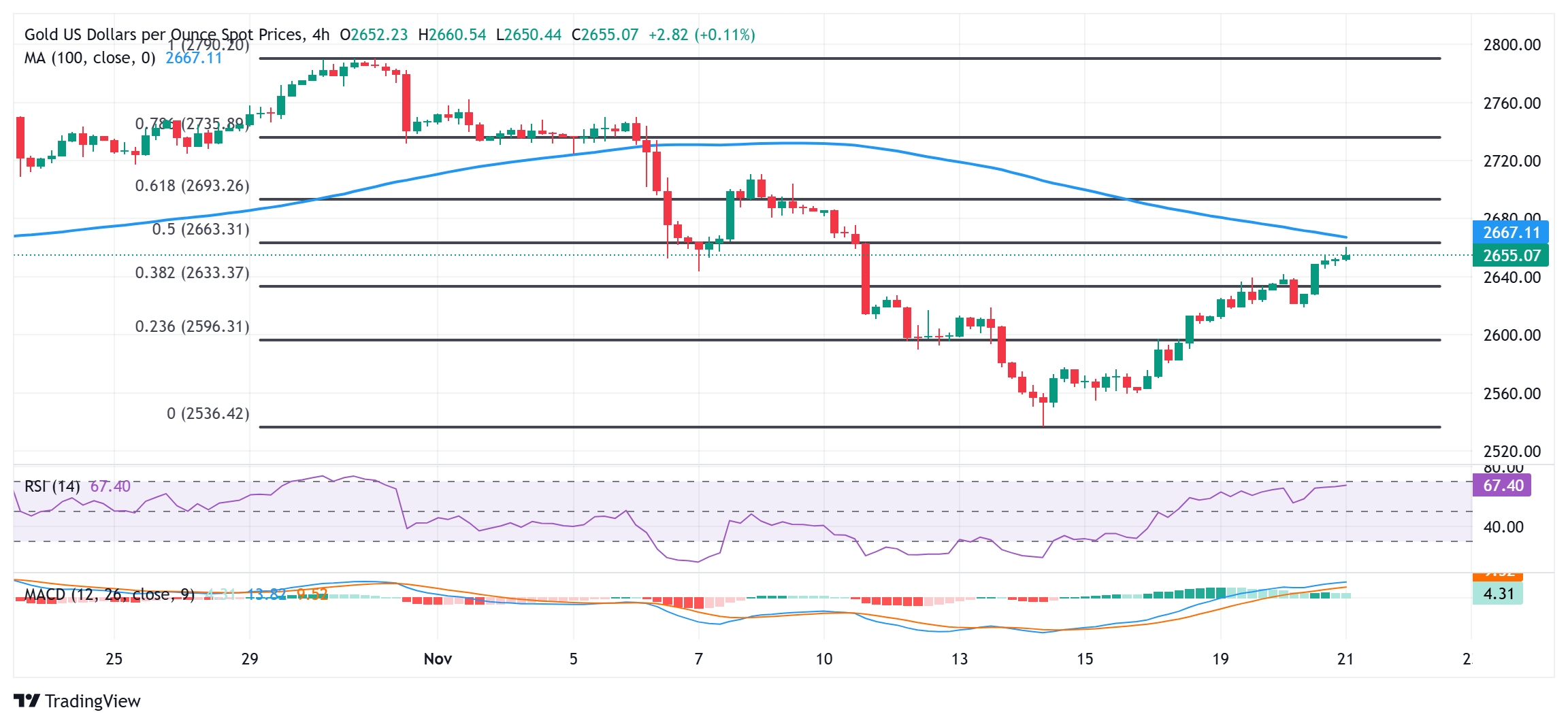
From a technical perspective, the intraday move-up could faces some resistance near the 50% retracement level of the recent pullback from the all-time peak touched in October, around the $2,665 area. The said barrier coincides with the 100-period Simple Moving Average (SMA) on the 4-hour chart, above which the Gold price could accelerate the momentum towards the $2,670-2,672 congestion zone. Some follow-through buying could allow the XAU/USD to aim at reclaiming the $2,700 round figure.
On the flip side, the $2,635-2,634 area, or the 38.2% Fibonacci retracement level, now seems to protect the immediate downside ahead of the $2,622-2,620 region and the $2,600 round figure. A convincing break below the latter could make the Gold price vulnerable and expose the 100-day Simple Moving Average (SMA), around the $2,557 region, with some intermediate support near the $2,570 zone. This is followed by last week’s swing low, around the $2,537-2,536 area, which if broken decisively will be seen as a fresh trigger for bearish traders and set the stage for deeper losses.
Risk sentiment FAQs
In the world of financial jargon the two widely used terms “risk-on” and “risk off'' refer to the level of risk that investors are willing to stomach during the period referenced. In a “risk-on” market, investors are optimistic about the future and more willing to buy risky assets. In a “risk-off” market investors start to ‘play it safe’ because they are worried about the future, and therefore buy less risky assets that are more certain of bringing a return, even if it is relatively modest.
Typically, during periods of “risk-on”, stock markets will rise, most commodities – except Gold – will also gain in value, since they benefit from a positive growth outlook. The currencies of nations that are heavy commodity exporters strengthen because of increased demand, and Cryptocurrencies rise. In a “risk-off” market, Bonds go up – especially major government Bonds – Gold shines, and safe-haven currencies such as the Japanese Yen, Swiss Franc and US Dollar all benefit.
The Australian Dollar (AUD), the Canadian Dollar (CAD), the New Zealand Dollar (NZD) and minor FX like the Ruble (RUB) and the South African Rand (ZAR), all tend to rise in markets that are “risk-on”. This is because the economies of these currencies are heavily reliant on commodity exports for growth, and commodities tend to rise in price during risk-on periods. This is because investors foresee greater demand for raw materials in the future due to heightened economic activity.
The major currencies that tend to rise during periods of “risk-off” are the US Dollar (USD), the Japanese Yen (JPY) and the Swiss Franc (CHF). The US Dollar, because it is the world’s reserve currency, and because in times of crisis investors buy US government debt, which is seen as safe because the largest economy in the world is unlikely to default. The Yen, from increased demand for Japanese government bonds, because a high proportion are held by domestic investors who are unlikely to dump them – even in a crisis. The Swiss Franc, because strict Swiss banking laws offer investors enhanced capital protection.
Author

Haresh Menghani
FXStreet
Haresh Menghani is a detail-oriented professional with 10+ years of extensive experience in analysing the global financial markets.