Gold price recovers to all time highs as US Dollar weakens after poor Services PMI
- Gold price bounces back to $2,280 after weak US ISM Services PMI
- Fed policymakers see no urgency for rate cuts.
- Investors await the Fed Powell’s speech for fresh guidance on interest rates.
Gold price (XAU/USD) recovers intraday losses and rebounds to fresh all-time highs near $2,280 in Wednesday’s early New York session. The precious metal strengthens after the United States Institute of Supply Management (ISM) reported weak Services PMI data for March. The Services PMI, which represents the service sector that accounts for two-thirds of the US economy, falls to 51.4 from expectations of 52.7 and the prior reading of 52.6. Weak Services PMI data has put significant pressure on the US Dollar. The US Dollar Index (DXY) slumps to 104.40
The near-term demand for precious metals is also upbeat due to deepening geopolitical tensions in Eastern Europe and the Middle East. Escalating geopolitical tensions have increased demand for safe-haven assets, providing strength to bullions. This is offsetting the impact of higher bond yields and waning Federal Reserve (Fed) rate cut expectations for the June meeting.
10-year US Treasury yields rise to 4.40% after Atlanta Federal Reserve Bank President Raphael Bostic gave hawkish interest rate guidance. Fed Bostic said he sees the central bank reducing interest rates only once this year. Bostic expects inflation to return to the 2% target until 2026. He added, "The Economy is maintaining the strong momentum it has had."
On Tuesday, two Fed policymakers said they see no need to hurry for rate cuts due to a strong economic outlook and tight labor market conditions. Cleveland Fed Bank President Loretta Mester added, “I think the bigger risk would be to begin reducing the funds rate too early.” Fed’s pivot to rate cuts could tighten the labor market further, which will eventually increase wage growth and revamp inflation. Generally, higher bond yields dampen Gold’s appeal as they increase the opportunity cost of holding investment in the latter.
This week, the major event will be the United States Nonfarm Payrolls (NFP) data, which will be published on Friday. The labor market data will influence market expectations for Fed rate cuts in June.
Daily digest market movers: Gold price recovers as US Dollar falls sharply
- Gold price keeps rising as geopolitical tensions strengthen the safe-haven bid. Rising geopolitical tensions lead investors towards safe-haven assets such as Gold.
- In the eastern part of Europe, continuous drone attacks from Ukraine on Russian Oil refineries have resulted in a fresh escalation in the Moscow-Kyiv tensions. US President Joe Biden criticized the event of Ukraine targeting Russia’s Oil infrastructure as it could have drastic consequences for global Oil prices.
- In the Middle East, Iran vows to retaliate on the deaths of their high-ranking commanders in an attack at the Iranian embassy in Damascus by the Israeli army. This has deepened fears of Iran’s direct entry into Israel-Palestine tensions. Moreover, the killing of seven aid workers in Gaza on Tuesday after an Israeli attack has also raised tensions between Israel and some of its main allies in the West.
- The Gold price maintains strength even though Federal Reserve policymakers seem to be leaning towards delaying interest-rate cuts until later than June. Cleveland Fed Bank President Loretta Mester and San Francisco Fed Bank President Mary Daly spoke on Tuesday. They both suggested that the Fed sees more risk in cutting interest rates too early. Fed Mester added: “With labor markets and economic growth both being very solid, we do not need to take that risk.” Both policymakers see three rate cuts as “reasonable” this year.
- Meanwhile, the US ADP reported robust hiring by private employers in March. 184K job-seekers were hired against expectations of 148K and February's reading of 155K, upwardly revised from 140K.
- Going forward, investors will focus on Fed Chairman Jerome Powell’s speech. Powell is expected to provide cues about when the central bank will pivot to rate cuts.
Technical Analysis: Gold price rebounds to fresh lifetime highs near $2,290
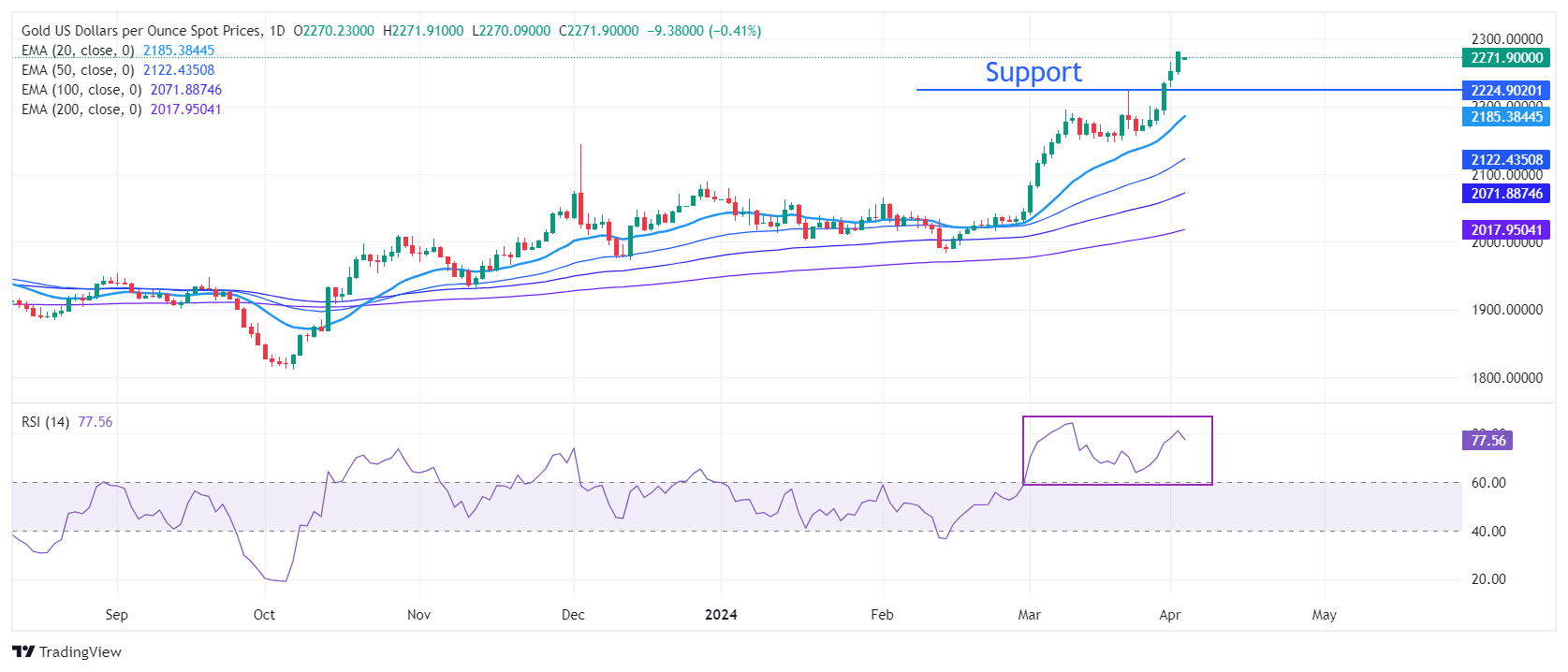
Gold price secures another milestone in Wednesday’s session. The precious metal prints a fresh all-time high near $2,290 after extending above Tuesday’s high of $2,275. However, the yellow metal struggles to continue its six-day winning spell as momentum oscillators have turned extremely overbought. The 14-period Relative Strength Index (RSI) tests 80.00.
The near-term demand is strong as the RSI has been oscillating in the bullish range of 60.00-80.00 for more than a month, making it a “buy on dips” contender.
All short-to-long term Exponential Moving Averages (EMAs) are sloping higher, suggesting strong near-term demand. On the downside, March 21 high at $2,223 will be a major support area for the Gold price bulls.
US Dollar FAQs
The US Dollar (USD) is the official currency of the United States of America, and the ‘de facto’ currency of a significant number of other countries where it is found in circulation alongside local notes. It is the most heavily traded currency in the world, accounting for over 88% of all global foreign exchange turnover, or an average of $6.6 trillion in transactions per day, according to data from 2022. Following the second world war, the USD took over from the British Pound as the world’s reserve currency. For most of its history, the US Dollar was backed by Gold, until the Bretton Woods Agreement in 1971 when the Gold Standard went away.
The most important single factor impacting on the value of the US Dollar is monetary policy, which is shaped by the Federal Reserve (Fed). The Fed has two mandates: to achieve price stability (control inflation) and foster full employment. Its primary tool to achieve these two goals is by adjusting interest rates. When prices are rising too quickly and inflation is above the Fed’s 2% target, the Fed will raise rates, which helps the USD value. When inflation falls below 2% or the Unemployment Rate is too high, the Fed may lower interest rates, which weighs on the Greenback.
In extreme situations, the Federal Reserve can also print more Dollars and enact quantitative easing (QE). QE is the process by which the Fed substantially increases the flow of credit in a stuck financial system. It is a non-standard policy measure used when credit has dried up because banks will not lend to each other (out of the fear of counterparty default). It is a last resort when simply lowering interest rates is unlikely to achieve the necessary result. It was the Fed’s weapon of choice to combat the credit crunch that occurred during the Great Financial Crisis in 2008. It involves the Fed printing more Dollars and using them to buy US government bonds predominantly from financial institutions. QE usually leads to a weaker US Dollar.
Quantitative tightening (QT) is the reverse process whereby the Federal Reserve stops buying bonds from financial institutions and does not reinvest the principal from the bonds it holds maturing in new purchases. It is usually positive for the US Dollar.
Author

Sagar Dua
FXStreet
Sagar Dua is associated with the financial markets from his college days. Along with pursuing post-graduation in Commerce in 2014, he started his markets training with chart analysis.