Gold prices soar on safe-haven demand amid Middle East conflict
- Gold rises over 1% after Iran launched missiles at Israel, intensifying Middle East conflict.
- Market focus shifts from strong US jobs data to geopolitical uncertainty, driving risk aversion and boosting safe-haven demand for Gold.
- A daily close below $2,665 could trigger a pullback, but ongoing tensions keep bullish momentum alive for new record highs.

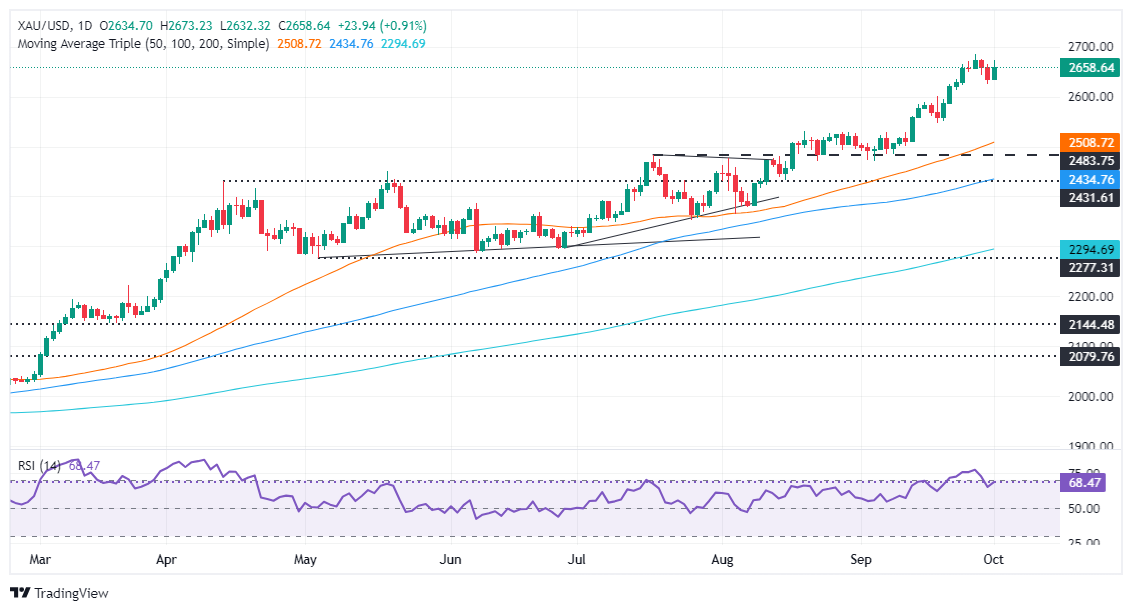
Gold price rallied over 1% on Tuesday amid growing tensions in the Middle East as Israel’s attack on Hezbollah spurred Iran’s reaction, which launched nearly two hundred missiles. This sponsored a leg-up in the non-yielding metal, shrugging off overall US Dollar strength. At the time of writing, the XAU/USD trades at $2,662 after bouncing off daily lows of $2,632.
Risk aversion is the name of the game, as investors' focus shifted from better-than-expected US jobs data to stabilized business activity in the manufacturing sector, according to the Institute for Supply Management (ISM).
Newswires revealed that Iran attacked Israel. According to ABC sources, Iran will launch 240-250 missiles at Israel. In the meantime, Israel revealed that the air force will continue striking targets in Lebanon, while US National Security Adviser Sullivan said, “There will be severe consequences for this attack.”
Jim Wyckoff, Kitco Analyst, wrote, “It’s very likely gold prices will hit new record highs if Iran strikes Israel. Silver prices would also likely hit new for-the-move highs.”
Gold prices extended their gains, printing a weekly high of $2,673. However, a daily close below the September 30 high of $2,665 could open the door for a pullback if geopolitical risks calm.
The Greenback, as measured by the US Dollar Index (DXY), rises 0.43% to 101.19, capping the non-yielding metal rally.
Daily digest market movers: Gold price rises on Mideast hostilities
- The US Department of Labor revealed that the August Job Openings & Labor Turnover Survey (JOLTS) increased from 7.711 million to 8.04 million, exceeding estimates of 7.655 million.
- The ISM Manufacturing PMI for September remained steady at 47.2, unchanged from the previous reading, but fell short of estimates of 47.5.
- Market participants have placed the odds of a 25 bps rate cut at 61.6%. According to the CME FedWatch Tool, the chances of a larger 50 bps cut have diminished to 38.4%.
XAU/USD technical analysis: Gold price climbs above $2,660
Gold price reversed Monday’s pullback toward $2,624 amid risk aversion. An escalation of the Middle East conflict could pave the way for higher prices. Although momentum favors buyers, as depicted by the Relative Strength Index (RSI), downside risks remain.
If Gold clears the all-time high of $2,685, it could extend its gains to $2,700. Conversely, if XAU/USD drops below $2,650, the door opened to testing the daily September 18 high at $2,600. Once surrendered, the following support will be the September 18 low of $2,546, followed by the 50-day Simple Moving Average (SMA) at $2,503.
Gold FAQs
Gold has played a key role in human’s history as it has been widely used as a store of value and medium of exchange. Currently, apart from its shine and usage for jewelry, the precious metal is widely seen as a safe-haven asset, meaning that it is considered a good investment during turbulent times. Gold is also widely seen as a hedge against inflation and against depreciating currencies as it doesn’t rely on any specific issuer or government.
Central banks are the biggest Gold holders. In their aim to support their currencies in turbulent times, central banks tend to diversify their reserves and buy Gold to improve the perceived strength of the economy and the currency. High Gold reserves can be a source of trust for a country’s solvency. Central banks added 1,136 tonnes of Gold worth around $70 billion to their reserves in 2022, according to data from the World Gold Council. This is the highest yearly purchase since records began. Central banks from emerging economies such as China, India and Turkey are quickly increasing their Gold reserves.
Gold has an inverse correlation with the US Dollar and US Treasuries, which are both major reserve and safe-haven assets. When the Dollar depreciates, Gold tends to rise, enabling investors and central banks to diversify their assets in turbulent times. Gold is also inversely correlated with risk assets. A rally in the stock market tends to weaken Gold price, while sell-offs in riskier markets tend to favor the precious metal.
The price can move due to a wide range of factors. Geopolitical instability or fears of a deep recession can quickly make Gold price escalate due to its safe-haven status. As a yield-less asset, Gold tends to rise with lower interest rates, while higher cost of money usually weighs down on the yellow metal. Still, most moves depend on how the US Dollar (USD) behaves as the asset is priced in dollars (XAU/USD). A strong Dollar tends to keep the price of Gold controlled, whereas a weaker Dollar is likely to push Gold prices up.
Author

Christian Borjon Valencia
FXStreet
Markets analyst, news editor, and trading instructor with over 14 years of experience across FX, commodities, US equity indices, and global macro markets.