Gold price faces challenges due to decline in safe-haven flows, awaits Fed rate decision
- Gold price depreciated as the US Dollar appreciated to a four-month high due to Trump trades.
- Precious metals are under pressure as safe-haven flows decline due to market optimism.
- The non-yielding XAU/USD faces challenges as US Treasury yields trade near the highest levels since July.

Gold price (XAU/USD) faced challenges as the dollar-denominated precious metals struggled due to a stronger US Dollar (USD) following the victory of former President Donald Trump in the US election.
Gold prices are under pressure as safe-haven flows decline amid market optimism and “Trump trades.” This shift is driven by the clarity of a presidential victory, while the market had previously been anticipating a contested outcome.
US Federal Reserve’s (Fed) policy decision will be eyed on Thursday. Markets expect a modest 25 basis point rate cut this week. This could provide support for Gold as lower interest rates reduce the opportunity cost of holding non-interest-bearing assets.
The CME FedWatch Tool shows a 98.1% probability of a quarter-point rate cut by the Fed in November.
Daily Digest Market Movers: Gold price struggles due to market optimism, Trump trades
- Non-yielding Gold faced downward pressure as US Treasury yields surged to their highest levels since July on Wednesday. The 2-year and 10-year US Treasury bond yields rose to 4.31% and 4.47%, respectively.
- Gold price may receive support as Republican Donald Trump could lead to higher inflation, given his pledge to significantly raise trade tariffs. This may prompt investors to seek safe-haven assets as a hedge against long-term inflation risks.
- Trump’s economic policy includes imposing tariffs, increasing the fiscal deficit, and reducing taxes. These proposals conflict with the Federal Reserve’s efforts to control inflation, likely prompting the US central bank to take a more gradual approach to easing monetary policy.
- The decline in the safe-haven XAU/USD seems relatively unaffected by concerns over Iran's plans for a retaliatory strike against Israel’s attack on its territory on October 26.
- On Tuesday, the US ISM Services Purchasing Managers Index increased to 56.0 in October, up from 54.9 in September, exceeding the forecast of 53.8. In contrast, the S&P Global Services PMI registered at 55.0 in October, slightly below the prior reading and the expected 55.3.
Technical Outlook: Gold price falls to near $2,650, next support around three-week lows
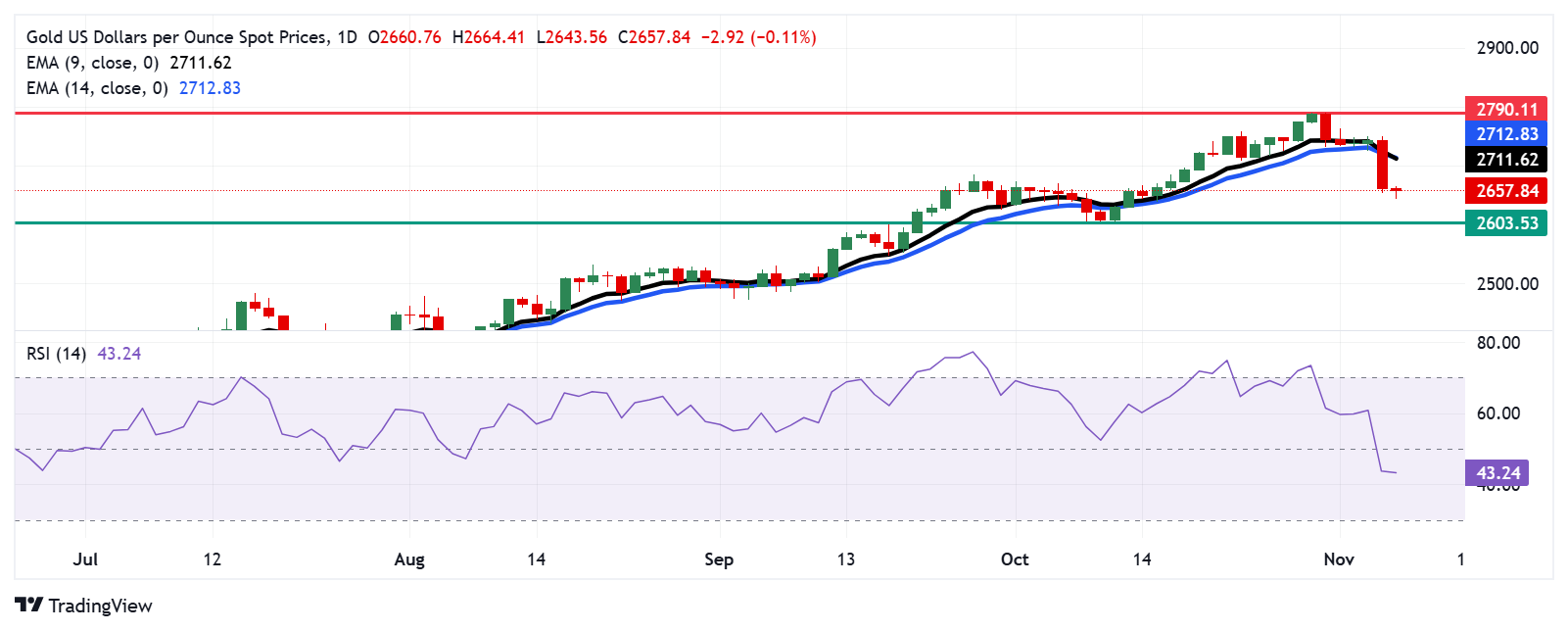
Gold price trades around $2,650 per troy ounce on Thursday, with technical analysis suggesting a potential continuation of the bearish bias. On the daily chart, the price remains below both the nine- and 14-day Exponential Moving Averages (EMAs). Furthermore, the 14-day Relative Strength Index (RSI) is below 50, which supports a bearish outlook for the yellow metal.
On the downside, the XAU/USD pair could test a three-week low of $2,603.53. A break below this level could put pressure on the Gold price to navigate the region around the psychological level of $2,500.00.
In terms of resistance, the psychological level of $2,700.00 appears as the immediate barrier, followed by the nine-day EMA at $2,711.40. A break above this level could support the pair to test the all-time high of $2,790.11, which was recorded on October 31.
XAU/USD: Daily Chart
Gold FAQs
Gold has played a key role in human’s history as it has been widely used as a store of value and medium of exchange. Currently, apart from its shine and usage for jewelry, the precious metal is widely seen as a safe-haven asset, meaning that it is considered a good investment during turbulent times. Gold is also widely seen as a hedge against inflation and against depreciating currencies as it doesn’t rely on any specific issuer or government.
Central banks are the biggest Gold holders. In their aim to support their currencies in turbulent times, central banks tend to diversify their reserves and buy Gold to improve the perceived strength of the economy and the currency. High Gold reserves can be a source of trust for a country’s solvency. Central banks added 1,136 tonnes of Gold worth around $70 billion to their reserves in 2022, according to data from the World Gold Council. This is the highest yearly purchase since records began. Central banks from emerging economies such as China, India and Turkey are quickly increasing their Gold reserves.
Gold has an inverse correlation with the US Dollar and US Treasuries, which are both major reserve and safe-haven assets. When the Dollar depreciates, Gold tends to rise, enabling investors and central banks to diversify their assets in turbulent times. Gold is also inversely correlated with risk assets. A rally in the stock market tends to weaken Gold price, while sell-offs in riskier markets tend to favor the precious metal.
The price can move due to a wide range of factors. Geopolitical instability or fears of a deep recession can quickly make Gold price escalate due to its safe-haven status. As a yield-less asset, Gold tends to rise with lower interest rates, while higher cost of money usually weighs down on the yellow metal. Still, most moves depend on how the US Dollar (USD) behaves as the asset is priced in dollars (XAU/USD). A strong Dollar tends to keep the price of Gold controlled, whereas a weaker Dollar is likely to push Gold prices up.
Author

Akhtar Faruqui
FXStreet
Akhtar Faruqui is a Forex Analyst based in New Delhi, India. With a keen eye for market trends and a passion for dissecting complex financial dynamics, he is dedicated to delivering accurate and insightful Forex news and analysis.