Gold price remains upbeat against US Dollar ahead of US core PCE price index data
- Gold price seeks more upside amid weak US Durable Goods Order data.
- Fed’s Schmid says there is no need to rush rate cuts.
- The US core PCE price index data will significantly impact prospects for Fed rate cuts.

Gold price (XAG/USD) exhibits strength against the US Dollar in Tuesday’s early New York session on hopes that the Federal Reserve (Fed) will eventually bring interest rates down. However, the upside in the precious metal seems capped as Fed policymakers lean towards maintaining interest rates higher for longer to build downward pressure on sticky inflation.
Non-yielding assets, such as Gold, attract higher inflows when investors believe the Fed will eventually begin to roll back its restrictive interest rate stance. Spot prices of Gold are up by 0.23% at $2,036.
Fed policymakers underpin a wait-and-watch approach on interest rates, citing that risks associated with premature rate cuts are higher than postponing them. The Fed is expected to avoid considering rate cuts until it gets evidence that inflation will fall sustainably to the 2% target.
This week, the US Dollar will be guided by the United States core Personal Consumption Expenditure – Price Index (PCE) data, which will be published on Thursday. Fed policymakers consider the underlying inflation data before preparing remarks on interest rates. The degree of change in the core PCE inflation data would influence market expectations for rate cuts.
Daily Digest Market Movers: Gold price awaits US core PCE data
- Gold price rises sharply to $2,040 as the US Dollar falls onto the backfoot.
- The precious metal climbs to almost a three-week high even though investors remain uncertain about rate cuts by the Federal Reserve (Fed).
- All Fed policymakers have argued against premature rate cuts as they could flare up price pressures again.
- Also, policymakers still gather evidence to confirm that inflation will decline sustainably to the 2% target.
- On Monday, Kansas City Federal Reserve Bank President Jeffrey Schmid said a tight labor market, considerable momentum in households’ demand, and inflation above 2% leave no room for an aggressive adjustment in the monetary policy stance.
- As per the viewpoint of Jeffrey Schmid, the Fed needs to be patient and observe how the economy responds to policy tightening. The rate cuts could be announced only after gaining confidence that a victory can be announced against sticky inflation.
- Meanwhile, the US Census Bureau has reported weaker than anticipated Durable Goods Orders data for January. New orders for Durable goods were contracted sharply by 6.1% against expectations of 4.8%. The economic data for December has been revised to -0.3% from a stagnant performance.
- Going forward, investors will majorly focus on the core PCE price index, which could meaningfully influence the expectations for rate cuts by the Fed.
- The expectations from investors show that the core PCE price index data rose by 0.4% on a month-on-month basis against a 0.2% increase in December. In the same period, the annual inflation data is expected to have decelerated to 2.8% from 2.9%.
Technical Analysis: Gold price aims to recapture $2,040
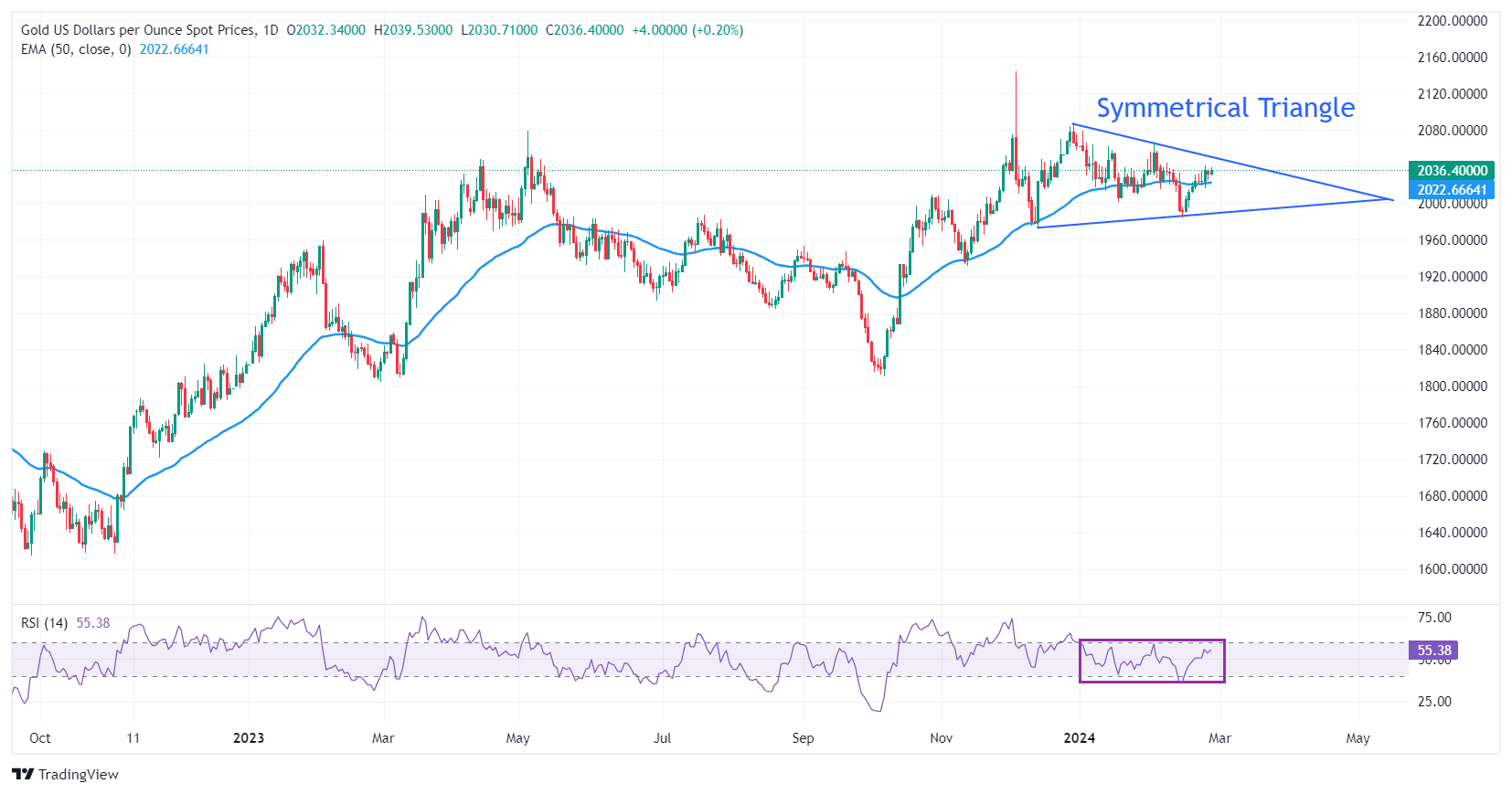
Gold price approaches the downward-sloping border of the Symmetrical Triangle pattern, which is plotted from the December 28 high at $2,088. The upward-sloping border of the chart pattern is placed from the December 13 low at $1,973.
The triangle could break out in either direction. However, the odds marginally favor a move in the direction of the trend before the formation of the triangle – in this case, up. A decisive break above or below the triangle boundary lines would indicate a breakout is underway.
The 14-period Relative Strength Index (RSI) oscillates in the 40.00-60.00 region, which indicates indecisiveness among investors.
US Interest rates FAQs
What are interest rates?
Interest rates are charged by financial institutions on loans to borrowers and are paid as interest to savers and depositors. They are influenced by base lending rates, which are set by central banks in response to changes in the economy. Central banks normally have a mandate to ensure price stability, which in most cases means targeting a core inflation rate of around 2%.
If inflation falls below target the central bank may cut base lending rates, with a view to stimulating lending and boosting the economy. If inflation rises substantially above 2% it normally results in the central bank raising base lending rates in an attempt to lower inflation.
How do interest rates impact currencies?
Higher interest rates generally help strengthen a country’s currency as they make it a more attractive place for global investors to park their money.
How do interest rates influence the price of Gold?
Higher interest rates overall weigh on the price of Gold because they increase the opportunity cost of holding Gold instead of investing in an interest-bearing asset or placing cash in the bank.
If interest rates are high that usually pushes up the price of the US Dollar (USD), and since Gold is priced in Dollars, this has the effect of lowering the price of Gold.
What is the Fed Funds rate?
The Fed funds rate is the overnight rate at which US banks lend to each other. It is the oft-quoted headline rate set by the Federal Reserve at its FOMC meetings. It is set as a range, for example 4.75%-5.00%, though the upper limit (in that case 5.00%) is the quoted figure.
Market expectations for future Fed funds rate are tracked by the CME FedWatch tool, which shapes how many financial markets behave in anticipation of future Federal Reserve monetary policy decisions.
Author

Sagar Dua
FXStreet
Sagar Dua is associated with the financial markets from his college days. Along with pursuing post-graduation in Commerce in 2014, he started his markets training with chart analysis.
















