Gold price strengthens ahead of data-packed week, Fed Powell’s testimony
- Gold price trades near a two-month high as Fed rate-cut bets for June deepen.
- Weak US Manufacturing PMI data weighs heavily on the US Dollar.
- Fed Powell may provide fresh insights on the timing for rate cuts this week.

Gold price (XAU/USD) hovers near a two-month high around $2,085 in Monday’s early New York session. The precious metal clings to gains amid increasing expectations of an interest-rate cut by the Federal Reserve (Fed) in its June monetary policy meeting.
However, the uncertainty over rate cut expectations could rebound this week as Fed Chair Jerome Powell is set to comment on inflation, interest rates, and the economy in his testimony before Congress.
Jerome Powell is expected to remain hawkish as Fed policymakers want to see inflation easing for months before changing their monetary policy stance. Strong labor market conditions allow them to patiently observe inflationary pressures and cut interest rates only after there is convincing evidence that inflation will decline to the desired target of 2%.
Apart from Fed Powell’s commentary, economic data such as the United States’ Institute of Supply Management (ISM) Services PMI, JOLTS Job Openings, and Nonfarm Payrolls data will remain in the spotlight.
Meanwhile, the US Dollar Index (DXY), which measures Greenback’s value against six major currencies, drops to 103.80, as the Manufacturing PMI surprisingly fell by 1.3 points to 47.8 from 49.1 in January. Investors had projected an increase to 49.5. The New Orders Index for the manufacturing sector fell back into contraction territory at 49.2 from 52.5 in January.
Daily digest market movers: Gold price strengthens while US Dollar remains under pressure
- Gold price trades closely to near the two-month high around $2,085 as investors’ expectations for Federal Reserve rate cuts in the June policy meeting remain firm. As per the CME FedWatch tool, traders see a little over 53% chance for a rate cut by 25 basis points (bps) in the June meeting.
- The expectations for rate cuts in June remain higher as the United States core Personal Consumption Expenditure Price Index (PCE) data for January came in line with market consensus.
- This week, the strength in the Gold price will be tested by the US ISM Services PMI and labor market data for February, as well as Fed Chair Jerome Powell’s testimony before Congress.
- Fed Powell is set to speak on Wednesday and Thursday. His outlook on interest rates could influence market expectations for the timing of rate cuts. Powell may reiterate the need for more evidence to confirm that inflation will sustainably return to the 2% target.
- Resilient labor market conditions have deepened uncertainty about inflation returning to 2%. On Friday, Federal Reserve Governor Adriana Kugler said: "I am cautiously optimistic that we will see continued progress on disinflation without significant deterioration of the labor market.”
- This week, the US Nonfarm Payrolls (NFP) data will provide a fresh outlook on the labor market. Before the official labor market data, investors will focus on the Automatic Data Processing (ADP) Employment Change data, which will be published on Wednesday. The expectations for fresh private payrolls are at 150K, higher than the prior reading of 107K.
- Meanwhile, the US Dollar fell sharply as the weak US ISM Manufacturing PMI for February suggests the strong US economy is releasing some heat. Going forward, the US ISM Services PMI, which will be published on Tuesday, will provide more guidance on economic prospects.
Technical Analysis: Gold price soars to $2,100
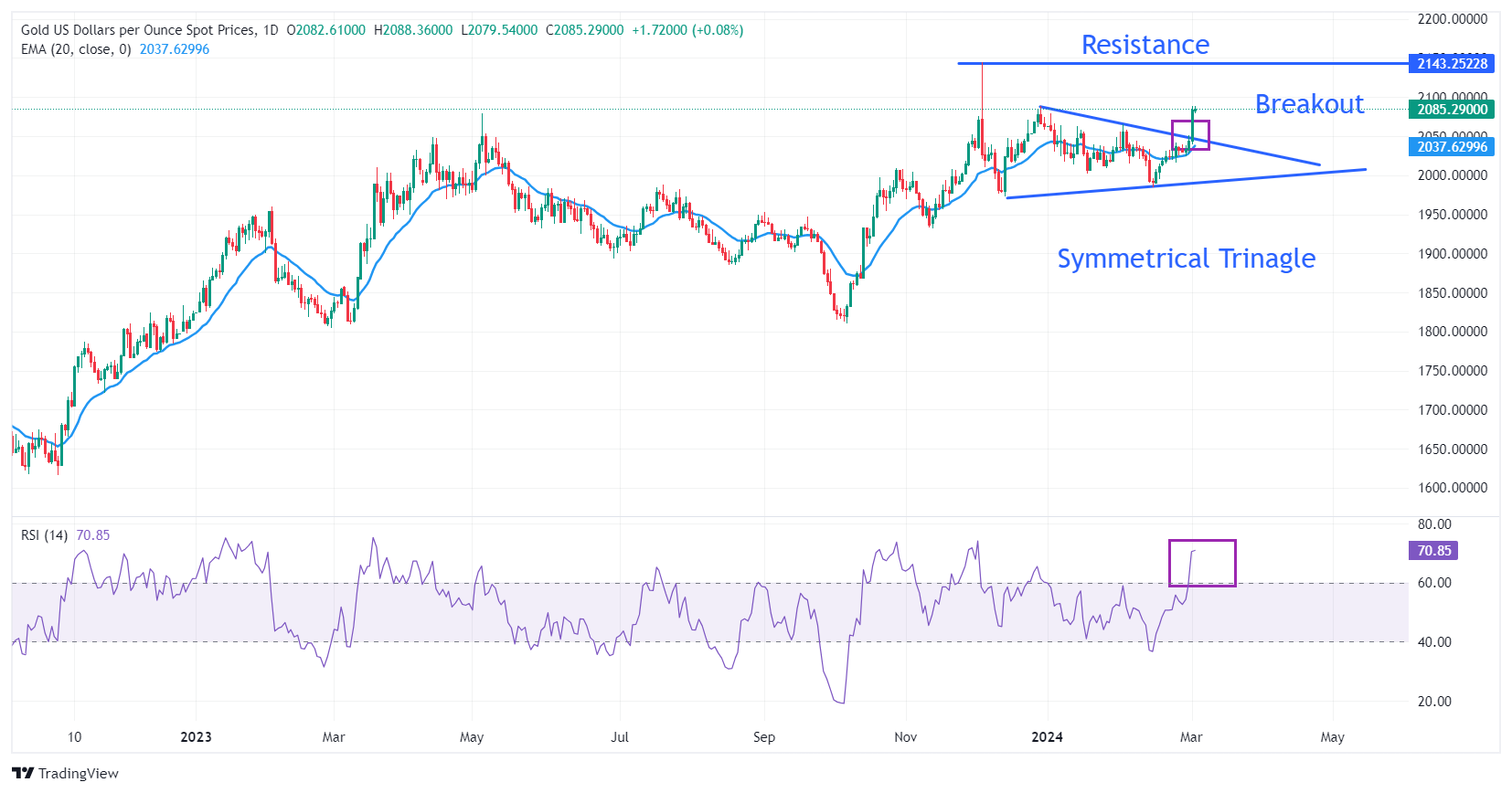
Gold price rallies after an upside break of the Symmetrical Triangle pattern formed on a daily timeframe. The breakout of the aforementioned chart pattern exhibits a volatility expansion, which leads to wider ticks on the upside and heavy volume. The precious metal could extend its upside towards the horizontal resistance plotted from the December 4 high at $2,144.48.
The upward-sloping 20-day Exponential Moving Average (EMA) is at $2,040, indicating strong demand in the near term.
The 14-period Relative Strength Index (RSI) climbs above 60.00, indicating a bullish momentum ahead amid the absence of divergence and oversold signals.--
US Interest rates FAQs
What are interest rates?
Interest rates are charged by financial institutions on loans to borrowers and are paid as interest to savers and depositors. They are influenced by base lending rates, which are set by central banks in response to changes in the economy. Central banks normally have a mandate to ensure price stability, which in most cases means targeting a core inflation rate of around 2%.
If inflation falls below target the central bank may cut base lending rates, with a view to stimulating lending and boosting the economy. If inflation rises substantially above 2% it normally results in the central bank raising base lending rates in an attempt to lower inflation.
How do interest rates impact currencies?
Higher interest rates generally help strengthen a country’s currency as they make it a more attractive place for global investors to park their money.
How do interest rates influence the price of Gold?
Higher interest rates overall weigh on the price of Gold because they increase the opportunity cost of holding Gold instead of investing in an interest-bearing asset or placing cash in the bank.
If interest rates are high that usually pushes up the price of the US Dollar (USD), and since Gold is priced in Dollars, this has the effect of lowering the price of Gold.
What is the Fed Funds rate?
The Fed funds rate is the overnight rate at which US banks lend to each other. It is the oft-quoted headline rate set by the Federal Reserve at its FOMC meetings. It is set as a range, for example 4.75%-5.00%, though the upper limit (in that case 5.00%) is the quoted figure.
Market expectations for future Fed funds rate are tracked by the CME FedWatch tool, which shapes how many financial markets behave in anticipation of future Federal Reserve monetary policy decisions.
Author

Sagar Dua
FXStreet
Sagar Dua is associated with the financial markets from his college days. Along with pursuing post-graduation in Commerce in 2014, he started his markets training with chart analysis.