Gold price stays near all-time highs on Fed rate cut hopes
- Gold remains stable above $2,500, buoyed by Fed Minutes suggesting a possible rate cut at the next meeting.
- The US Dollar Index (DXY) falls 0.20% to 101.10, weakening the Greenback and supporting Gold prices.
- Investors focus on upcoming US economic data and Fed Chair Powell's speech at the Jackson Hole Symposium on Friday.

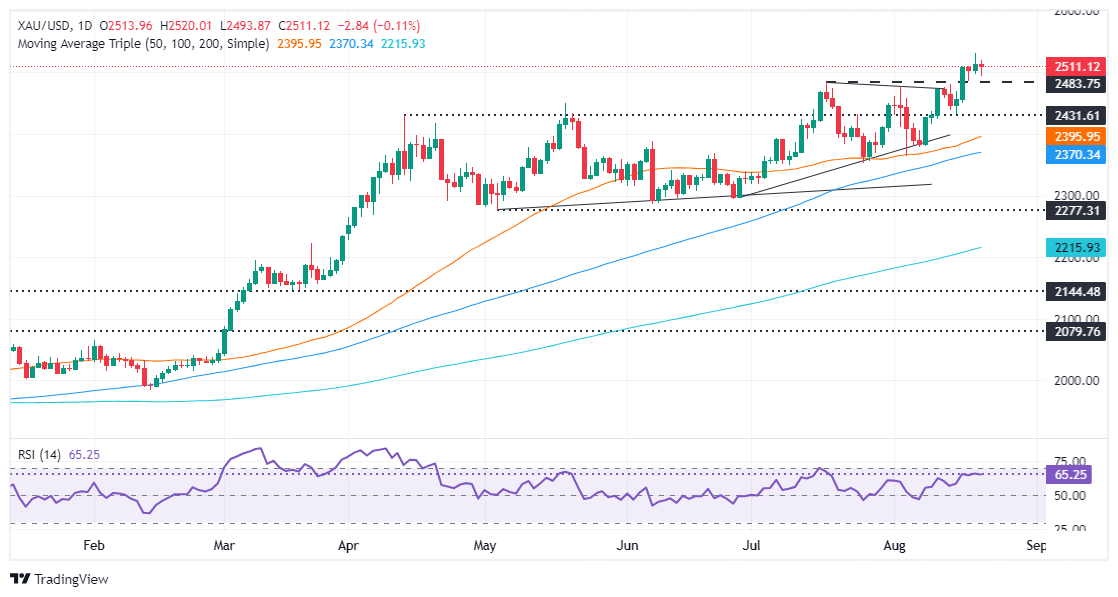
Gold stayed firm above $2,500 for the third straight day after Minutes of the US Federal Reserve (Fed) opened the door for an interest rate cut at the upcoming September meeting, weakening the Greenback. The XAU/USD trades at $2,511, virtually unchanged.
Investors cheered the content of the Fed's July meeting Minutes as Wall Street continued to trade in green territory. The Greenback tumbled sharply over 0.20%, as reflected by the US Dollar Index (DXY), which hovers around 101.10.
The Minutes revealed that most Fed participants said that “it would likely be appropriate to ease policy at the next meeting if data continued to come in as expected,” adding that the progress on inflation and the increase in the unemployment rate opened the door for a quarter or a percentage point rate cut at the July meeting.
Although Fed officials voted unanimously to hold rates unchanged at the July meeting, many officials saw rates as restrictive. Regarding the Fed’s dual mandate, risks have become more balanced, with most policymakers growing more concerned about achieving the maximum employment mandate, while inflation risks have diminished slightly.
In addition, traders will be eyeing a light economic docket, with the release of Initial Jobless Claims, S&P Global PMIs and housing data on Thursday.
On Friday, traders will watch Fed Chair Jerome Powell's speech at the beginning of the Jackson Hole Symposium, hosted by the Kansas City Fed in Wyoming.
Daily digest market movers: Gold price is firm after FOMC Minutes
- Gold prices advanced as US Treasury bond yields slumped. The US 10-year Treasury note is down 1.5 basis points (bps) at 3.792%.
- Following the release of the last FOMC minutes, traders expect 102 basis points of easing, according to the Chicago Board of Trade (CBOT) December 2024 fed funds futures contract.
- US Initial Jobless Claims data for the week ending August 17 are expected to rise to 230K, up from 227K a week before.
- Business activity revealed by S&P Global is expected to show a slight decrease in the Services PMI from 55 to 54. The Manufacturing PMI is foreseen remaining unchanged at 49.6.
- Existing Home Sales are expected to grow from 3.89 million to 3.93 million.
Technical analysis: Gold price to test $2,550 once it clears $2,530
Gold’s daily chart suggests that the yellow metal is expected to rise further if buyers breach the all-time high at $2,531. Momentum suggests that bulls are in charge, as portrayed by the Relative Strength Index (RSI).
Therefore, XAU/USD first resistance would be the $2,550 area, followed by the $2,600 mark. Nevertheless, Gold’s weakness and the non-yielding metal could retrace below the $2,500 figure.
In that outcome, the next support would be the July 17 peak at $2,483, followed by the May 20 high at $2,450. Once cleared, the next stop would be the 50-day Simple Moving Average (SMA) at $2,395.
Gold FAQs
Gold has played a key role in human’s history as it has been widely used as a store of value and medium of exchange. Currently, apart from its shine and usage for jewelry, the precious metal is widely seen as a safe-haven asset, meaning that it is considered a good investment during turbulent times. Gold is also widely seen as a hedge against inflation and against depreciating currencies as it doesn’t rely on any specific issuer or government.
Central banks are the biggest Gold holders. In their aim to support their currencies in turbulent times, central banks tend to diversify their reserves and buy Gold to improve the perceived strength of the economy and the currency. High Gold reserves can be a source of trust for a country’s solvency. Central banks added 1,136 tonnes of Gold worth around $70 billion to their reserves in 2022, according to data from the World Gold Council. This is the highest yearly purchase since records began. Central banks from emerging economies such as China, India and Turkey are quickly increasing their Gold reserves.
Gold has an inverse correlation with the US Dollar and US Treasuries, which are both major reserve and safe-haven assets. When the Dollar depreciates, Gold tends to rise, enabling investors and central banks to diversify their assets in turbulent times. Gold is also inversely correlated with risk assets. A rally in the stock market tends to weaken Gold price, while sell-offs in riskier markets tend to favor the precious metal.
The price can move due to a wide range of factors. Geopolitical instability or fears of a deep recession can quickly make Gold price escalate due to its safe-haven status. As a yield-less asset, Gold tends to rise with lower interest rates, while higher cost of money usually weighs down on the yellow metal. Still, most moves depend on how the US Dollar (USD) behaves as the asset is priced in dollars (XAU/USD). A strong Dollar tends to keep the price of Gold controlled, whereas a weaker Dollar is likely to push Gold prices up.
Author

Christian Borjon Valencia
FXStreet
Markets analyst, news editor, and trading instructor with over 14 years of experience across FX, commodities, US equity indices, and global macro markets.