|

Gold Price Forecast: XAU/USD bears are lurking near a 38.2% Fibonacci

  • The Gold price is correcting to a 38.2% Fibonacci retracement level.
  • The Gold price bears are lurking around Federal Reserve's hawkish tones.

Gold price closed with its third-straight gain on Wednesday despite a firmer US Dollar that was recovering in a phase of hawkish Federal Reserve sentiment following Friday's US Nonfarm Payrolls job report. Gold price travelled between a low of $1,869.20 and $1,886.33 on the day.

Federal Reserve speakers out in force

Federal Reserve chair Jerome Powell on Tuesday said the central bank will stay the course despite strong economic data which gave rise to the bin in the Gold price. The Federal Reserve's mantra that interest rates will stay higher for longer, however, came to light on Wednesday which underpinned the hawkish take of comments from Federal Reserve Jerome Powell's Economic Club of Washington on Tuesday when he said rates might need to move higher if the US economy remained strong. 

Federal Reserve's John Williams reinforced that interest rates were “barely into restrictive territory”, and rates would need to stay at a restrictive level “for a few years to make sure we get inflation to 2%”.  Federal Reserve's Lisa Cook argued that they “need a restrictive policy for some time to cool prices”. Federal Reserve's Neel Kashkari emphasised that the “services side of the economy is still hot”, noting the lack of progress on core services inflation ex-housing. As a consequence, the US Dollar was able to run higher in the US session which helped the Gold price bears with a sell-off in the cash open on Wall Street. 

Gold price technical analysis
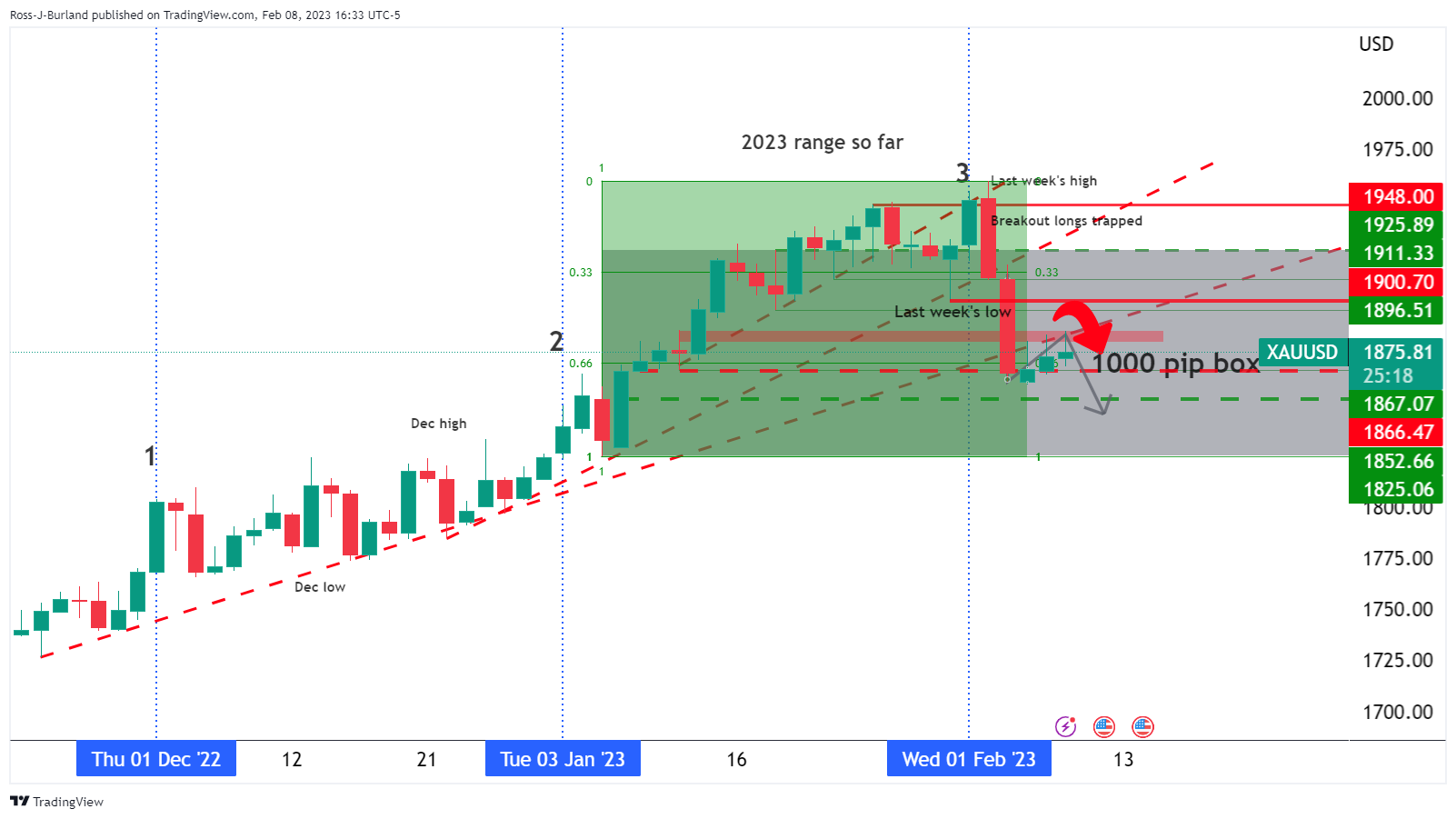
The Gold price is correcting to a 38.2% Fibonacci retracement level within a 1000 pip box and a bias to the downside for the coming times while below $1,900 and on the backside of three weeks of rise.

Author

Ross J Burland

Ross J Burland, born in England, UK, is a sportsman at heart. He played Rugby and Judo for his county, Kent and the South East of England Rugby team.


More from Ross J Burland
Share:

Editor's Picks

GBP/USD off highs, back to 1.3620

GBP/USD remains slightly on the defensive at the end of the week, receding to the low 1.3600s after hitting fresh tops past 1.3670 earlier in the day. Cable’s correction comes after two daily gains in a row and amid a tepid advance in the Greenback, while poor UK data also accompany the downside.

EUR/USD treads water below 1.1700

EUR/USD now trades with modest losses around 1.1670 following another unsuccessful atempt to advance past 1.1700 the figure in a convincing fashion. The pair’s decline follows a maginal rebound in the US Dollar as market participants continue to assess recent US data as well as developments from the US bond market.

Gold trims gains, recedes to the sub-$4,600 area

Gold rapidly leaves behind Thursday’s inconclusive price action and advances markedly on Friday, briefly surpassing the $4,600 mark per troy ounce to hit three-month peaks. Meanwhile, the precious metal’s solid performance comes despite marginal gains in the buck coupled with another day of rising US Treasury yields across the curve.

Crypto Today: Bitcoin, Ethereum, XRP bulls accelerate rally amid rising ETF inflows

The cryptocurrency market remains bullish on Friday, led by Bitcoin’s surge above $77,000. Altcoins, including Ethereum and Ripple, mirror BTC’s positive outlook, trading near $2,400 and $1.35, respectively.

Week ahead – Fed’s Jackson Hole and Nvidia earnings to dictate markets

Kevin Warsh to make his Jackson Hole debut amid confusing messaging. But a major hawkish surprise unlikely after bond market intervention. Nvidia earnings to also determine market direction as stock rally cools.

$20 billion offered, $2 billion taken: Why Treasury doubled its buyback cap

The US Treasury moved off its own calendar on Wednesday, and that is the part worth sitting with. At 12:32 GMT, the department said it would at least double the size of liquidity support buyback operations in the 10-year to 20-year and 20-year to 30-year sectors, lifting the maximum from $2 billion per operation to at least $4 billion, effective September 9 and running to November 4.