Gold Price Forecast: XAU/USD bears approach $1,900 on hawkish central banks, PMI data eyed
- Gold Price renews three-month low after five-day losing streak, pressured of late.
- Hawkish central bank actions amplify economic fears and underpin US Dollar demand, weighing on XAU/USD.
- Mostly upbeat United States data, upbeat statements from Federal Reserve Chairman Jerome Powell also bolstered USD and favored Gold sellers.
- Preliminary readings of PMIs for June eyed for further directions of Gold Price as it approaches $1,900 support confluence.

Gold Price (XAU/USD) remains depressed at the lowest levels since mid-March as bears attack the $1,913 level as the XAU/USD traders begin Friday’s Asian session with bears in power. That said, the bullion dropped the most in two weeks the previous day after major central banks and their policymakers advocated for higher rates, which in turn suggests more toll on the global economy amid tighter labor markets and higher inflation. The same joins the hawkish comments from the US Federal Reserve (Fed) Chairman Jerome Powell and mostly upbeat United States data to favor the US Dollar and weigh on the Gold Price.
Gold Price drops on central banks’ hawkish play
Gold Price declines in the last five consecutive days as bears prod the lowest levels in three months amid hawkish central bank actions, as well as the mixed US data. That said, a slew of central banks announced interest rate increases on Thursday. Among them, the majority crossed the market consensus but failed to impress the respective currencies amid fears that the broad rate hikes have an economic toll, which in turn directs the market players toward the US Dollar’s haven demand and drowns the Gold Price.
That said, the Bank of England (BoE), informally known as the “Old Lady”, surprised markets by lifting benchmark rates by 50 basis points (bps) to 5% versus major expectations favoring a 0.25% rate hike.
Further, the Swiss National Bank (SNB) matched market forecasts while announcing 25 basis points increase in its benchmark interest rate, to 1.75%. This was the fifth consecutive rate lift from the Swiss central bank. Additionally, the Central Bank of the Republic of Türkiye (CBRT) hiked rates for the first time since August 2021 whereas the Norges Central Bank announced rate increases.
Fed Chair Powell, US data weigh on XAU/USD price
Apart from the aforementioned rate hikes, hawkish statements from Fed Chair Jerome Powell also underpinned the US Dollar and joined mostly upbeat US data to propel the US Dollar and weigh on the Gold price.
On Thursday, Fed Chairman Jerome Powell repeated most of his previous day’s remarks during his testimony 2.0, this time in front of the Senate Housing Committee. However, his statements like, “(It) will be appropriate to raise rates again this year, perhaps two more times,” allowed the US Dollar to refresh the intraday high while eyeing to reverse Wednesday’s losses.
On the same line, Federal Reserve (Fed) Governor Michelle Bowman said that "Additional policy rate increases" will be needed to reach a sufficiently restrictive level and control inflation.
Talking about the data, US Chicago Fed National Activity Index for May dropped to -0.15 versus 0.0 expected and upwardly revised 0.14 previous readings. Further, the Initial Jobless Claims reprinted the 264K figures (revised) for the week ended on June 16 compared to 260K market forecasts. It’s worth noting that the Continuing Jobless Claims dropped unexpectedly to 1.759M from 1.772M (revised) prior and 1.782M analysts’ estimations. Additionally, US Existing Home Sales marked a surprise recovery by 0.2% MoM for May compared to -0.6% expected and -3.2% prior (revised from 3.4%).
It should be noted, however, that the recent downbeat comments from Thomas Barkin, President of the Federal Reserve Bank of Richmond, allow the Gold Price to lick its wounds near the multi-month high. However, the bearish trend remains intact.
Amid these plays, Wall Street benchmark closed mixed but the US Treasury bond yields were firmer.
Moving on, preliminary readings of the June month’s PMIs for the key economies will be crucial to watch for the intraday directions. However, major attention will be given to the market’s reaction to the recently hawkish central bank actions.
Gold Price technical analysis
Gold Price justifies a successful downside break of the $1,942 support confluence, now resistance, while approaching another key level towards the south.
That said, a convergence of the 50% Fibonacci retracement of the XAU/USD upside from late November to May 2023 and a seven-month-old support line, near $1,900, appears a short-term important support to watch for the Gold bears, especially amid the oversold conditions of the Relative Strength Index (RSI) line, placed at 14. It’s worth noting that the bearish signals from the Moving Average Convergence and Divergence (MACD) indicator add strength to the downside bias.
In a case where the Gold Price breaks the $1,900 support, the odds of witnessing a slump toward the 61.8% Fibonacci retracement near $1860, also known as the golden ratio, will be in the spotlight.
Alternatively, a downward-sloping resistance line from mid-May and the 38.2% Fibonacci retracement level join the 100-DMA to highlight the $1,942 as a crucial resistance to watch during the Gold Price recovery.
Should the XAU/USD crosses the $1,942 hurdle, February’s high of around $1,960 may act as an extra filter towards the north.
Gold Price: Daily chart
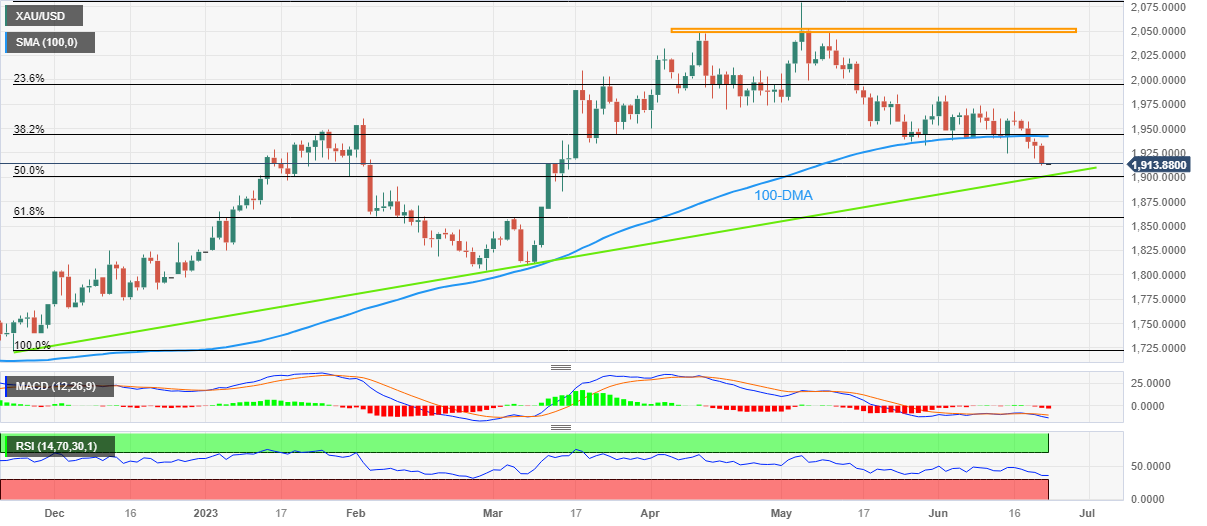
Trend: Limited downside expected
Author

Anil Panchal
FXStreet
Anil Panchal has nearly 15 years of experience in tracking financial markets. With a keen interest in macroeconomics, Anil aptly tracks global news/updates and stays well-informed about the global financial moves and their implications.
















